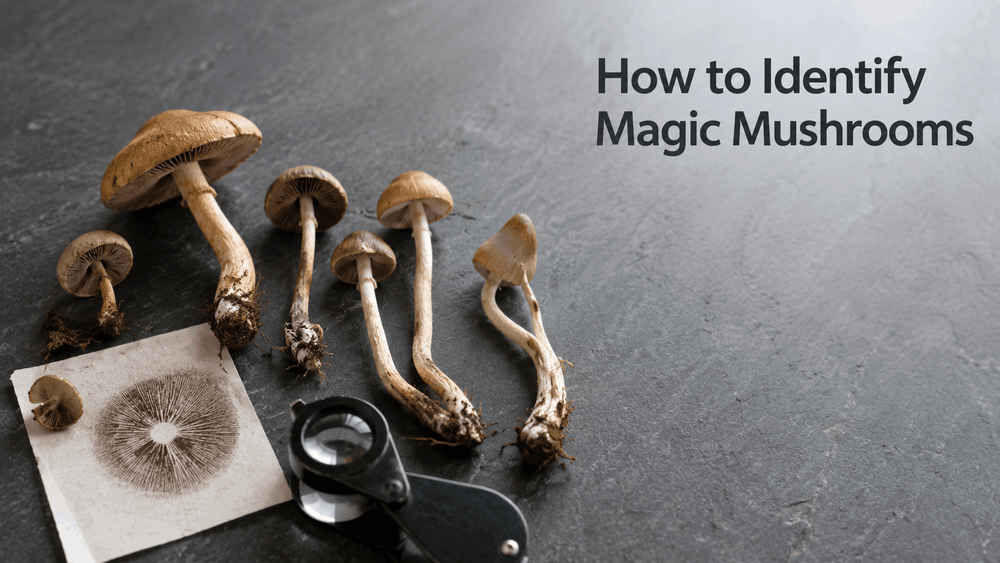
Types of Magic Mushrooms: Species & How to Identify Them
Posted by Spore Genetics Research Team on May 8th 2023
Types of Magic Mushrooms: Species & How to Identify Them
“Magic mushrooms” isn’t one mushroom—it’s a broad group of psilocybin-producing species, most of them in the genus Psilocybe, with over 100 species worldwide. They’re often grouped by where they grow: dung-loving, wood-loving, and grassland species. Telling them apart relies on a handful of features—spore print color, cap and gill structure, habitat, and blue bruising—used together, never one alone. Here’s an overview of the main types and the methodical way researchers identify them.
If you’ve ever wondered how many kinds of magic mushrooms there are, how they relate to one another, and how they’re actually told apart, this guide maps out the major species and the identification features that distinguish them.
How Magic Mushrooms Are Classified
Most psilocybin mushrooms belong to the genus Psilocybe, though a few—like the Panaeolus (Blue Meanie) group—sit in related genera. Within Psilocybe, one of the most useful ways to organize the species is by habitat: what they grow on. This grouping also helps with identification, since habitat is a major clue.
How to Identify Magic Mushrooms: The Key Features
There is no single test that identifies a psilocybin mushroom. Reliable identification is a process of combining several features—and understanding that each one only narrows the field rather than confirming an answer on its own. These are the features researchers rely on, in roughly the order they’re used:
1. Spore Print Color
The single most useful identification feature. Taking a spore print—laying a cap gill-side down on paper or glass for several hours—reveals the color of the spore deposit, which is remarkably consistent within a genus. Most Psilocybe species print dark purple-brown to purple-black; Panaeolus prints jet black. Crucially, a rusty-brown or white print rules psilocybin out—and rusty-brown is a warning sign of potentially deadly genera. Our spore print color chart breaks down what each genus deposits.
2. Blue Bruising
Most psilocybin mushrooms bruise blue-to-blue-green where the tissue is handled, cut, or damaged—a reaction caused by psilocin oxidizing in air. It’s a strong supporting clue, but not proof in either direction: a few non-psilocybin mushrooms also blue, and some active species bruise weakly. We cover exactly what it does and doesn’t tell you in why do mushrooms bruise blue.
3. Cap, Gill & Stem Morphology
Physical structure narrows things further: cap shape (conical, bell-shaped, or convex, often with a central bump called an umbo), gill color and attachment, stem thickness, and the presence or absence of a partial veil or ring. These traits vary between species and are what separate, say, a slender liberty cap from a stout cubensis.
4. Habitat & Substrate
Where a mushroom grows is a genuine identification feature, not just trivia. Dung, wood, and grassland species (below) each favor different substrates, and knowing what a mushroom is fruiting from—and in what climate and season—meaningfully narrows the candidates.
5. Microscopy
The definitive layer. Under magnification, spore size, shape, and features like the germ pore, plus microscopic structures on the gills, separate look-alikes that appear identical to the naked eye. This is where taxonomy is actually settled—and it’s the legal, research-focused use of the spores we supply. If you’re setting up, see our guide on how to study spores under a microscope.
A Critical Safety Note on Look-Alikes
Field identification of wild psilocybin mushrooms is genuinely dangerous, and no article can make it safe. Several psilocybin species have toxic look-alikes that share habitat and general appearance—small brown mushrooms are notoriously difficult to tell apart, and some deadly species (certain Galerina and Conocybe, which carry the same amatoxins as the death cap) can grow in the very same wood or grass. A purple-brown spore print and blue bruising narrow the field but do not guarantee safety, and the consequences of a mistake can be fatal. This is a core reason the responsible use of spores is microscopy and taxonomy—studying identification features under controlled conditions—rather than foraging. Never consume a wild mushroom on the strength of an article.
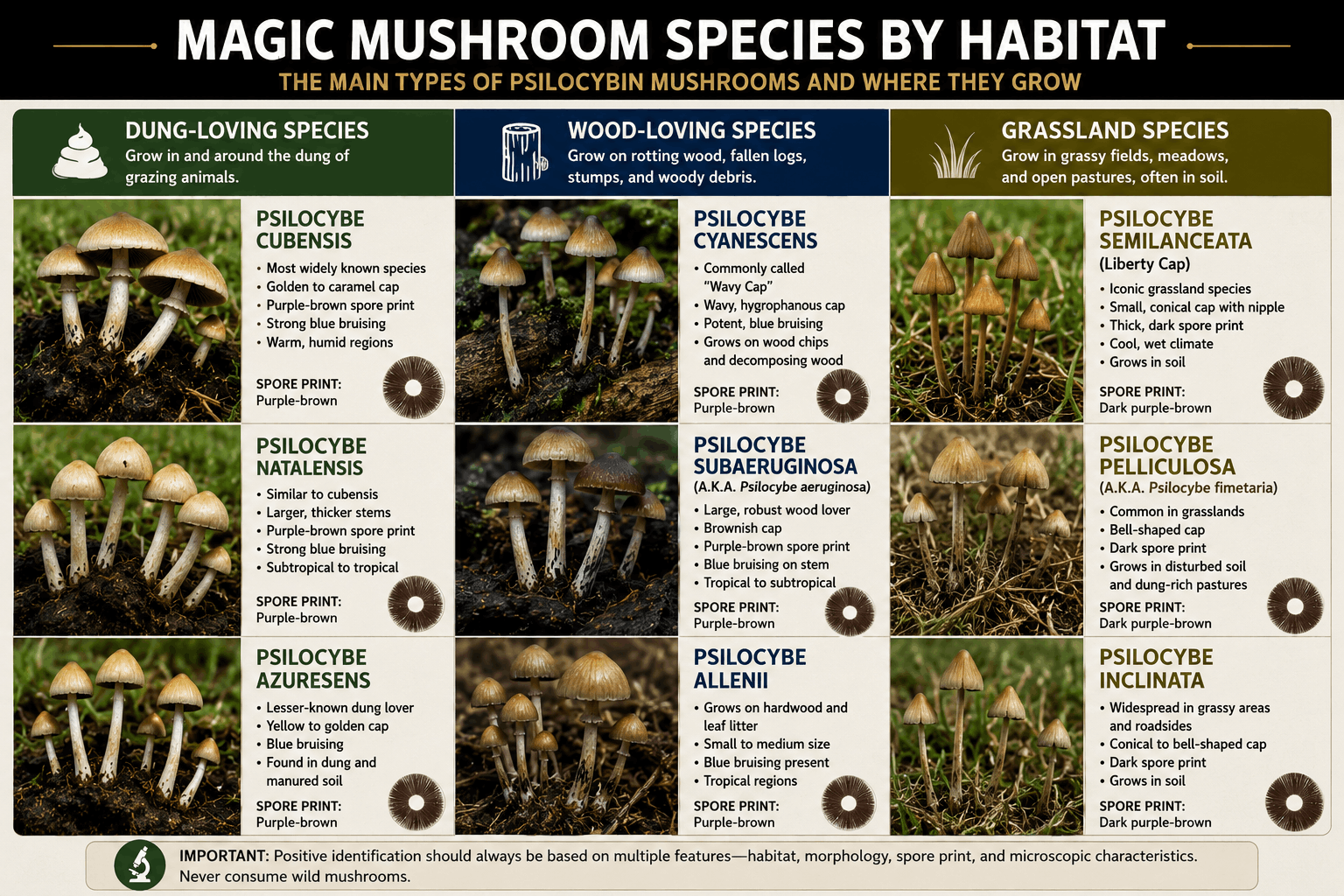
Dung-Loving Species
These grow in and around the dung of grazing animals in warm, humid regions. The most famous by far is Psilocybe cubensis—the most widely known magic mushroom species, and the one behind the hundreds of named cubensis strains like Golden Teacher and B+. For where these grow in the wild, see our guide to where magic mushrooms grow.
Wood-Loving Species
These grow on wood-based material—mulch, wood chips, and woody debris—rather than dung. This group includes several closely related and sometimes hard-to-distinguish species:
- Psilocybe cyanescens — the “wavy cap,” known for its rippled cap margin.
- Psilocybe azurescens — the “flying saucer,” a large coastal species.
- Psilocybe allenii — a West Coast species often confused with cyanescens.
- Psilocybe ovoideocystidiata — an eastern U.S. species that fruits in spring.
The wood-loving group is a good illustration of why microscopy matters: cyanescens and allenii are so similar in the field that they were only formally separated as species relatively recently, and spore and microscopic features are what reliably distinguish them.
Grassland Species
These grow from rich soil in fields, meadows, and pastures rather than directly on dung or wood. The best-known is the liberty cap (Psilocybe semilanceata)—one of the most recognizable wild mushrooms in the world, especially across Europe, identified by its distinctive pointed, nippled conical cap.
Related Genera: Panaeolus
Not every psilocybin mushroom is a Psilocybe. The genus Panaeolus includes species like Panaeolus cyanescens (the “Blue Meanie”), a tropical grassland mushroom distinguished from Psilocybe by its black spore print—a perfect example of how spore color alone can move a mushroom into a different genus.
What the Types Have in Common
Despite their differences, these species share some recognizable traits: most produce purple-brown spore prints (with exceptions like Panaeolus), and nearly all bruise blue where handled—a reaction linked to their chemistry. Learning to read these shared features, alongside habitat and morphology, is central to telling the many types apart. To go deeper on the spores themselves, see our guide to what psilocybin spores are, or browse the full lineup in our cubensis strain guides.
Frequently Asked Questions
How do you identify magic mushrooms?
By combining several features—never one alone: spore print color (usually purple-brown for Psilocybe), blue bruising where handled, cap/gill/stem morphology, habitat and substrate, and ultimately microscopy of the spores. Because toxic look-alikes exist, field identification is genuinely risky and the safe, legal use of spores is microscopy and taxonomy rather than foraging.
How can you tell if a mushroom is magic?
The strongest single clues are a dark purple-brown spore print combined with blue bruising on handling—but neither is conclusive on its own, and several harmless or toxic species share one feature or the other. Confident identification requires multiple features together, confirmed under a microscope.
How to identify magic mushrooms versus poisonous ones?
This is exactly where field ID is most dangerous. Some deadly mushrooms (certain Galerina and Conocybe species) share habitat with psilocybin species and can superficially resemble them, and a rusty-brown spore print is a serious warning sign. There is no shortcut that reliably separates them by eye, which is why this should never be attempted for consumption.
How many types of magic mushrooms are there?
There are over 100 species of psilocybin-producing mushrooms, most in the genus Psilocybe, with others in related genera like Panaeolus.
What is the most common type of magic mushroom?
Psilocybe cubensis is by far the most well-known and widely studied, and it’s the species behind the many named “strains” like Golden Teacher.
How are the different types grouped?
A common approach is by habitat—dung-loving (like cubensis), wood-loving (like cyanescens and azurescens), and grassland (like the liberty cap).
Do all magic mushrooms look alike?
No—they vary widely in size, cap shape, and habitat, though many share purple-brown spore prints and blue bruising. Accurate identification always depends on multiple features together.
Disclaimer: Psilocybe and Panaeolus spores are sold strictly for microscopy, taxonomy, and research purposes. This article is educational and is not a foraging guide—wild mushroom identification requires expertise and multiple confirmed features, and several psilocybin species have toxic or deadly look-alikes. Never consume a wild mushroom without expert confirmation. Cultivation of psilocybin mushrooms is illegal in many jurisdictions, including federally in the United States. We ship to every U.S. state except Georgia and Idaho.