Psilocybe Cubensis: Identification, Habitat & Spore Print
Posted by Spore Genetics Research Team on May 8th 2023
Psilocybe Cubensis: Identification, Habitat & Facts
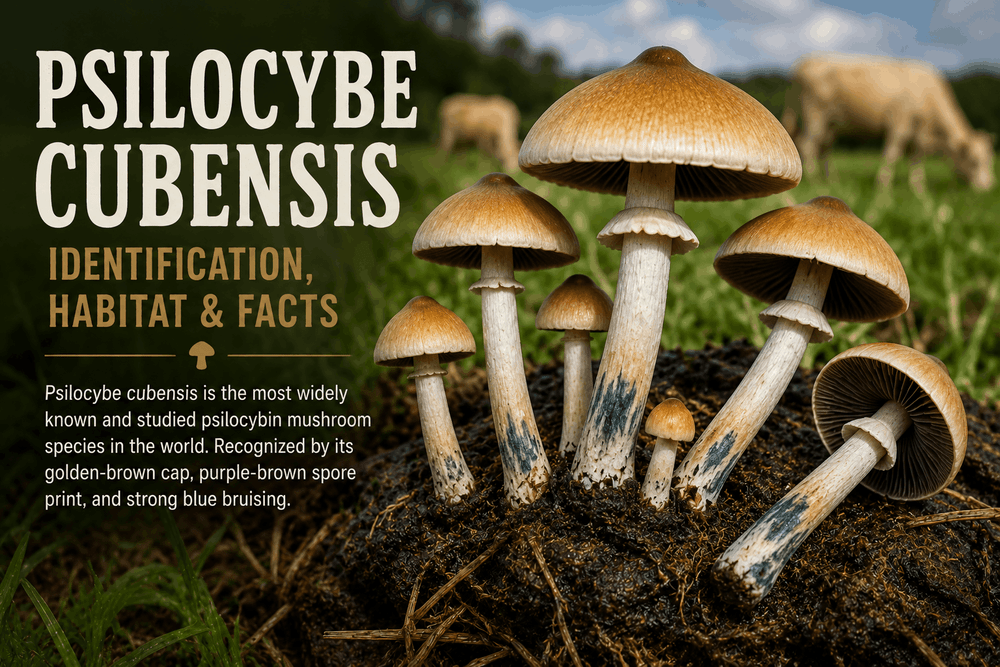
Psilocybe cubensis is the most widely known and studied psilocybin mushroom species in the world. A dung-loving mushroom of warm, humid regions, it’s recognized by its golden-brown cap, purple-brown spore print, and strong blue bruising—and it’s the species behind the vast majority of named “strains” like Golden Teacher and B+.
If there’s one species at the center of the magic mushroom world, it’s Psilocybe cubensis. Here’s a clear, educational look at what it is, how the species is identified, where it grows, what its spores look like under the microscope, and how its many strains relate to the single species.
Want to examine the species yourself? Shop Psilocybe cubensis spore syringes — from $15, every strain in stock for single orders, for microscopy and taxonomy research only.
What Is Psilocybe Cubensis?
Psilocybe cubensis is a species of psilocybin-containing mushroom in the family Hymenogastraceae. It’s the most commonly encountered member of the genus Psilocybe—largely because it’s widespread, relatively large, and the most studied. It’s a coprophilous (dung-loving) species, meaning it grows in and around the dung of grazing animals in warm, humid climates, which distinguishes it from the wood-loving group like Psilocybe cyanescens and the grassland liberty cap.
Identification & Key Features
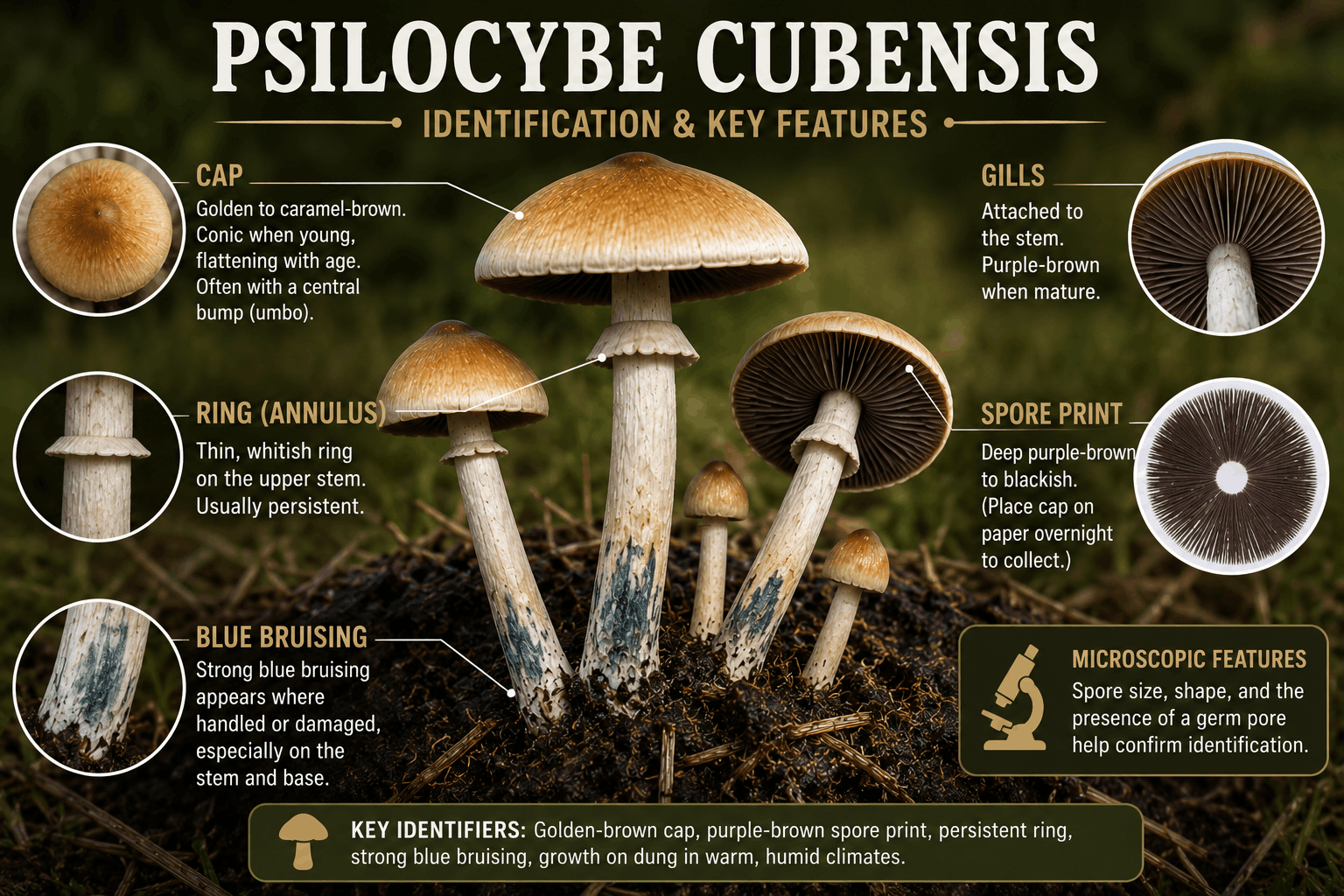
Psilocybe cubensis is typically recognized by a golden to caramel-brown cap (often paler at the margins), which is conic when young and flattens with age, sometimes with a central bump. It has a whitish stem, a persistent ring (annulus) on the upper stem, and—two hallmark traits—a deep purple-brown to blackish spore print and strong blue bruising where handled or damaged. Its relatively large size and prominent ring help separate it from many smaller Psilocybe species. As always, identification should rest on multiple features together, including microscopic ones — our guide to the types of magic mushrooms covers that methodology across the genus.
Habitat & Range: Where Does Psilocybe Cubensis Grow?
Psilocybe cubensis is a mushroom of warm, humid, subtropical and tropical climates. It grows on the dung of cattle and other grazing animals, or on rich, well-manured soils, and fruits in warm, moist conditions—its close association with pastureland is a big part of why it’s so widespread and well-documented. Its global range includes Central and South America, Southeast Asia, India, and northern Australia.
In the United States, its natural range is concentrated in the warm, humid Gulf Coast and Southeast — states like Florida, Texas, Louisiana, Mississippi, and Alabama, where cattle pasture and a subtropical climate suit it. It becomes far less likely moving north into cooler, drier regions. This is range and ecology, not a foraging map — wild identification carries real risk from toxic look-alikes, and the responsible way to study the species is under the microscope. For how habitat fits across all the psilocybin species, see where magic mushrooms grow.
Psilocybe Cubensis Under the Microscope
Because it’s so widespread and its spores are large and well-defined, Psilocybe cubensis is one of the most rewarding species for microscopy and taxonomy — and a common starting point for researchers learning the craft. A few defining features:
- Spore print color: dark purple-brown to violet-brown, sometimes nearly blackish — a hallmark of the genus, and a key contrast against the jet-black print of a Panaeolus or the rusty-brown of a dangerous look-alike. See our spore print color chart.
- Spore shape: subrhomboid to ellipsoid, smooth, thick-walled, with a clearly visible germ pore — textbook features that make cubensis an ideal reference spore.
- Size: comparatively large among Psilocybe spores, which is part of why they’re so satisfying to examine under magnification.
If you’re setting up, our guide on how to study spores under a microscope covers slide prep and what to look for. You can explore cubensis and other species in our mushroom spores collection, provided strictly for microscopy and research.
Psilocybe Cubensis & Its Many Strains
Here’s a point that confuses a lot of people: names like Golden Teacher, B+, and Amazonian aren’t separate species—they’re all cultivated strains of the single species Psilocybe cubensis, selected over time for consistent traits and appearance. In other words, the enormous variety you see all traces back to one species. For a full breakdown of the varieties and how they differ, see our guide to Psilocybe cubensis strains.
Frequently Asked Questions
What is Psilocybe cubensis?
It’s the most well-known species of psilocybin mushroom—a dung-loving mushroom of warm, humid regions, recognized by its golden-brown cap, purple-brown spore print, and blue bruising.
How is Psilocybe cubensis identified?
By its golden-brown cap, whitish stem with a persistent ring, purple-brown to blackish spore print, and strong blue bruising—assessed together with microscopic features.
What color is a Psilocybe cubensis spore print?
Dark purple-brown to violet-brown, sometimes nearly black. That deep print is characteristic of the genus and helps separate cubensis from black-spored Panaeolus and rusty-brown-spored look-alikes.
Where does Psilocybe cubensis grow?
In warm, humid subtropical and tropical regions worldwide, on the dung of grazing animals or well-manured soils. In the United States its range centers on the Gulf Coast and Southeast.
Are Golden Teacher and B+ different from cubensis?
No—they’re cultivated strains of the single species Psilocybe cubensis, not separate species. The many named varieties all belong to this one species.
Disclaimer: Psilocybe spores are sold strictly for microscopy, taxonomy, and research purposes. Cultivation of psilocybin mushrooms is illegal in many jurisdictions, including federally in the United States. This article is educational and not intended to encourage any activity that violates federal or local laws. Never consume wild mushrooms. We ship to every U.S. state except Georgia and Idaho.