
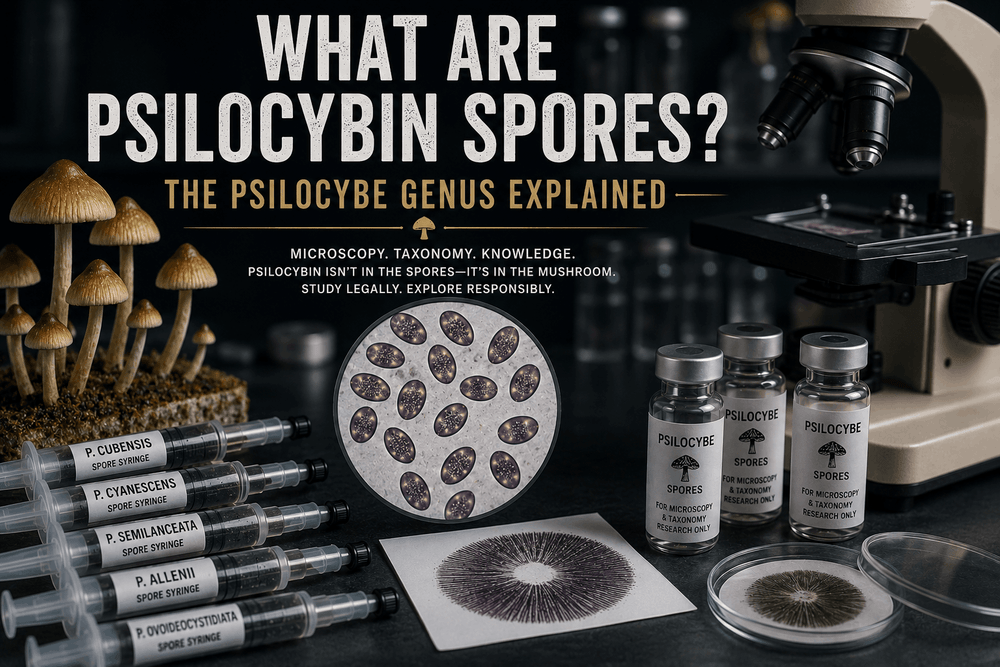
What Are Psilocybin Spores? The Psilocybe Genus Explained
Posted by Spore Genetics Research Team on Apr 30th 2023
What Are Psilocybin Spores? The Psilocybe Genus Explained
Psilocybin spores are the microscopic reproductive cells of mushrooms in the genus Psilocybe—often called "magic mushroom spores." A key fact for researchers: the spores themselves contain no psilocybin, which is why they can be studied legally for microscopy and taxonomy in most areas. The Psilocybe genus includes more than 200 species, making its spores a rich subject for study.
If you've explored the world of mushroom spores, you've likely encountered the terms "psilocybin spores," "psilocybe spores," and "magic mushroom spores." Here's a clear, educational guide to what they actually are, how they're studied, and how the different species relate to one another.
What Are Psilocybin Spores?
Spores are the reproductive units of fungi—tiny, single-celled structures a mushroom releases by the millions to reproduce. "Psilocybin spores" refers to the spores of Psilocybe mushrooms, the genus known for producing psilocybin. Importantly, the psilocybin compound develops in the mature mushroom's tissue, not in the spores, so a spore sample contains none of the controlled substance. This is the basis on which spores are sold for legal microscopy and taxonomy research. Under the microscope, Psilocybe spores typically appear purple-brown and have distinctive shapes used to identify species.
The Psilocybe Genus: 200+ Species
The genus Psilocybe is remarkably diverse, with over 200 species adapted to habitats worldwide. They're often grouped by where they grow:
· Dung & grassland lovers — including the famous Psilocybe cubensis and the grassland liberty cap (P. semilanceata).
· Wood lovers — such as Psilocybe cyanescens (the "wavy cap"), Psilocybe allenii, and Psilocybe ovoideocystidiata.
Each species carries unique microscopic and morphological features, which is what makes the genus such a rewarding focus for taxonomic study.
Psilocybe vs. Cubensis Spores: What's the Difference?
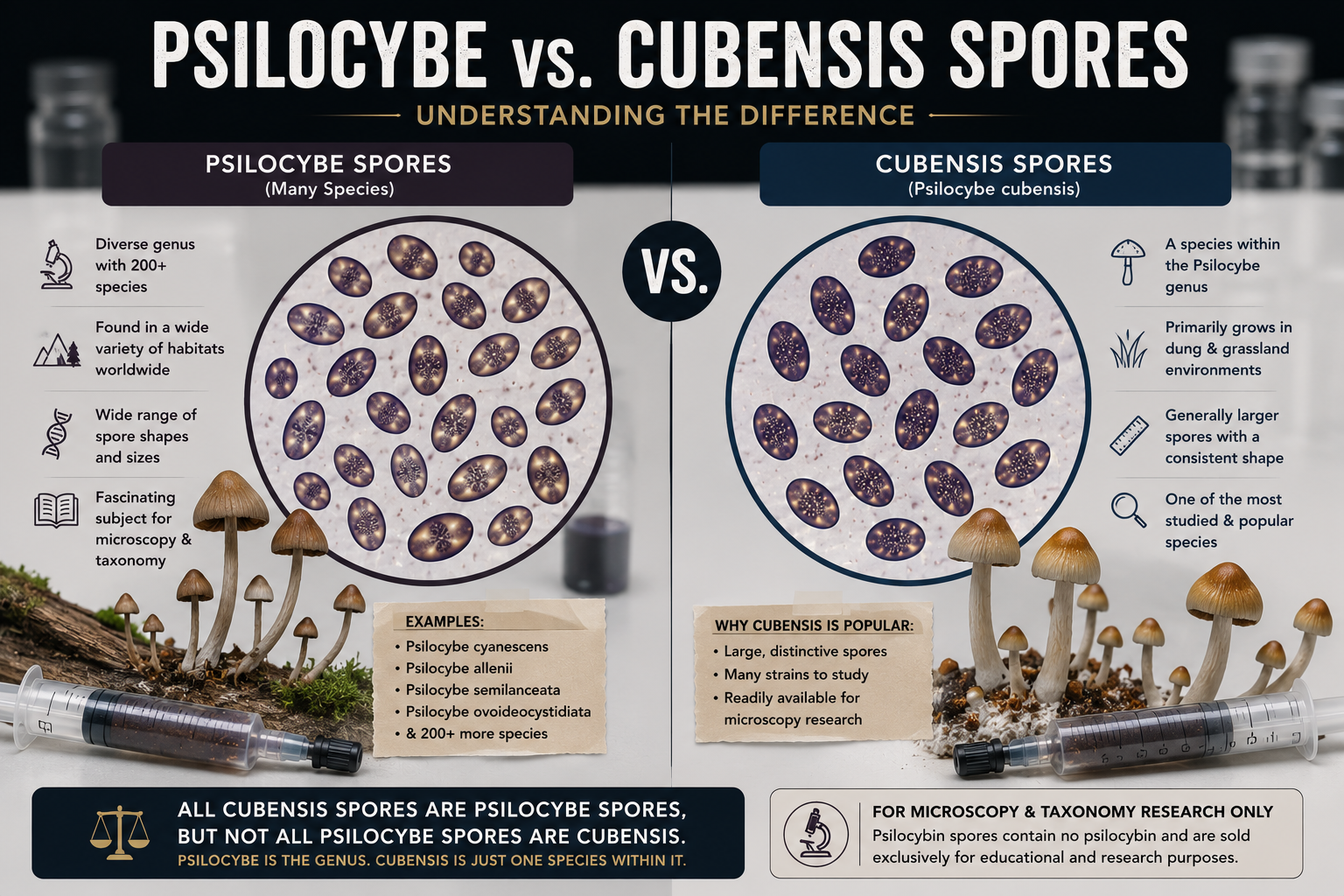
This is a common point of confusion. "Cubensis" isn't separate from "Psilocybe"—Psilocybe cubensis is simply the most well-known species within the Psilocybe genus. So all cubensis spores are psilocybe spores, but not all psilocybe spores are cubensis. Cubensis is especially popular for study because of its large spores and the huge number of cubensis strains available to compare.
How Psilocybin Spores Are Studied
Spores are examined under a microscope to observe their size, shape, color, and surface features—the details used to identify and classify species. They're typically supplied in one of two formats: a spore syringe (spores suspended in sterile liquid, easy to apply to a slide) or a spore print (spores deposited on a surface). Both are popular tools for microscopy enthusiasts, students, and taxonomists.
Where to Explore Psilocybe Spores
If you're interested in studying these fascinating spores, you can browse our full selection in the Mushroom Spores collection, including magic spore syringes and individual species. Each is provided strictly for microscopy and taxonomy research.
Frequently Asked Questions
Do psilocybin spores contain psilocybin?
No. Psilocybin develops in the mature mushroom's tissue, not in the spores. This is why spore samples can be studied legally for microscopy and taxonomy in most areas.
What's the difference between psilocybe and cubensis spores?
Psilocybe is the genus; cubensis is one species within it. All cubensis spores are psilocybe spores, but the genus includes 200+ other species too.
What are magic mushroom spores used for?
They're used for microscopy and taxonomy—studying spore morphology and identifying or classifying species under a microscope.
Are psilocybin spores legal?
Because the spores contain no psilocybin, they're legal to study in most areas—but laws vary by location, so always check your local regulations.
Disclaimer: Psilocybe spores are sold strictly for microscopy, taxonomy, and research purposes. Cultivation of psilocybin mushrooms is illegal in many jurisdictions, including federally in the United States. This article is educational and not intended to encourage any activity that violates federal or local laws. Spore laws vary by location—always confirm your local regulations.