Psilocybe Allenii: Identification, Habitat & vs. Cyanescens
Posted by Spore Genetics Research Team on Apr 28th 2023
Psilocybe Allenii: Identification, Habitat & vs. Cyanescens
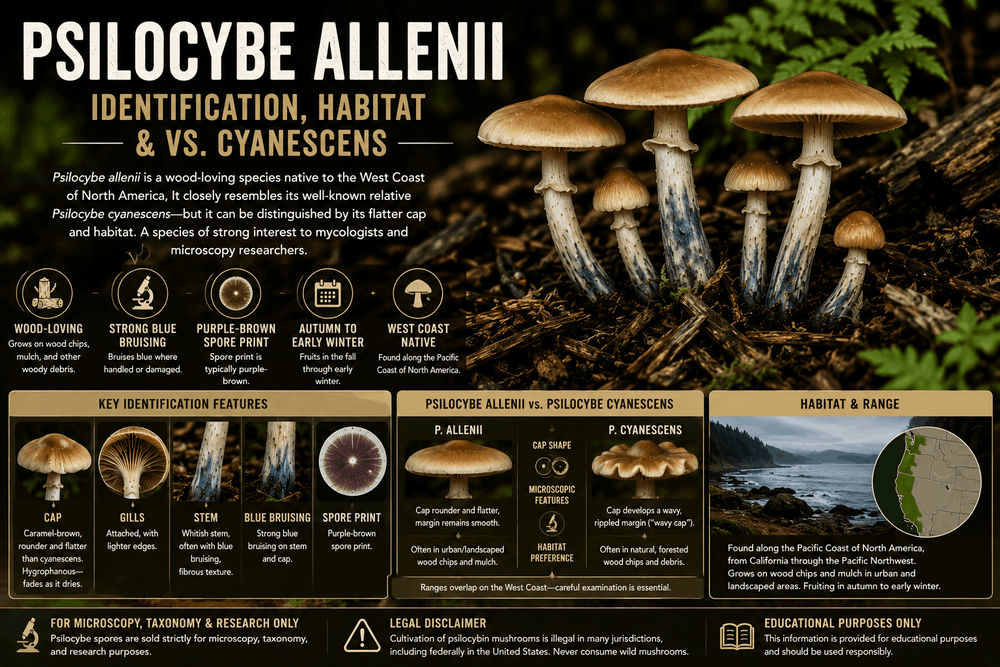
Psilocybe allenii is a wood-loving species native to the West Coast of North America, named after mycologist John W. Allen. It closely resembles its well-known relative Psilocybe cyanescens—so much so that the two are frequently confused—but it can be distinguished by its flatter cap and habitat. It's a species of strong interest to mycologists and microscopy researchers. Let's learn about the intricacies of psilocybe allenii vs cyanescens.
Allenii is one of the more recently described wood-loving Psilocybe species, and its similarity to other members of the group makes it a fascinating subject for comparative study. Here's how to recognize it, where it grows, and how it differs from its famous look-alike.
What Is Psilocybe Allenii?
Psilocybe allenii is a lignicolous (wood-loving) mushroom in the family Hymenogastraceae, formally described in 2012 and named in honor of ethnomycologist John W. Allen. Like its relatives Psilocybe cyanescens and Psilocybe ovoideocystidiata, it grows on wood-based substrates—mulch, wood chips, and landscaping debris—rather than on dung or grassland.
Identification & Key Features
Psilocybe allenii has a caramel-brown cap that's typically rounder and flatter than the wavy-margined cyanescens, fading as it dries (hygrophanous). It features a whitish stem, a purple-brown spore print, and the strong blue bruising characteristic of the genus. As always with wild mushrooms, accurate identification depends on examining several features together, including microscopic characteristics.
Psilocybe Allenii vs. Psilocybe Cyanescens
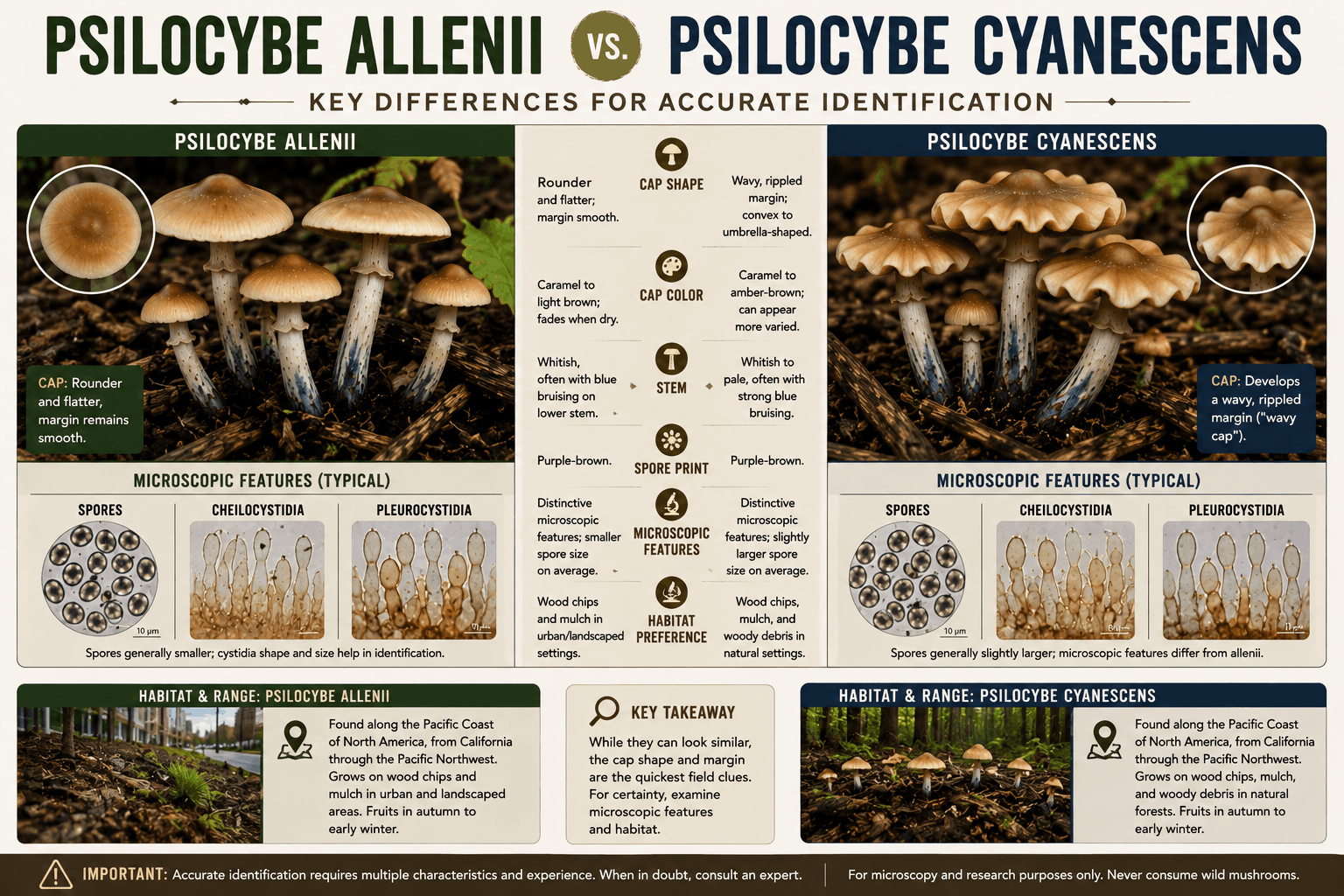
This is the comparison that trips up most people, since the two species overlap in range and appearance. The clearest difference is the cap: Psilocybe cyanescens develops a distinctly wavy, rippled cap margin (its "wavy cap" nickname), while Psilocybe allenii's cap tends to stay rounder and flatter. They also differ subtly in microscopic features and preferred microhabitat. Where their ranges overlap along the West Coast, careful examination is the only reliable way to tell them apart.
Habitat & Range
Psilocybe allenii is found primarily along the Pacific Coast of North America, from California up through the Pacific Northwest, where it favors wood chips and mulch in urban and landscaped settings. Like many wood-loving Psilocybe species, it's an autumn-to-early-winter fruiter. You can explore related wood-loving species in our Exotic Mushroom Spores collection.
Frequently Asked Questions
What is Psilocybe allenii?
It's a wood-loving Psilocybe species from the West Coast of North America, described in 2012 and named after mycologist John W. Allen. It closely resembles Psilocybe cyanescens.
How do you tell Psilocybe allenii from cyanescens?
The main difference is the cap: allenii's stays rounder and flatter, while cyanescens develops a wavy, rippled margin. They also differ in subtle microscopic features and microhabitat.
Where does Psilocybe allenii grow?
Along the Pacific Coast, from California through the Pacific Northwest, typically on wood chips and mulch in urban and landscaped areas.
Disclaimer: Psilocybe spores are sold strictly for microscopy, taxonomy, and research purposes. Cultivation of psilocybin mushrooms is illegal in many jurisdictions, including federally in the United States. This article is educational and not intended to encourage any activity that violates federal or local laws. Never consume wild mushrooms.