
Liberty Cap (Psilocybe Semilanceata): ID & Habitat
Posted by Spore Genetics Research Team on Apr 29th 2023
Liberty Cap (Psilocybe Semilanceata): Identification & Habitat
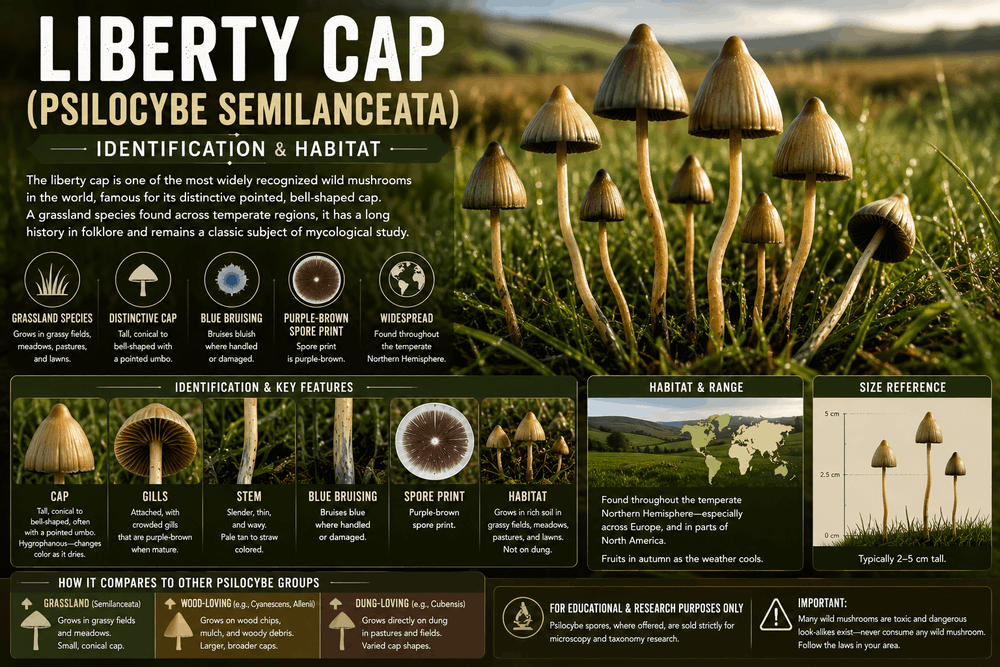
The liberty cap (Psilocybe semilanceata) is one of the most widely recognized wild mushrooms in the world, famous for its distinctive pointed, bell-shaped cap. A grassland species found across temperate regions, it has a long history in folklore and remains a classic subject of mycological study and identification.
Few mushrooms are as iconic as the liberty cap. Its unmistakable shape and storied past make it one of the first species many people learn to recognize. Here's a clear, educational look at what it is, how to identify it, and where it grows.
What Is the Liberty Cap?
Psilocybe semilanceata—the liberty cap—is a small grassland mushroom in the family Hymenogastraceae. Unlike the wood-loving Psilocybe species, it's a grassland dweller, and unlike the dung-loving cubensis group, it grows from rich soil rather than directly on manure. Its common name comes from its resemblance to the “liberty cap” (Phrygian cap) of classical and revolutionary symbolism.
Identification & Key Features
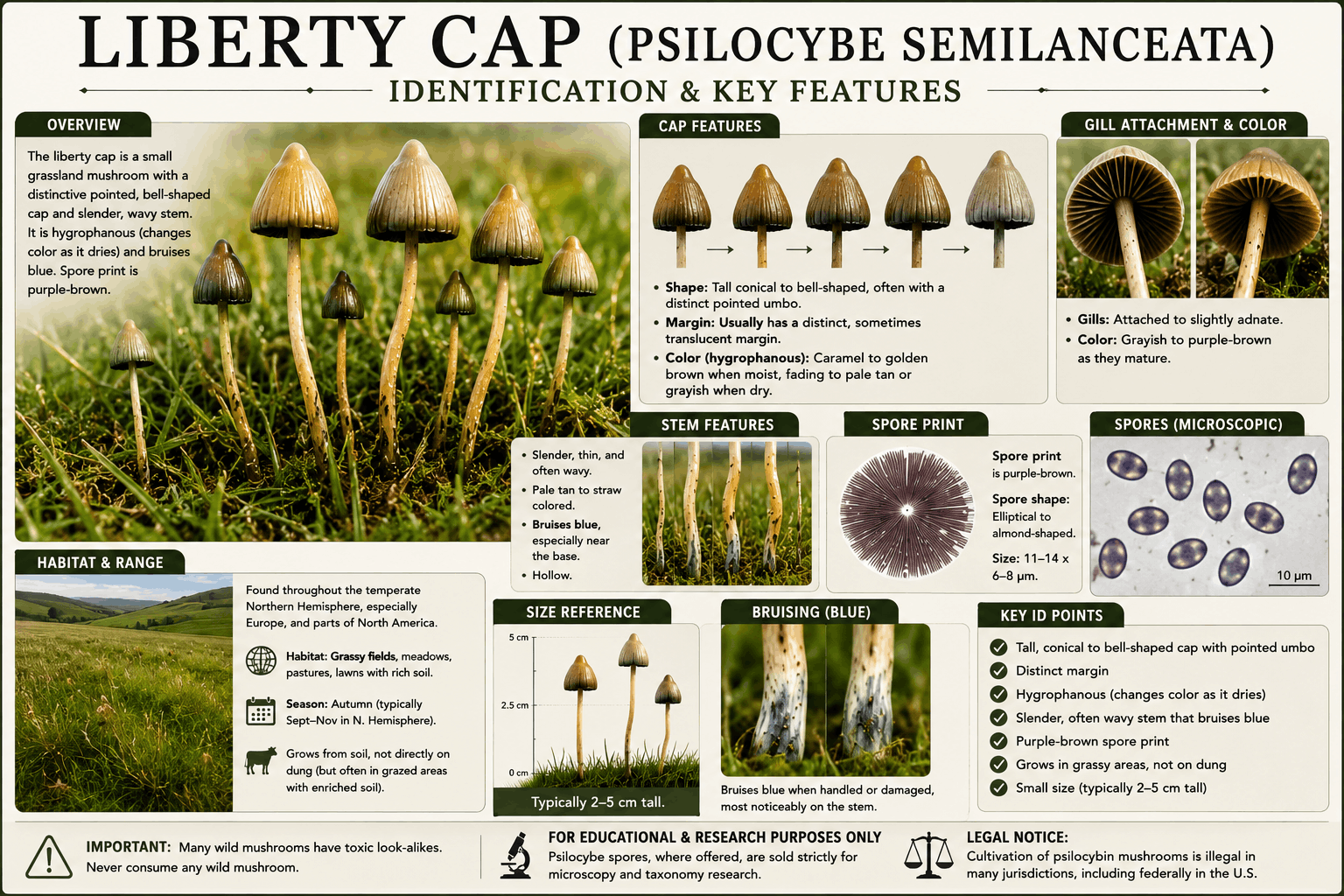
The liberty cap's signature feature is its cap: tall, conical to bell-shaped, often with a small pointed nipple (umbo) at the top, and frequently with a distinct margin. It's hygrophanous, changing color as it dries, ranging from caramel to pale tan. The stem is slender and wavy, and like other Psilocybe species it bruises bluish. Its spore print is purple-brown. Its small size and grassland habitat distinguish it from the larger wood- and dung-loving species.
Habitat & Range
Psilocybe semilanceata is found throughout the temperate Northern Hemisphere—especially across Europe, where it's particularly abundant, as well as parts of North America. It favors grassy fields, meadows, pastures, and lawns with rich soil, typically fruiting in autumn as the weather cools. It does not grow directly on dung, though it's often associated with grazed land where the soil is enriched.
History & Cultural Significance
The liberty cap holds a notable place in the history of mycology. It was among the first European Psilocybe species to be widely documented, and its prevalence across the European countryside made it a focal point of early scientific and cultural interest in the genus. Its striking shape and folklore have cemented it as one of the most recognizable mushrooms in the world.
How It Compares to Other Psilocybe Species
The liberty cap is a grassland species, which sets it apart from the wood-loving group like Psilocybe cyanescens and Psilocybe allenii, and from the dung-loving cubensis strains. Comparing habitat, size, and morphology across these groups is a core part of Psilocybe taxonomy. You can explore the species we offer for microscopy study in our Exotic Mushroom Spores collection.
Frequently Asked Questions
What is a liberty cap mushroom?
The liberty cap (Psilocybe semilanceata) is a small grassland Psilocybe species recognized by its tall, pointed, bell-shaped cap. It's one of the most well-known wild mushrooms in the world.
Where do liberty caps grow?
In grassy fields, meadows, pastures, and lawns across the temperate Northern Hemisphere—especially Europe—typically fruiting in autumn. They grow from rich soil, not directly on dung.
How do you identify a liberty cap?
By its distinctive tall conical cap with a pointed tip, slender wavy stem, bluish bruising, purple-brown spore print, and grassland habitat. As always, multiple features should be assessed together.
Disclaimer: This article is for educational and identification purposes only. Many wild mushrooms are toxic and dangerous look-alikes exist—never consume any wild mushroom. Psilocybe spores, where offered, are sold strictly for microscopy and taxonomy research; cultivation of psilocybin mushrooms is illegal in many jurisdictions, including federally in the United States. Always follow the laws in your area.