
Psilocybe Azurescens (Flying Saucer): ID & Habitat
Posted by Spore Genetics Research Team on May 7th 2023
Psilocybe Azurescens (Flying Saucer): Identification & Habitat
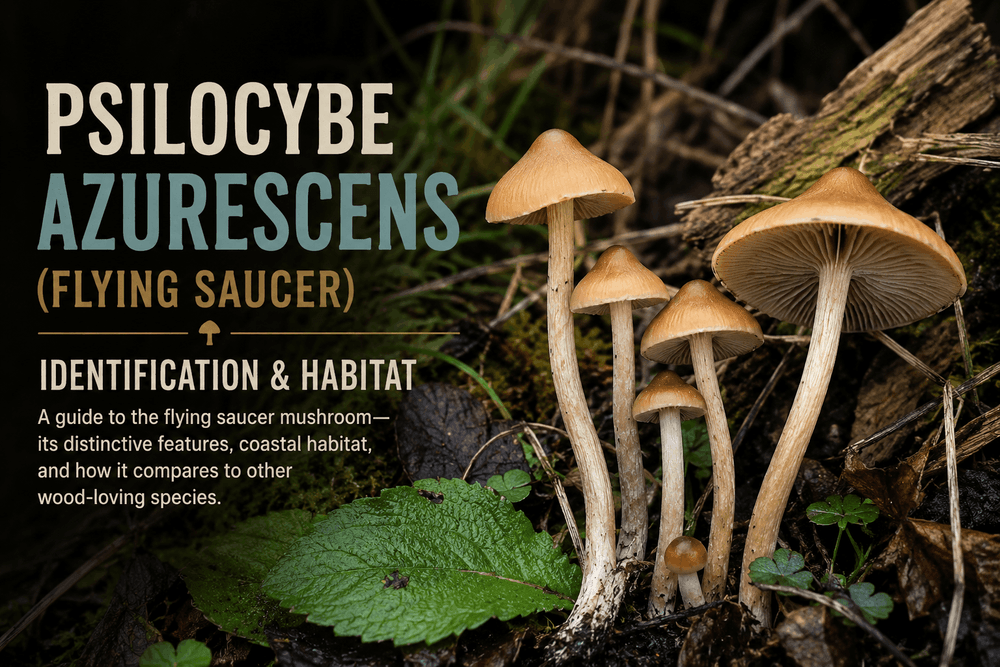
Psilocybe azurescens—nicknamed the "flying saucer" mushroom for its distinctive wavy, saucer-shaped cap—is a wood-loving species native to the Pacific Coast of the United States. It's renowned among mycologists as one of the most robust and potent members of the genus, and its coastal, dune-grass habitat sets it apart from its relatives.
Among the wood-loving Psilocybe species, azurescens is one of the most striking and most studied. Here's a clear look at what it is, how to identify it, where it grows, and how it compares to its relatives.
What Is Psilocybe Azurescens?
Psilocybe azurescens is a lignicolous (wood-loving) mushroom in the family Hymenogastraceae, first described from the Columbia River region of the Pacific Northwest. It's famous for two things: its size and structure, and its strong blue bruising (the azure in its name). Like its relative Psilocybe cyanescens, it grows on wood-based material—but it has a particular affinity for coastal dune grasses and the woody debris around them.
Identification & Key Features
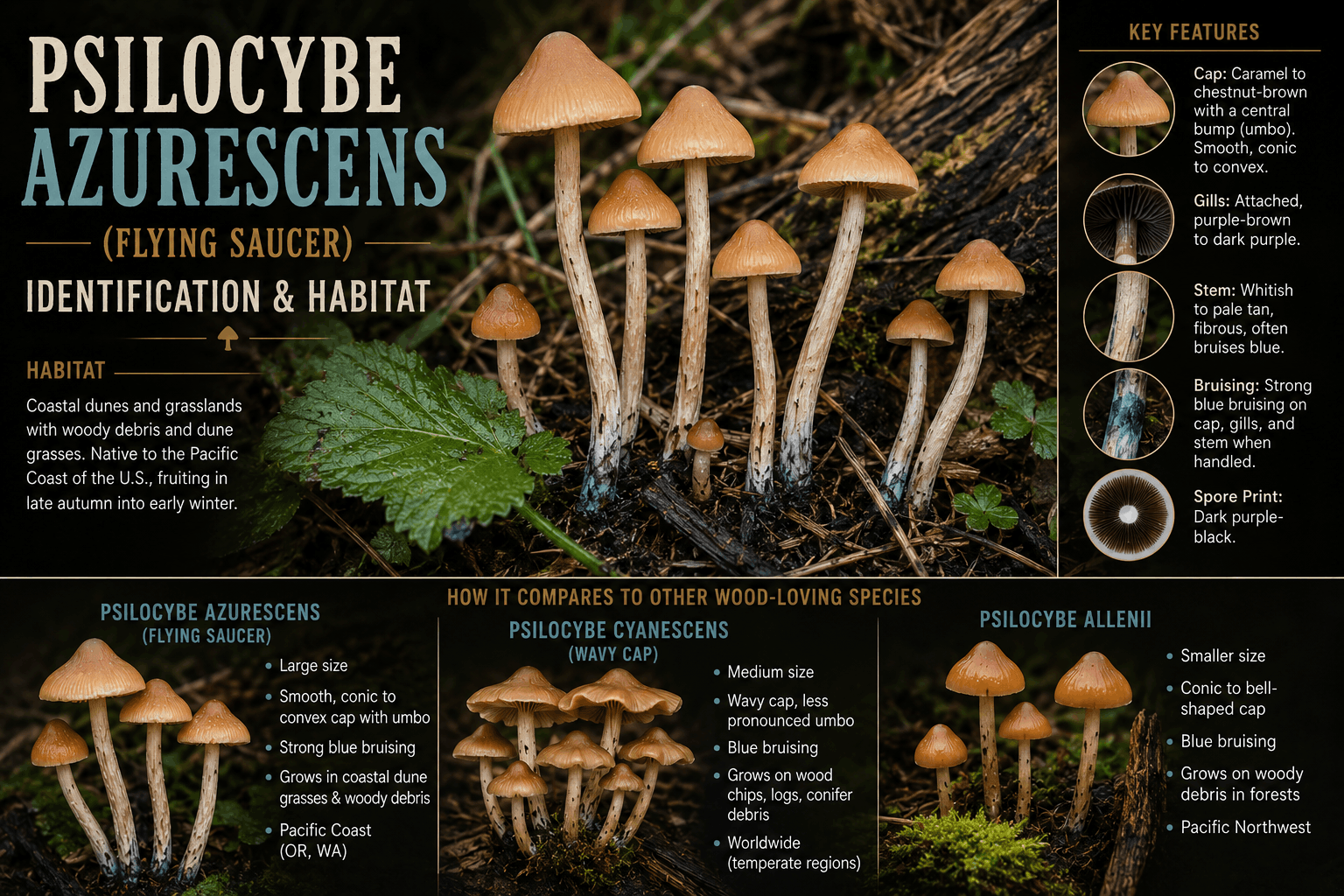
The flying saucer's most recognizable trait is its cap: caramel to chestnut-brown, conic to convex when young, then flattening with a wavy, undulating margin and often a pronounced central bump (umbo). It has a whitish stem, a purple-black to purple-brown spore print, and bruises strongly blue where handled. Its sizeable, sturdy fruiting bodies help distinguish it from smaller wood-loving relatives. As always, identification should rest on multiple features together, including microscopic ones.
Habitat & Range
Psilocybe azurescens is found primarily along the Pacific Coast of the United States, concentrated around the Oregon and Washington coastline—particularly the area near the mouth of the Columbia River. It favors sandy, coastal habitats: dune grasses, wood chips, and woody debris in cool, humid maritime conditions. It typically fruits in late autumn into early winter, tolerating colder temperatures than many other species.
How It Compares to Other Wood-Loving Species
Azurescens belongs to the same wood-loving group as Psilocybe cyanescens and Psilocybe allenii, but it stands out for its larger size, coastal dune-grass habitat, and reputation for potency. Comparing these species side by side—their caps, ranges, and microscopic features—is a rewarding part of Psilocybe taxonomy. For your own study, we offer the Psilocybe Azurescens Isolated Spore Syringe and the 30ml Master Isolate Vial, alongside other species in our Exotic Mushroom Spores collection.
Frequently Asked Questions
What is Psilocybe azurescens?
It's a wood-loving Psilocybe species from the U.S. Pacific Coast, nicknamed the "flying saucer" for its wavy, saucer-shaped cap. It's known for its large size and strong blue bruising.
Why is it called the flying saucer mushroom?
The nickname comes from its cap, which flattens into a distinctive wavy, saucer-like shape as it matures.
Where does Psilocybe azurescens grow?
Along the Pacific Coast of the U.S.—especially around the Oregon and Washington coast near the Columbia River—in sandy, coastal habitats with dune grasses and woody debris, fruiting in late autumn and early winter.
How is it identified?
By its wavy caramel cap with a central bump, whitish stem, purple-black spore print, strong blue bruising, and coastal wood-based habitat—assessed together with microscopic features.
Disclaimer: Psilocybe spores are sold strictly for microscopy, taxonomy, and research purposes. Cultivation of psilocybin mushrooms is illegal in many jurisdictions, including federally in the United States. This article is educational and not intended to encourage any activity that violates federal or local laws. Never consume wild mushrooms.