Amanita Muscaria (Fly Agaric) Guide
The World's Most Famous Toadstool
The red-and-white mushroom of fairy tales is real — and stranger than the stories. Here's the true Amanita muscaria: its biology, its folklore, and the honest facts about its toxicity.
Amanita muscaria, the Fly Agaric, is the iconic bright-red, white-spotted mushroom of storybooks — a mycorrhizal species that partners with tree roots across the Northern Hemisphere. It is psychoactive, but through very different compounds than “magic mushrooms,” and it is genuinely toxic — not a food and not a casual psychoactive.
New to mushrooms in general? Start with mushroom spore basics. Below: how to know it, where it lives, its history, and the safety facts that matter.
Amanita Muscaria at a Glance
| Species | Amanita muscaria |
| Common names | Fly Agaric, the storybook toadstool |
| Cap | Bright red to orange, with white warts |
| Ecology | Ectomycorrhizal — partners with tree roots |
| Active compounds | Ibotenic acid & muscimol (not psilocybin) |
| Distribution | Across the Northern Hemisphere |
| Legal status | Legal in most of the U.S. (contains no psilocybin) |
The Storybook Mushroom
No mushroom is more recognizable. That red cap flecked with white is the archetypal “toadstool” — it turns up in fairy tales and children's books, in Alice in Wonderland, in video games, and woven through the red-and-white imagery of Christmas. Long before any of that, Amanita muscaria held a place in the folklore and ritual of cultures across the northern world, including the shamanic traditions of Siberia.
Its very name tells a small story: “Fly Agaric” comes from an old practice of using pieces of the cap in milk to stupefy flies. Few mushrooms carry this much cultural weight — which is exactly why it's worth understanding the real organism behind the legend.
How to Recognize It
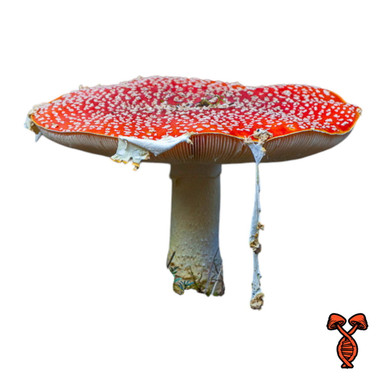
The classic look: a bright red to orange cap studded with white warts (leftovers of the veil that once wrapped the young mushroom), sitting above white gills and a white stem with a ring and a bulbous base. The warts can wash off in heavy rain, and the cap fades with age, so color alone isn't the whole picture.
A serious caution belongs here: the genus Amanita also contains some of the deadliest mushrooms on earth. Never identify — and never eat — a wild mushroom from a photo. Real identification takes training, multiple features, and often a microscope.
A Partner to the Trees
Here's what makes Amanita muscaria so different from gourmet mushrooms: it's ectomycorrhizal. Rather than breaking down dead wood or straw, its mycelium forms a living partnership with the roots of trees — birch, pine, and spruce especially — trading nutrients back and forth underground.
That's also why you can't grow it on a block or in a jar like an oyster. Establishing it is a slow, outdoor, host-tree project for observation rather than harvest — see our Amanita muscaria cultivation guide for what that actually involves.
Muscimol, Not Psilocybin
Amanita muscaria is psychoactive, but it is not a “magic mushroom.” Its activity comes from ibotenic acid and muscimol — a completely different class of compound from the psilocybin found in Psilocybe species. The two are distinct chemically, in their effects, and in the eyes of the law.
That difference is the reason Amanita muscaria occupies a very different legal space (below) — and also why its effects are unpredictable and, importantly, tied up with real toxicity.
⚠ A Serious Safety Note
Amanita muscaria is toxic. Ibotenic acid and muscimol can cause real poisoning — nausea, vomiting, confusion, delirium, and in some cases serious medical emergencies. This is not a food and not a casual psychoactive.
Never eat wild Amanita mushrooms. The genus includes some of the most lethal fungi known, and lookalikes have killed experienced foragers. A photo is never enough.
Keep any specimens away from children and pets. We supply this species for cultivation, observation, and research — not for consumption. If someone may have ingested it, contact Poison Control or emergency services immediately.
Is Amanita Muscaria Legal?
Because it contains no psilocybin and isn't a federally controlled substance, Amanita muscaria is legal to buy, sell, and possess across most of the United States — a very different situation from psilocybin mushrooms.
That said, a few places restrict it (Louisiana is the well-known example), and rules abroad vary. Always confirm the laws where you live before ordering. This is general information, not legal advice.
Amanita Muscaria Culture
A living culture for observation, taxonomy, and mycorrhizal research — the starting point for anyone studying this remarkable species.
Browse Cultures & Supplies
Drag or scroll to explore →


Amanita Muscaria FAQ
Is Amanita muscaria the same as magic mushrooms?
No. Magic mushrooms contain psilocybin; Amanita muscaria contains ibotenic acid and muscimol — different compounds, different effects, and a different legal status entirely.
Is Amanita muscaria poisonous?
Yes — it's toxic and can cause serious poisoning. It isn't a food and shouldn't be treated as one. And no wild mushroom should ever be eaten on a photo ID, given the deadly species in this genus.
Can you grow Amanita muscaria at home?
Not like a gourmet mushroom. Because it's mycorrhizal, it needs a living host tree — it's a slow outdoor project for observation, not a block-grown crop. See our cultivation guide.
Is it legal?
In most of the U.S., yes — it contains no psilocybin and isn't federally scheduled. A few places (like Louisiana) restrict it, so check your local laws. This isn't legal advice.
Questions About Amanita Muscaria?
Curious how to establish it, or how it compares to other cultures? Reach out any time via email, or read the cultivation guide.
Spore Genetics — Exceptional Mushroom Spores & Cultures