Panaeolus Cyanescens (Blue Meanie): Identification Guide
Posted by Spore Genetics Research Team on May 8th 2023
Panaeolus Cyanescens (Blue Meanie): Identification & Facts
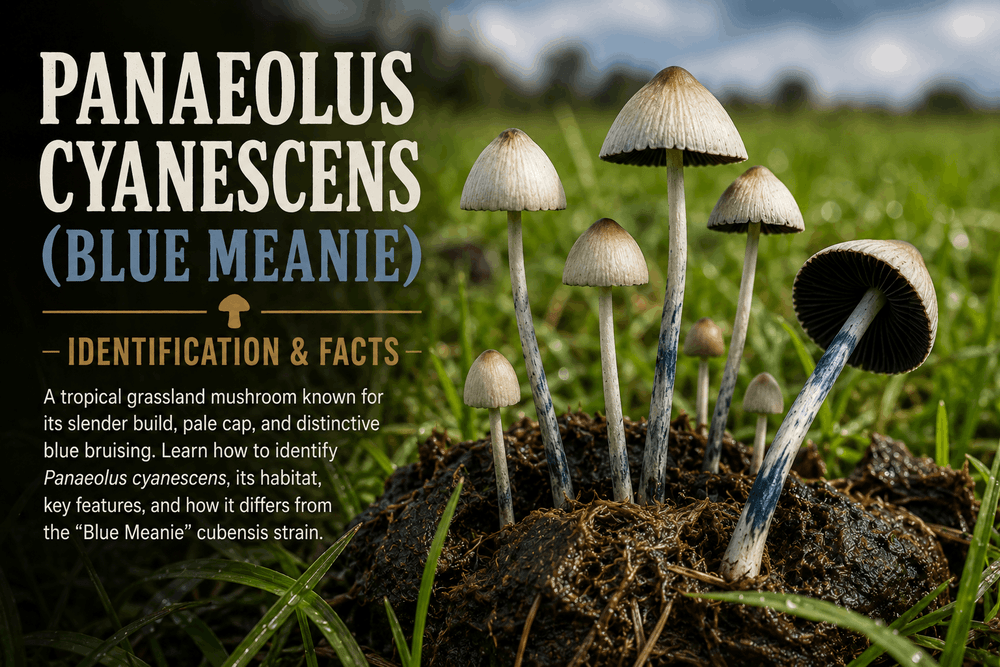
Panaeolus cyanescens—commonly called the “Blue Meanie”—is a tropical and subtropical grassland mushroom known for its slender build, pale cap, and strong blue bruising. Unlike the wood- and dung-loving Psilocybe species, it belongs to a separate genus (Panaeolus), and it’s a distinct organism from the Psilocybe cubensis strain that shares the “Blue Meanie” nickname.
The Blue Meanie name causes a lot of confusion, because it’s used for two completely different mushrooms. This guide focuses on the true Panaeolus cyanescens—what it is, how to identify it, what its spores look like, where it grows, and how to tell it apart from its cubensis namesake.
What Is Panaeolus Cyanescens?
Panaeolus cyanescens is a grassland mushroom in the genus Panaeolus, also known by the synonym Copelandia cyanescens. It’s native to warm, humid tropical and subtropical regions—including parts of Central America, Southeast Asia, and Australia—where it typically grows on or near dung in pastures and grassy fields. The “cyanescens” in its name (and the “Blue Meanie” nickname) refers to its pronounced blue bruising when handled.
How to Identify Panaeolus Cyanescens
Panaeolus cyanescens is a slender, delicate mushroom, and identification rests on several features together—never one alone:
- Cap: pale grayish to off-white, hemispheric to broadly convex, often cracking into a mosaic in dry conditions.
- Stem: long, thin, and fragile, pale, often bruising blue toward the base.
- Gills: mottled gray to black as the spores mature, a hallmark of the Panaeolus genus.
- Blue bruising: its most notable trait—pronounced blue-green bruising where the tissue is handled or damaged.
- Spore print: jet black — the single most important distinguishing feature, and the reason it can’t be confused with a Psilocybe once a print is taken.
Panaeolus Cyanescens Under the Microscope
The spore print is where Panaeolus separates cleanly from the psilocybes it’s often grouped with. Panaeolus cyanescens drops a jet-black spore print — not the dark purple-brown of a Psilocybe cubensis, and nothing like a pale-spored gourmet species. See where black sits among the genera on our spore print color chart. Under magnification, its spores are opaque, lemon-shaped (citriform) to ellipsoid, thick-walled, and carry a distinct germ pore — a genuinely different look from the subrhomboid cubensis spore. That black-print, citriform-spore combination is exactly the kind of detail that settles identification under the microscope, which is the responsible way to study a species like this. If you’re setting up, see how to study spores under a microscope.
Why It’s Called “Blue Meanie”
The name comes straight from the bruising. Where the mushroom is bruised or handled, it stains a vivid blue—the same psilocin-oxidation reaction seen across active species, and unusually strong in this one. Our guide on why mushrooms bruise blue explains the chemistry. Panaeolus cyanescens is also noted in the mycological literature as one of the more potent psilocybin-producing species, which is part of why it’s so widely discussed—though, as with everything we supply, it’s offered strictly as a microscopy and taxonomy specimen.
Panaeolus Cyanescens vs. the “Blue Meanie” Cubensis Strain
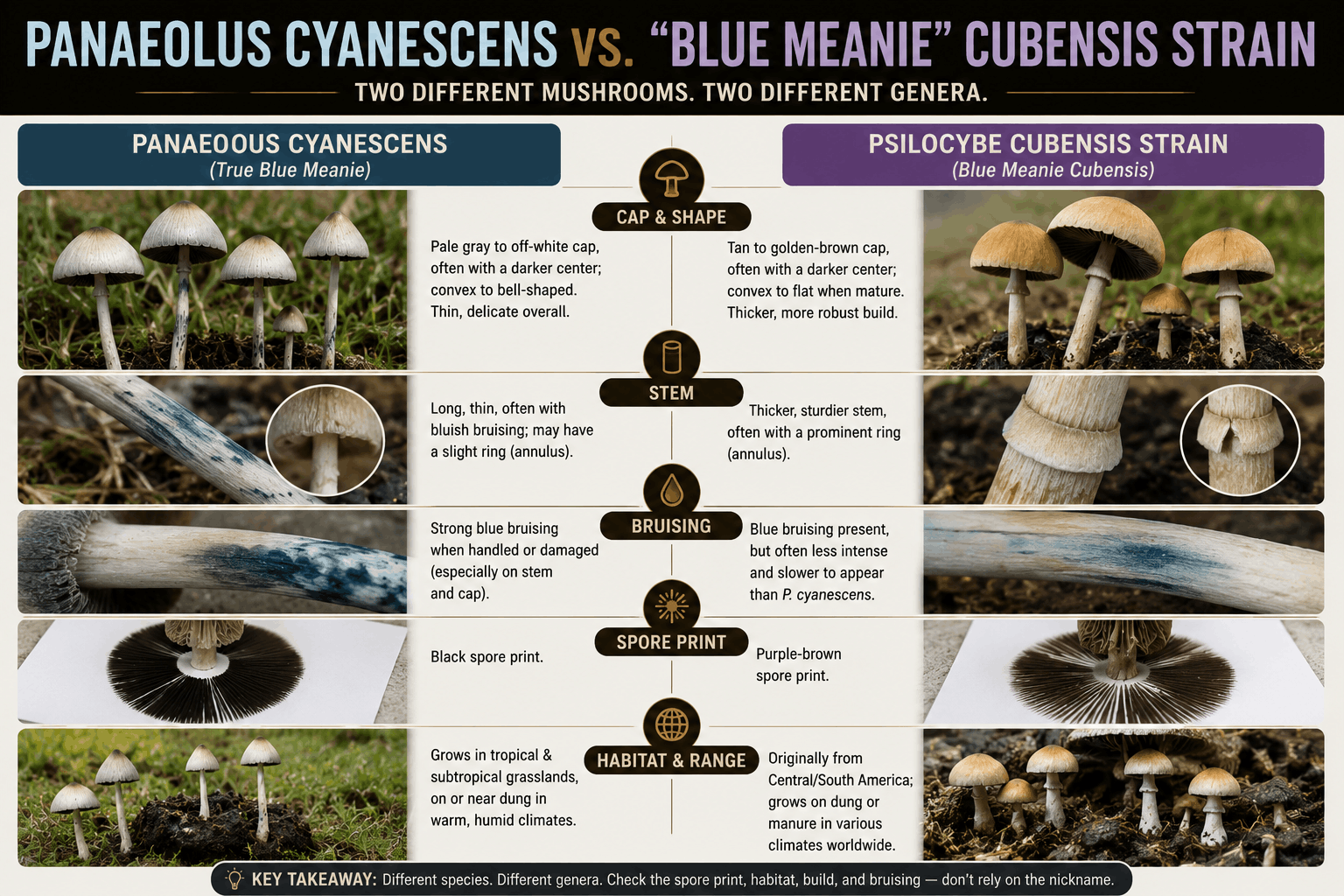
Here’s the confusion cleared up. “Blue Meanie” refers to two different mushrooms: the true Panaeolus cyanescens (this species), and a separate Psilocybe cubensis strain that’s also nicknamed “Blue Meanie.” They’re different species in different genera:
| Panaeolus cyanescens | “Blue Meanie” cubensis strain | |
|---|---|---|
| Genus / species | Panaeolus cyanescens (its own species) | A strain of Psilocybe cubensis |
| Spore print | Jet black | Dark purple-brown |
| Build | Slender, delicate, thin-stemmed | Stouter, typical cubensis stature |
| Habitat | Tropical/subtropical grassland & dung | Cultivated worldwide as a cubensis strain |
So when someone says “Blue Meanie,” it’s always worth clarifying which mushroom they mean. If you’re specifically looking for the cubensis strain rather than this species, that’s our Blue Meanie cubensis spore syringe (also offered as an isolated syringe). For the broader cubensis picture, see our Psilocybe cubensis strains guide.
Habitat & Range
Panaeolus cyanescens favors warm, humid climates and is found in tropical and subtropical grasslands worldwide, where it grows in and around dung in well-grazed pastures. It fruits in warm, moist conditions, which is why it’s associated with tropical regions rather than the temperate ranges of many wood-loving species. For how habitat fits into identification across the psilocybin species, see our guide to the types of magic mushrooms.
Explore the Panaeolus Genus
Panaeolus is a fascinating genus to study alongside the more familiar Psilocybe species—and it includes other members like the widespread Panaeolus cinctulus. If you’re interested in examining these spores for microscopy, you can find Panaeolus cyanescens and related varieties in our Panaeolus spores collection, and browse other species in our Exotic Mushroom Spores selection.
Frequently Asked Questions
What is a Blue Meanie mushroom?
“Blue Meanie” is a nickname used for two different mushrooms: Panaeolus cyanescens (a tropical grassland species) and a separate Psilocybe cubensis strain. This guide covers the true Panaeolus cyanescens.
How do you identify Panaeolus cyanescens?
By its slender build, pale grayish cap, mottled gray-black gills, strong blue bruising, and—critically—its jet-black spore print, assessed together with microscopic features like its lemon-shaped spores.
What color is a Panaeolus cyanescens spore print?
Jet black. That black print is the clearest way to separate Panaeolus from the purple-brown-spored Psilocybe species, including the cubensis strain that shares the “Blue Meanie” name.
What’s the difference between Panaeolus cyanescens and the Blue Meanie cubensis strain?
They’re different species in different genera. The clearest difference is the spore print—black for Panaeolus cyanescens, purple-brown for the cubensis strain—plus differences in build and habitat.
Why is it called the Blue Meanie?
Because of its pronounced blue bruising where the tissue is handled—a psilocin-oxidation reaction that’s unusually strong in this species. It’s also noted for its potency, which adds to its reputation.
Where does Panaeolus cyanescens grow?
In warm, humid tropical and subtropical grasslands worldwide, typically on or near dung in grazed pastures.
Disclaimer: Panaeolus and Psilocybe spores are sold strictly for microscopy, taxonomy, and research purposes. Cultivation of psilocybin mushrooms is illegal in many jurisdictions, including federally in the United States. This article is educational and not intended to encourage any activity that violates federal or local laws. Never consume wild mushrooms. We ship to every U.S. state except Georgia and Idaho.