
Where Do Magic Mushrooms Grow? Habitats in Dung, Grass & Wood
Posted by Spore Genetics Research Team on Feb 2nd 2026
Where Do Magic Mushrooms Grow? Habitats & U.S. Range
Magic mushrooms grow in the wild across a range of natural habitats—most commonly on herbivore dung in tropical and subtropical pastures, in grasslands and meadows, and on decaying wood and woody debris. Different Psilocybe species have adapted to different environments and climates, which is why the species you might encounter depends heavily on the region and state you’re in. Here’s how habitat and U.S. geography shape where each type occurs.
When you think of magic mushrooms, most typically think of just the psilocybe cubensis mushrooms such as a Golden Teacher, Melmak, PES Amazonian, Pink Buffalo, or any of the classics. Here’s the truth, there are so many different species among us that naturally grow in the wild that are exponentially magical. Roughly over 200 species of fungi produce the beloved psilocybin. But where exactly do some of these species grow naturally? Why are some mushrooms grass lovers but others enjoy dung or wood? Let me give you guys a clear view on some of the species of fungi and their natural needs in habitats.
Dung-Loving Mushrooms: Cow Dung & Pasture Species
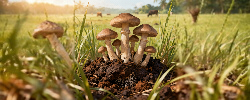
These are the most common psilocybin mushrooms that we all know and love to research. Dung is such a nutrient jackpot! These kinds of cubensis magic mushrooms are particularly fond of herbivore dung such as cow & horse manure and enjoy tropical/subtropical pastures.
The way these mushrooms spread is quite easy but interesting and we have to thank our cows and horses for this. They inadvertently spread the spores by eating the grass that has been sporulated on, and after digestion within the animal, they drop their dung patties creating a perfect ground for mushrooms to come to full life.
Below I will list a few dung loving cubensis mushrooms in case you didn’t catch them earlier -
Where Cubensis Grows in the United States
In North America, Psilocybe cubensis is a warm-climate species tied closely to cattle country along the Gulf Coast. It has been documented across Texas, Louisiana, Mississippi, Alabama, and Florida, where humid summers, frequent rain, and year-round grazing create exactly the conditions it wants. Fruiting tends to follow warm rain in pastures where cattle have been active, rather than appearing on any predictable calendar.
Further north the climate simply doesn’t support it. Cubensis needs sustained warmth and humidity, which is why the species drops off sharply outside the southern tier — and why the grass-loving and wood-loving species below dominate cooler regions instead.
Not Everything Growing in a Cow Patty Is Psilocybin
This is the part most habitat articles skip, and it matters. Dung is one of the richest fungal habitats on earth, and the overwhelming majority of what fruits from it is not psychoactive at all. A single pasture can produce psychoactive species, harmless species, choice edibles, and genuinely dangerous species — sometimes within a few feet of each other.
Here are the genera you’re most likely to encounter in and around herbivore dung:
| Genus / Species | Spore Print | What It Is |
|---|---|---|
| Psilocybe cubensis | Purple-brown | Psychoactive; bruises blue |
| Panaeolus cyanescens | Jet black | Psychoactive; bruises blue |
| Panaeolus foenisecii | Dark brown | Not psychoactive; extremely common in lawns |
| Protostropharia semiglobata | Purple-brown | Dung roundhead — not psychoactive, close look-alike |
| Deconica coprophila | Purple-brown | Dung specialist; not psychoactive |
| Agaricus campestris | Chocolate brown | Meadow mushroom — a pasture edible |
| Coprinopsis / Coprinus | Black | Inky caps; some edible, one reacts badly with alcohol |
| Bolbitius | Rusty brown | Fragile, short-lived; not psychoactive |
| Conocybe | Rusty brown | Some species deadly (amatoxins) |
How Spore Color Sorts Them — and Where It Stops
Spore print color does a lot of the work here. Panaeolus prints jet black, Agaricus chocolate brown, Coprinus black, and Conocybe and Bolbitius rusty brown — so a print alone eliminates most of the field fast. Our spore print color chart breaks down what each genus deposits.
But spore color has a real limit in dung habitat, and it’s worth knowing. Protostropharia semiglobata and Deconica coprophila both print purple-brown, exactly like Psilocybe cubensis. A print will not separate them. What does help is blue bruising — psilocin oxidizes on handling and damage, so psychoactive species discolor blue where the non-psychoactive purple-brown-spored dung species do not. For the full picture of that reaction, see why do mushrooms bruise blue.
And the genus that should stop you cold is Conocybe. Rusty brown spores, small brown caps, grassy and dung-enriched ground — and some species carry the same amatoxins found in the death cap. Rusty brown is a stop sign, in pasture just as much as in the woods.
Grass-Loving Mushrooms: The Greenery is Key
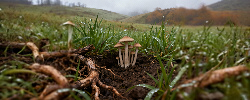
Who says you need dung in order to create some potency fueled mushrooms? There is a beauty with grass lovers because they don’t need much other than fertile soils near meadows, lawns, and grazed fields. This is great when you have decaying grass roots, which totally happens often. Grass loving species will be a lot easier to come across in the wild as they don’t usually need much when it comes to growing because these psilocybin mushrooms have adapted to withstand cooler climates.
There is one place in the world that has an abundance of these grass loving mushrooms and that’s Europe. There are reports of findings in pretty much every country in Europe being a classic Autumn fruiter that drives Europeans to forage. The next runner up would be the Pacific Northwest of North America especially around Washington, Oregon, and Northern Cali which also trickles into areas around Canada.
Below will be a few psilocybin mushrooms that are grass lovers -
· Panaeleous Cyanescens Estero
· Psilocybe Semilanceata (Liberty Cap)
Wood-Loving & Sand-Loving Mushrooms
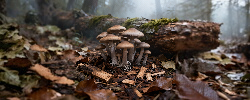
Most times people tend to forget we have wood loving and sand loving mushrooms too. Truthfully we have so many mushrooms in our ecosystem that points to the fact mushrooms were here long before any of us. While I may only be talking about the sand & wood lovers in this passage, I want you to know that fungi will feed on anything you can think of because they are the pinnacle of decomposing, regeneration, and adaptation. They help sustain life in general by turning waste into resources for all life here, not just us humans.
Steering the conversation towards the sand loving mushrooms, these fungi are adapted to harsh, low-nutrient sandy environments like coastal dunes and dune grasses. They often anchor to buried woody debris or lignin-rich organic matter within the sand, forming dense mycelial mats and protective structures that help them withstand drought, fire, and erosion by retaining moisture to keep the network alive. These fungi favor cool-climate and subtropical humid coastal habitats, and tend to be on the rarer side without one specific region of abundance. Here are a couple that we know of containing psilocybin -
Now let’s shift over to wood loving psilocybin mushrooms. These are going to be a lot more prevalent as opposed to sand lovers. Woody debris and mulch are everywhere, while pure sandy dune habitats with the right woody mix are coastal-specific and need the right conditions. With that being said, wood loving mushrooms are going to be found abundantly in Australia and New Zealand, some point to the theory that they originated from there. Head over to North America and they can be found naturally in the pacific northwest such as Oregon, Washington, and Northern California and other parts down south where humidity is abundant. I’ll list two strains below that are psilocybin producing wood loving strains -
Where Magic Mushrooms Grow in the U.S. — Region by Region
Because each group is tied to a climate and a substrate, the psilocybin species that occur naturally shift as you move across the country. This is about natural range and ecology — which species the environment can support — not a foraging map. Climate is the deciding factor: cubensis needs sustained heat and humidity, while the wood- and grass-loving species tolerate the cool, wet conditions of the north and coasts.
| Region | Climate | Species Type Supported |
|---|---|---|
| Gulf Coast & Deep South (TX, LA, MS, AL, FL, GA) |
Warm, humid, subtropical | Dung-loving cubensis country — the classic U.S. range for P. cubensis |
| Pacific Northwest (WA, OR, N. CA) |
Cool, wet, mild coastal | Wood-loving strongholds — P. cyanescens, azurescens, allenii |
| Northeast & Mid-Atlantic (NY, PA, NJ, MD, OH) |
Temperate, seasonal | Wood-lovers like P. ovoideocystidiata; too cold for wild cubensis |
| Upper Midwest & North (MI, MN, WI, KS) |
Cold winters, continental | Sparse; occasional grass/wood species, no wild cubensis |
| Mountain West & Southwest (CO, and arid states) |
Dry, high-altitude | Largely unsuitable — too dry for most psilocybin species |
The pattern is climate-driven and consistent: the warm, cattle-grazed Southeast is the natural home of wild Psilocybe cubensis, while the cool, damp Pacific Northwest is wood-lover territory for species like cyanescens and azurescens. The temperate Northeast supports its own wood-loving species such as ovoideocystidiata, and the cold, dry interior of the country supports very little. So the honest answer to “do psilocybin mushrooms grow in my state?” is: it depends almost entirely on your climate, and northern or arid states rarely support the warm-weather cubensis people usually picture.
None of this is an invitation to forage. Wild psilocybin species overlap in habitat with dangerous look-alikes, and the point of understanding range is ecological — the same species are available to study legally as microscopy specimens, without any of the identification risk. Explore them in our mushroom spores collection.
Frequently Asked Questions
Where do psilocybin mushrooms grow?
Psilocybin-producing species grow on a variety of natural substrates—herbivore dung, grassland soils, and decaying wood—primarily in tropical, subtropical, and temperate climates around the world. In the U.S., the species present depends heavily on regional climate.
Where do shrooms grow naturally?
In the wild, different species favor different habitats: dung-loving species thrive in cattle and horse pastures, grass-loving species in meadows and fields, and wood-loving species on mulch and decaying logs.
What states do magic mushrooms grow in?
Wild Psilocybe cubensis is a warm-climate species found mainly across the Gulf Coast and Deep South — Texas, Louisiana, Mississippi, Alabama, Florida, and Georgia. Cooler wood-loving species like P. cyanescens and P. azurescens occur in the Pacific Northwest, while the temperate Northeast has its own species such as P. ovoideocystidiata. Cold and arid interior states support very little.
Do psilocybin mushrooms grow in northern states?
Wild Psilocybe cubensis generally does not — it needs sustained heat and humidity it can’t get in the north. Some cooler-tolerant wood- and grass-loving species occur in the Pacific Northwest and parts of the Northeast, but the cold, dry interior supports very few psilocybin species.
What do magic mushrooms grow on?
Depending on the species, magic mushrooms grow on herbivore dung, fertile grassland soil, woody debris and mulch, or sandy coastal substrates rich in lignin.
What mushrooms grow in cow manure?
Cow manure supports a wide range of fungi. Alongside psychoactive species like Psilocybe cubensis and Panaeolus cyanescens, you’ll commonly find non-psychoactive genera such as Protostropharia, Deconica, Panaeolus foenisecii, Bolbitius, and inky caps — plus pasture edibles like the meadow mushroom, and toxic species including some Conocybe.
Are all mushrooms growing in cow dung psychedelic?
No — and most are not. The majority of dung-dwelling fungi contain no psilocybin at all, and several look-alikes share the same purple-brown spore print as Psilocybe. Some species found in the same habitat are seriously toxic, which is why habitat alone is never an identification.
Does Psilocybe cubensis grow wild in Texas?
Yes. Psilocybe cubensis occurs along the US Gulf Coast, including Texas, where cattle pastures and warm, humid, rainy conditions suit it. Fruiting generally follows warm rain rather than a fixed season.
Disclaimer: Psilocybe cubensis spores are sold strictly for microscopy, taxonomy, and research purposes. Cultivation of Psilocybe cubensis mushrooms is illegal in many jurisdictions, including federally in the United States. None of the information provided or products sold are intended to encourage or facilitate any activity that violates federal or local laws. All references are intended for educational purposes related to microscopy and gourmet mushrooms only. This article is not a foraging guide — wild mushroom identification requires multiple features and experience, and several species found in dung and pasture habitat are toxic or deadly. Never consume a wild mushroom without expert confirmation.