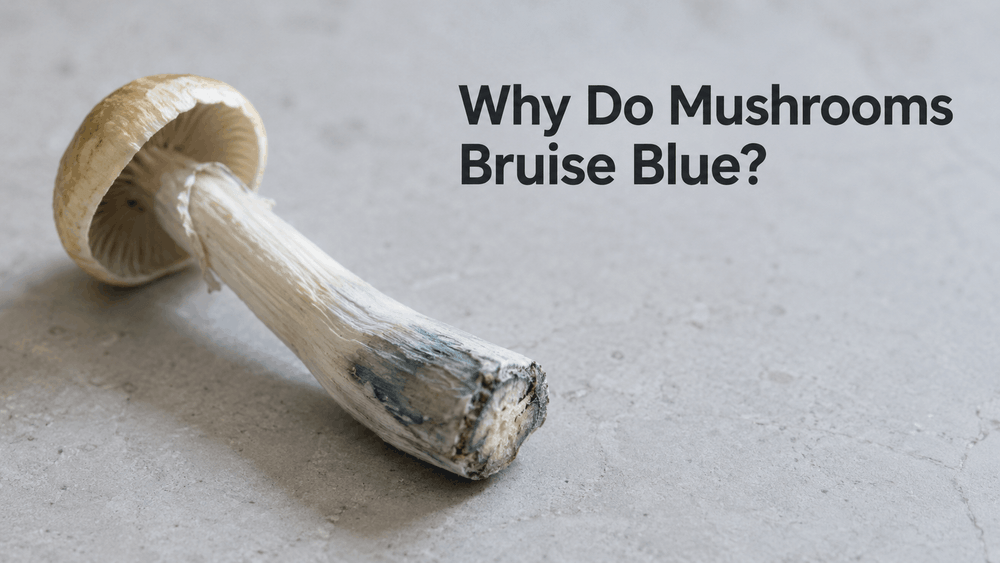
Why Do Mushrooms Bruise Blue? The Science of Blue Bruising
Posted by Spore Genetics Research Team on Feb 19th 2024
Why Do Mushrooms Bruise Blue? The Science of Blue Bruising
Mushrooms bruise blue because of a chemical reaction: when tissue containing psilocybin and psilocin is damaged — bruised, cut, or handled — the psilocin is exposed to oxygen and oxidizes, forming blue-colored compounds. The bluing is essentially the mushroom’s chemistry reacting to air, and it’s most associated with psilocybin-producing species. But it is not a foolproof identification test, and that distinction matters more than most people realize.
Few features of a mushroom are as visually striking — or as misunderstood — as blue bruising. Here’s exactly what causes it, what it does and doesn’t tell you, and why researchers treat it as one clue among many rather than a definitive answer.
What Causes the Blue Color?
The bluing reaction comes down to psilocin oxidation. Psilocybin-producing mushrooms contain two related compounds: psilocybin, which is stable, and psilocin, which is not. When the mushroom’s tissue is bruised or broken, enzymes in the mushroom convert psilocybin to psilocin, and the newly exposed psilocin reacts with oxygen in the air.
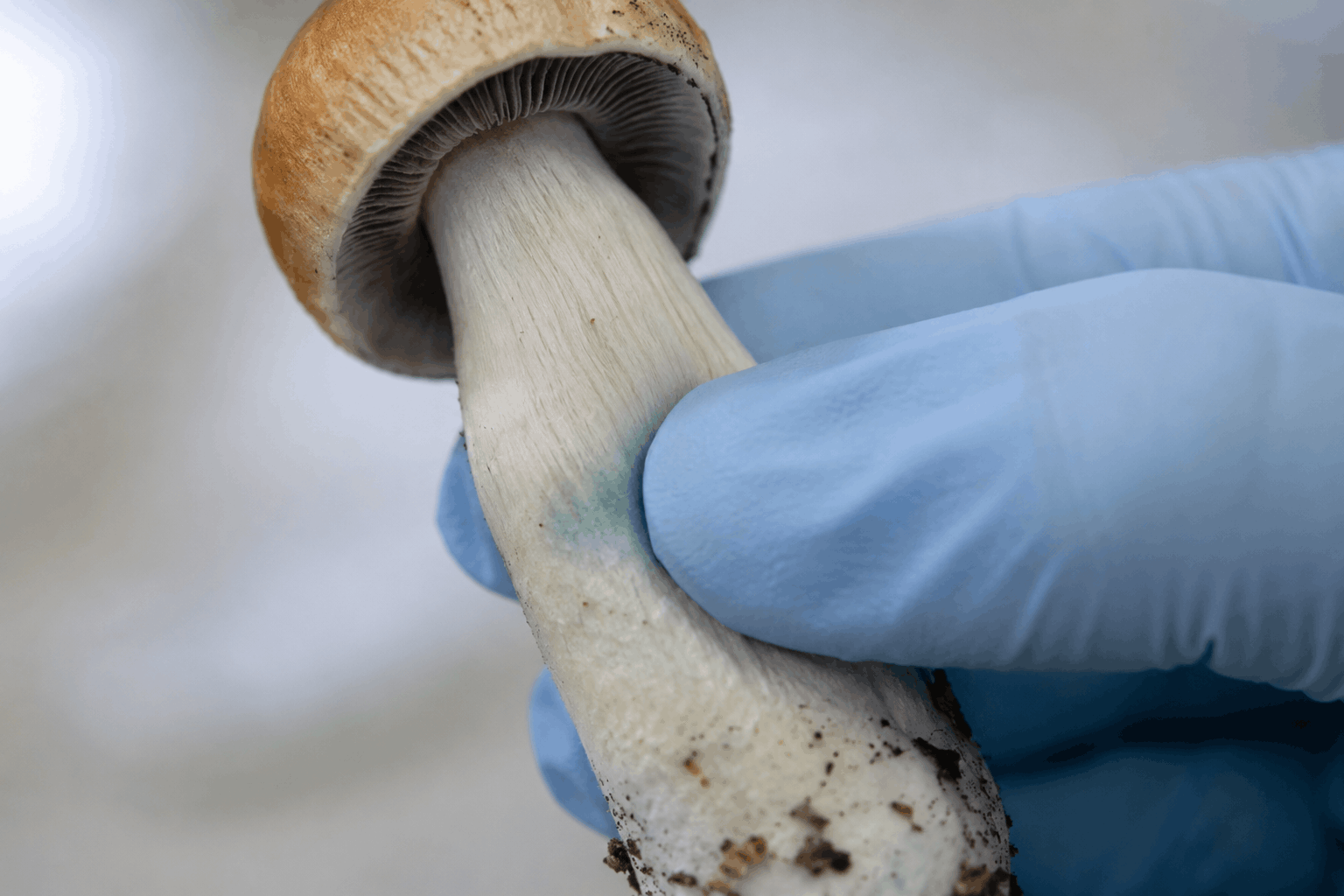
That oxidation causes the psilocin molecules to bond together into larger blue-colored compounds. The result is the blue-to-blue-green discoloration you see spreading across a damaged stem or cap — sometimes within seconds, sometimes over several minutes. In essence, the blue is the visible signature of psilocin reacting with air, a bit like how a sliced apple browns when its exposed flesh oxidizes.
Why Damage Triggers It
Undisturbed, an intact mushroom generally won’t show much bluing — the reactive compounds are held safely inside intact cells. It’s damage that sets the reaction off:
- Handling — fingerprints and pressure marks often bruise blue where the mushroom was touched.
- Cutting or breaking — a cut stem base is one of the most common places to see it.
- Age and drying — bluing can also appear as tissue naturally breaks down.
This is why bruising is described as a reaction: it needs the trigger of broken tissue plus exposure to oxygen to occur.
Does Blue Bruising Mean a Mushroom Is “Magic”?
Not reliably — and this is the single most important thing to understand about bluing. While blue bruising is strongly associated with psilocybin-active species, it is not a definitive test, in either direction:
- Some non-psilocybin mushrooms also bruise blue or blue-green for entirely different chemical reasons. Several bolete species, for example, blue vividly when cut and contain no psilocybin at all.
- Some psilocybin species bruise weakly or inconsistently, and conditions like temperature, age, and handling affect how strongly the reaction shows.
In other words, bluing raises the probability that a mushroom is psilocybin-active, but it neither confirms nor rules it out on its own. Treating a blue bruise as proof is exactly the kind of shortcut that leads to misidentification.
Blue Bruising and Identification — Where It Fits
For anyone studying mushrooms, bruising is a data point, not a verdict. Reliable identification always combines multiple features — spore print color, cap and gill structure, habitat, and microscopy — and bruising is one supporting observation among them.
Spore print color does much of the heavy lifting here. A purple-brown print points toward Psilocybe, while a jet-black print suggests Panaeolus, and rusty-brown is a warning sign of potentially toxic genera. Our spore print color chart breaks down what each genus deposits. Combined with bruising behavior and microscopic examination of the spores themselves, these features build a picture that no single test could provide.
A crucial safety note: blue bruising is not a safety test. It does not indicate whether a mushroom is safe to eat, and some toxic species can discolor when damaged. Wild mushroom identification requires expertise and multiple confirmed features — never rely on bruising, or any single trait, to judge a wild mushroom.
Which Mushrooms Are Known for Blue Bruising?
Strong, characteristic bluing is a hallmark of many well-known psilocybin species, including much of the Psilocybe genus. Classic examples include Golden Teacher and other Psilocybe cubensis strains, whose whitish stems commonly bruise blue where handled, as well as more potent species like Panaeolus cyanescens (Blue Meanies) — whose very name comes from its dramatic bluing. Even albino and leucistic strains, which lack normal pigment, still bruise blue, because bruising is driven by psilocin chemistry rather than by the pigments responsible for cap color. We cover that quirk in our guide to albino vs. leucistic mushrooms.
Frequently Asked Questions
Why do mushrooms turn blue when you touch them?
Touching or bruising the tissue damages the cells, exposing psilocin to oxygen. The psilocin oxidizes and bonds into blue-colored compounds, producing the characteristic bruise where the mushroom was handled.
What does it mean when a mushroom bruises blue?
It usually indicates the presence of psilocin, so bluing is commonly associated with psilocybin-active species. However, it is not conclusive — some non-psilocybin mushrooms also blue, so it’s treated as one identification clue among several, not proof.
Do all psilocybin mushrooms bruise blue?
Most do to some degree, but not always strongly or consistently. Age, temperature, and handling all affect how visible the reaction is, and a few species bruise only weakly.
Do any poisonous mushrooms bruise blue?
Yes. Some non-psilocybin mushrooms, including certain boletes, bruise blue through unrelated chemistry, and bruising says nothing about toxicity. Blue bruising is never a safety test — never judge whether a wild mushroom is safe by its bruising.
Is the blue color the psilocybin itself?
Not exactly. The blue comes from psilocin (which psilocybin converts into) oxidizing and bonding into larger colored compounds. So the color is a byproduct of the reaction, not the psilocybin molecule directly.
How long does it take for a mushroom to bruise blue?
It varies — sometimes within seconds of damage, sometimes over several minutes. Fresher tissue and warmer conditions tend to show the reaction faster and more vividly.
Interested in studying these species under the microscope? Browse our mushroom spores and cubensis strain guides.
Disclaimer: This article is educational and covers the chemistry and identification significance of blue bruising. It is not a foraging or safety guide — blue bruising does not indicate whether a mushroom is safe, and several species that bruise are toxic. Never consume a wild mushroom without expert identification. Psilocybe cubensis spores sold by Spore Genetics are intended strictly for microscopy, taxonomy, and research purposes. Cultivation is illegal in many jurisdictions, including federally in the United States. We ship to every U.S. state except Georgia and Idaho.