
Spore Print Color Chart: Identifying Mushrooms by Spore Color
Posted by Spore Genetics Research Team on Jun 2nd 2023
Spore Print Color Chart: Identifying Mushrooms by Spore Color
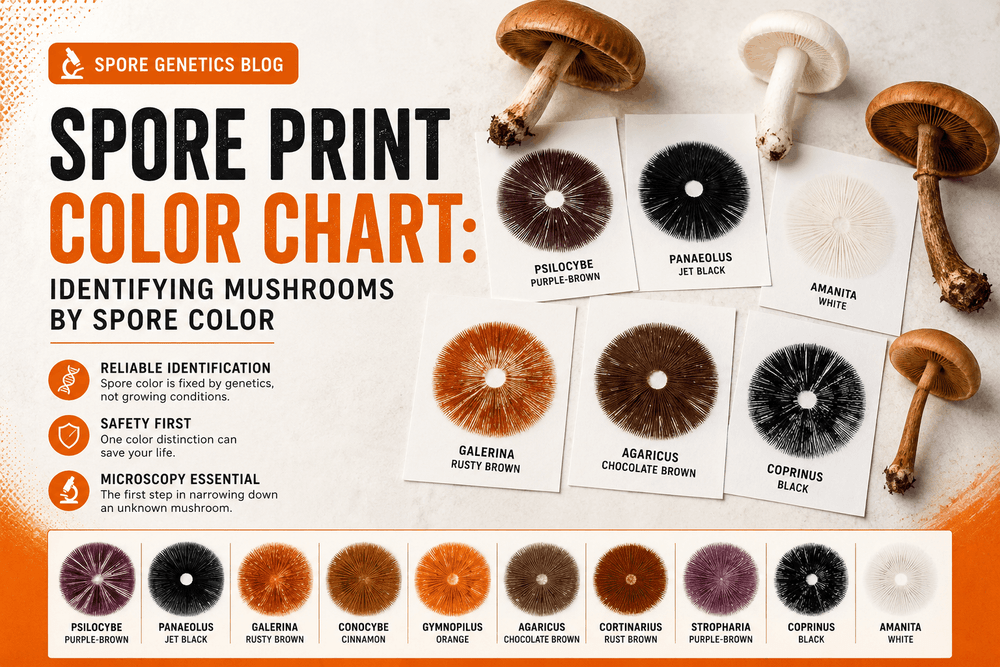
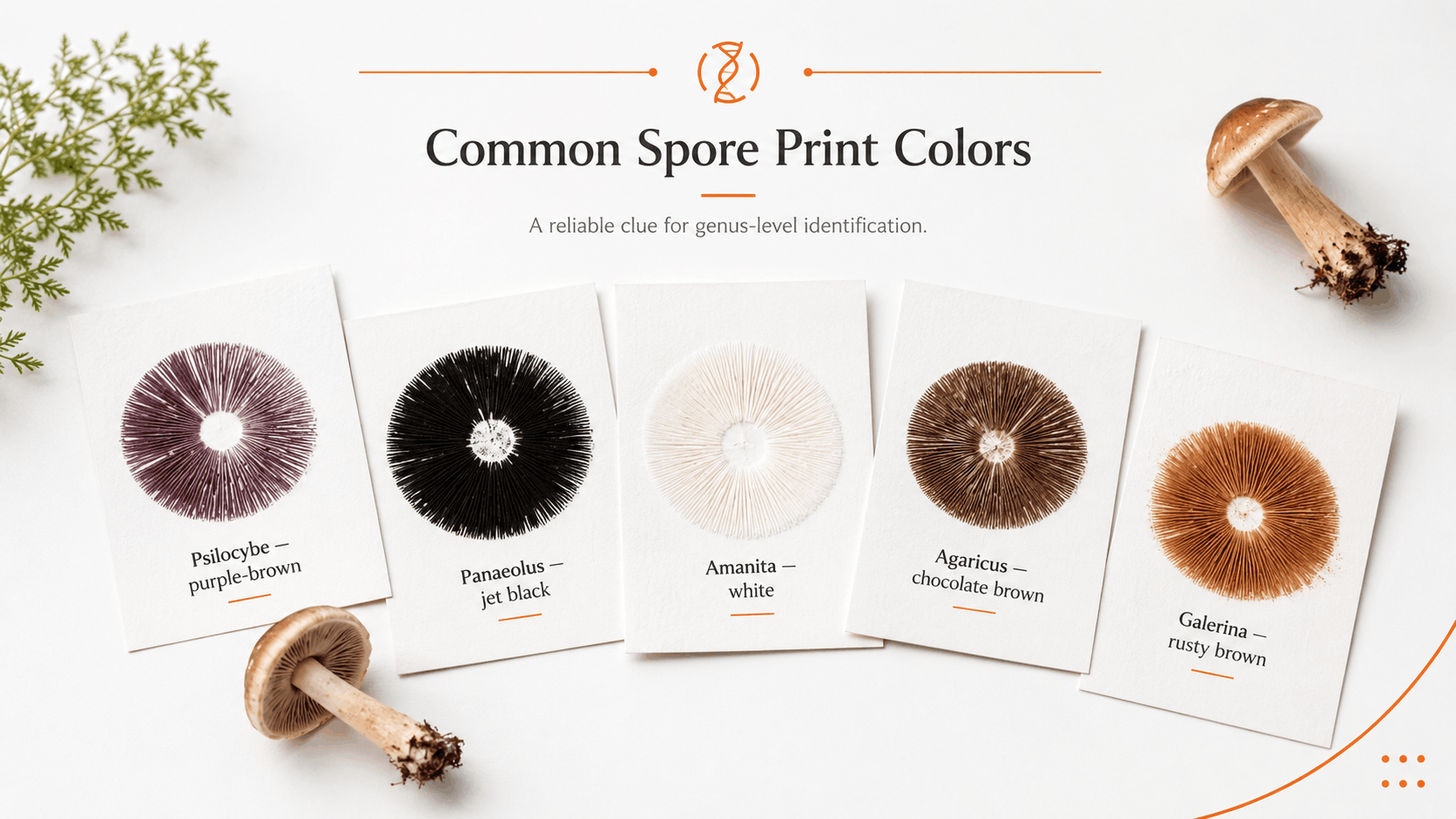
Spore print color is one of the most reliable identification features in mycology. Psilocybe species produce a dark purple-brown to purple-black print; Panaeolus prints jet black; Amanita prints white; Agaricus prints chocolate brown; and the deadly Galerina prints rusty brown. Because spore color is fixed by genetics rather than growing conditions, it stays consistent even when cap color, size, and shape vary widely.
Below is a full reference chart by genus, a closer look at Psilocybe prints, and the one color distinction that matters more than any other for safety.
Why Spore Print Color Matters
A mushroom's outward appearance is unreliable. Cap color fades with age and sun exposure, size depends on substrate and moisture, and shape changes as the fruit matures. Spore color doesn't move — it's a genetic trait, which is exactly why taxonomists lean on it so heavily.
That's also why a spore print is usually the first step in narrowing an unknown mushroom down to a genus. It won't get you to a species on its own, but it eliminates most of the field in a single observation. For the full method, see our guide on how to use a spore print.
Spore Print Color Chart by Genus
| Genus / Group | Spore Print Color | Notes |
|---|---|---|
| Psilocybe | Dark purple-brown to purple-black | Cubensis, azurescens, cyanescens |
| Panaeolus | Jet black | Darker than Psilocybe — a key separator |
| Galerina | Rusty brown | Deadly poisonous |
| Conocybe | Rusty brown to cinnamon | Some species deadly |
| Gymnopilus | Orange to rusty brown | Bright orange caps |
| Cortinarius | Rust brown | Largest genus of gilled fungi |
| Agaricus | Chocolate to dark brown | Button, cremini, portobello |
| Stropharia | Purple-brown | Wine caps; close to Psilocybe |
| Coprinus / Coprinellus | Black | Inky caps; gills deliquesce |
| Amanita | White | Includes death cap & destroying angel |
| Pleurotus | White to pale lilac-grey | Oyster mushrooms |
| Lentinula | White | Shiitake |
| Hericium | White | Lion's Mane |
| Ganoderma | Brown | Reishi |
| Russula / Lactarius | White to yellow-ochre | Brittle gills |
| Entoloma / Volvariella | Pink to salmon | Distinctive; some Entoloma toxic |
| Boletus | Olive-brown | Pored, not gilled |
Psilocybe Spore Print Color
Psilocybe species — including Psilocybe cubensis, azurescens, and cyanescens — consistently produce a dark purple-brown to purple-black print. Under good light on white paper, the purple undertone is unmistakable once you've seen it.
Importantly, this holds across strains. Golden Teacher, B+, Penis Envy, and every other cubensis variety print the same purple-brown, because they're all the same species. Strain differences show up in cap color, morphology, and growth habit — not in spore color.
The one nuance is albino and leucistic strains. Reduced-pigment varieties like Albino Penis Envy produce noticeably paler, fainter prints, and near-albino specimens can print so lightly they're hard to read at all. That's a pigment expression, not a different species.
The Most Important Distinction: Purple-Brown vs. Rusty Brown
If you take one thing from this chart, make it this one.
Galerina marginata — the deadly galerina — grows in the same wood-chip and forest habitats as wood-loving Psilocybe species, and superficially resembles them. It contains amatoxins, the same class of compounds found in the death cap, and poisonings have occurred from confusion between the two.
The spore print separates them cleanly: Psilocybe prints purple-brown; Galerina prints rusty brown. Held side by side the difference is obvious, but from memory it's easy to get wrong — which is exactly why a fresh print on white paper matters.
The same applies to Conocybe, another rusty-brown-spored genus containing dangerously toxic species. Rusty brown is a stop sign. And spore color alone is never sufficient for a foraging decision — it's one feature among many, and identification for consumption should always involve an experienced mycologist.
How to Read Spore Print Color Accurately
A few practical points that make the difference between a readable print and a useless one:
- Use white paper — or half white, half black, so you can read both pale and dark prints.
- Judge in natural light. Incandescent and LED bulbs shift purples toward brown and can flip your call.
- Get a thick deposit. A thin print reads lighter than the true color; give it several hours to overnight.
- Check it fresh. Some prints darken slightly as they dry.
- Compare against a known reference whenever you can — relative comparison beats memory.
Storing Spore Prints
Once you have a good print, a foil-sealed print kept cool, dark, and dry is the longest-lasting way to archive genetics — considerably more durable than a syringe. For full shelf-life and storage detail, see our guide on how to store mushroom spores and how long they last, or compare formats in spore syringe vs spore print.
If you'd rather start from a professionally prepared deposit, browse our mushroom spore prints, or explore mushroom spores and isolated spore syringes for microscopy work.
Frequently Asked Questions
What color is a Psilocybe spore print?
Dark purple-brown to purple-black. This is consistent across all Psilocybe species and all cubensis strains, though albino and leucistic varieties print noticeably paler.
What color spore print do magic mushrooms have?
Psilocybe species print purple-brown to purple-black, while Panaeolus species (such as Pan Cyan) print jet black. The distinction between the two is a useful genus-level separator.
Why is spore print color used for identification?
Because it's genetically fixed. Cap color, size, and shape all shift with age and environment, but spore color stays constant — making it one of the most dependable features available without a microscope.
What's the difference between a Psilocybe and a Galerina spore print?
Psilocybe prints purple-brown; the deadly Galerina marginata prints rusty brown. They share habitat and look broadly similar, so this distinction is a critical safety check.
Does spore print color vary between cubensis strains?
No. Every Psilocybe cubensis strain prints purple-brown, because they're all one species. Only pigment-reduced (albino and leucistic) varieties differ, printing paler.
Can I identify a mushroom from spore print color alone?
No. Spore color narrows the field to a genus or group, but species-level identification needs habitat, morphology, bruising reaction, and often microscopy. Never rely on a single feature.
Disclaimer: This chart is educational reference material for mycology, taxonomy, and microscopy. It is not a foraging guide and must not be used as the sole basis for determining whether any mushroom is safe to eat. Many toxic and deadly species closely resemble edible ones, and misidentification can be fatal. Always consult an experienced mycologist before consuming any wild mushroom. Spores sold by Spore Genetics are supplied strictly for microscopy, taxonomy, and research purposes.