Texas Magic Mushrooms: Species, Habitat & Range
Posted by Spore Genetics Research Team on Jun 5th 2023
Texas Magic Mushrooms: Species, Habitat & Range
Texas — with its humid Gulf Coast and vast expanses of cattle country — is one of the most reliable regions in the United States for wild Psilocybe cubensis, the warm-climate psilocybin mushroom old-timers there nicknamed the “Texas yellow cap.” But the state's size means its mushrooms are concentrated where the climate allows. Here's which species occur, where in Texas they grow, and how they're studied.
This covers natural range and ecology, not foraging. Texas pastures hold dangerous look-alikes alongside the actives, so read the safety section below.
Why the Texas Gulf Coast Is Prime Cubensis Range
Wild Psilocybe cubensis needs sustained heat, humidity, and grazing animals — and the Texas Gulf Coast and South Texas deliver all three. Warm subtropical air, frequent rain, and one of the largest cattle industries in the country make the eastern and coastal parts of the state a natural stronghold for dung-loving cubensis. This is the same warm-South pattern as Arkansas, and the opposite of the cool, wood-loving Pacific Northwest. For the national picture, see where magic mushrooms grow.
The Key Species of Texas
Psilocybe cubensis (“Texas Yellow Cap”)
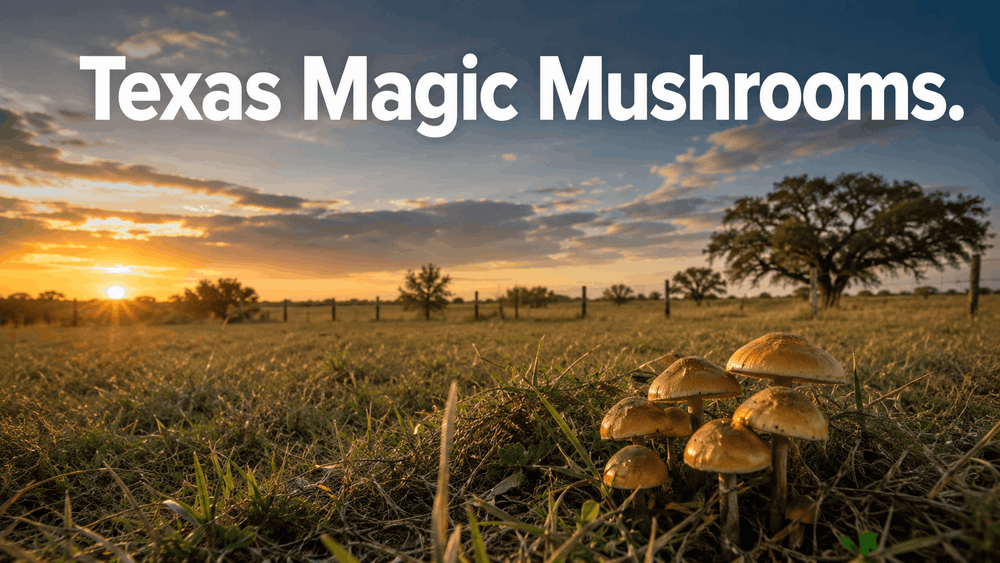
The headline species, and the reason Texas is on every distribution map. Psilocybe cubensis fruits on herbivore dung in the state's warm, humid pastures, and its golden-brown caps earned it the enduring local nickname “Texas yellow cap.” It prints dark purple-brown and bruises blue where handled. Explore the many cultivated lines as microscopy specimens in our mushroom spores collection — including the classic Golden Teacher — and read our Psilocybe cubensis guide.
Panaeolus cyanescens (Pan Cyan)
A warm-climate, dung-loving species suited to the humid Gulf Coast, Panaeolus cyanescens is slender and fast-fruiting and prints jet black. Study it as our Panaeolus cyanescens Estero spore syringe.
Panaeolus cinctulus (Banded Mottlegill)
A widespread dung- and compost-loving species found in lawns, gardens, and manured ground across much of Texas.
Gymnopilus Species
In Texas woodlands, wood-rotting Gymnopilus species appear on stumps and logs — orange-capped and rusty-brown-spored, a print color that matters for safety (below).
Where in Texas They Grow
Because Texas spans wildly different climates, its psilocybin mushrooms are far from evenly distributed. The humid eastern third, the Gulf Coast, and South Texas cattle country are the productive zones — warm and wet enough for cubensis. The arid west, the Panhandle, and the drier Hill Country largely can't support it: without sustained humidity, wild cubensis drops off sharply. In Texas, the honest answer to “do they grow near me?” depends almost entirely on local climate.
The Safety Rule for Texas Pastures
Dung is one of the richest fungal habitats on earth, and most of what grows there is not psychoactive. Harmless purple-brown-spored species like Protostropharia semiglobata print the same color as cubensis, so a print alone won't separate them — only the active species bruise blue. The real danger is rusty-brown-spored mushrooms: some Conocybe in grass and dung carry the same deadly amatoxins as the death cap. Rusty brown is a hard stop. See our spore print color chart and our guide to deadly look-alikes.
When They Fruit
Texas cubensis fruits through the warm, rainy months, appearing in pastures a day or two after warm rain rather than on a set schedule. This is ecology, not a treasure map — and pasture foraging carries genuine toxic-look-alike risk.
Studying Texas Species
Because the spores contain no psilocybin, they're studied legally as microscopy and taxonomy specimens across most of the country — the safe way to explore the state's species without any identification risk. Browse our mushroom spores and isolated spore syringes, and see how to study spores under a microscope. For the legal picture, see are mushroom spores legal.
Frequently Asked Questions
What magic mushrooms grow in Texas?
Texas's warm, humid regions favor dung-loving species, led by Psilocybe cubensis (the “Texas yellow cap”), along with Panaeolus cyanescens, Panaeolus cinctulus, and wood-rotting Gymnopilus.
What is a Texas yellow cap?
“Texas yellow cap” is a long-standing local nickname for wild Psilocybe cubensis, referring to its golden-brown caps as they occur in Texas pastures.
Does Psilocybe cubensis grow wild in Texas?
Yes — the Gulf Coast and South Texas cattle country are among the most reliable wild cubensis range in the U.S. Fruiting follows warm rain in grazed pastures.
Where in Texas do magic mushrooms grow?
Mainly the humid eastern third, the Gulf Coast, and South Texas. The arid west and Panhandle are generally too dry to support wild cubensis.
Are magic mushrooms legal in Texas?
No — psilocybin is federally Schedule I and Texas has not decriminalized it, so psilocybin mushrooms are illegal in the state. Mushroom spores, which contain no psilocybin, are used legally for microscopy in most states; see our legality guide.
Disclaimer: This article is educational and covers natural species range and taxonomy — it is not a foraging guide. Texas pasture and dung habitats contain toxic and potentially deadly species alongside harmless ones. Never consume any wild mushroom without expert confirmation. Psilocybe spores sold by Spore Genetics are provided strictly for microscopy, taxonomy, and research. We ship to every U.S. state except Georgia and Idaho.