Galerina marginata (Funeral Bell): The Deadly Psilocybe Look-Alike
Posted by Spore Genetics Research Team on May 14th 2023
Galerina marginata (Funeral Bell): The Deadly Psilocybe Look-Alike
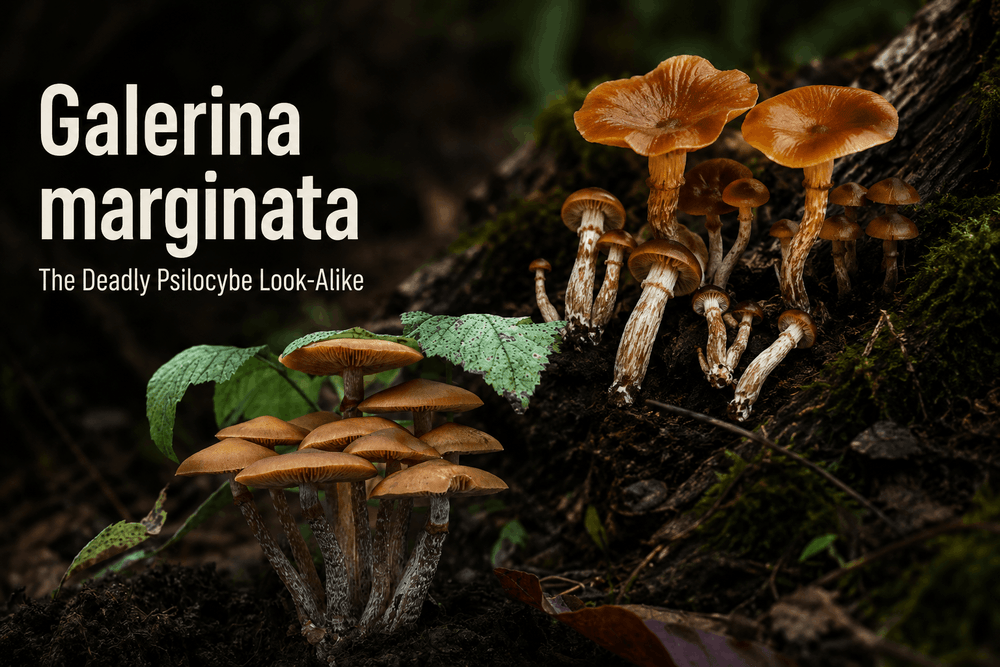
Galerina marginata — commonly called the funeral bell or autumn skullcap — is a small brown wood-rotting mushroom that contains the same amatoxins found in the death cap. It is one of the most dangerous look-alikes to wood-loving Psilocybe species, and mistaking one for the other can be fatal. This is exactly why spore print color, microscopy, and multiple confirmed features — never a single visual impression — matter so much.
Anyone studying wood-loving psilocybes should know this mushroom cold. Here’s what Galerina marginata is, the several names it goes by, why it’s so dangerous, and the features that separate it from the Psilocybe species it grows alongside.
What Is Galerina marginata?
Galerina marginata is a small, brown, wood-rotting mushroom found across the Northern Hemisphere, fruiting on decaying logs, stumps, and buried wood — often in the cooler months of autumn. It has a slender stem, a thin ring, and a modestly sized brown cap that fades as it dries. Its innocuous “little brown mushroom” appearance hides the real danger: it contains amatoxins, the same class of deadly compounds responsible for most fatal mushroom poisonings worldwide.
The Many Names: Funeral Bell, Autumn Skullcap & Galerina autumnalis
One mushroom, several names — which is part of why it causes confusion. The species is most often called the funeral bell, a nod to how deadly it is, or the autumn skullcap, after its brown, bell-to-skullcap-shaped cap and its cool-season fruiting. You will also see it listed under the older name Galerina autumnalis.
That last name matters for anyone reading older field guides. Galerina autumnalis, Galerina oregonensis, and several other once-separate names have since been folded into a single species — Galerina marginata — after genetic work showed they were all the same mushroom. So if a guide describes a deadly “autumn skullcap” or “Galerina autumnalis,” it is describing exactly the mushroom covered here. Different label, same amatoxins.
Why It’s So Dangerous
Amatoxins are not destroyed by cooking, freezing, or drying, and symptoms are notoriously delayed — often appearing 6 to 24 hours after ingestion, by which point serious liver damage may already be underway. There is no simple home test. A mushroom the size of a fingernail can carry a medically significant dose. The nickname “funeral bell” is not an exaggeration.
Why It Gets Confused With Psilocybe
The danger is specifically about habitat and appearance overlap. Galerina is a wood-loving mushroom, and so are several psilocybin species — Psilocybe cyanescens, azurescens, allenii, and ovoideocystidiata all fruit on wood chips, mulch, and woody debris. Galerina can grow in the very same beds, at the same time of year, and to the untrained eye a small brown Galerina and a small brown wood-loving Psilocybe can look broadly similar. That overlap — same substrate, same season, similar size and color — is exactly what makes this the classic deadly mix-up.
How to Tell Them Apart
No single feature is a safe test, but these are the distinctions that matter most:
| Feature | Galerina marginata | Wood-loving Psilocybe |
|---|---|---|
| Spore print | Rusty brown | Dark purple-brown to purple-black |
| Blue bruising | None | Usually bruises blue where handled |
| Ring | Thin ring on stem, often dusted rusty by falling spores | Varies by species; veil remnants may be present |
| Definitive check | Microscopy — spore size, shape, and ornamentation separate them reliably | |
The single most useful signal is the spore print. Galerina drops a rusty brown print; psilocybin species drop dark purple-brown. That one difference eliminates most of the risk on paper — and it’s why a rusty-brown print is treated as a hard stop. Our spore print color chart shows exactly where each genus falls, and because Galerina does not contain psilocybin, it also does not show the blue bruising reaction that most active species do.
Why This Is a Microscopy Story, Not a Foraging One
Here is the honest takeaway: the reliable way to separate Galerina from a wood-loving Psilocybe is a spore print plus microscopy, not a glance in the field. Their macroscopic overlap is real, the consequences of error are fatal, and delayed symptoms mean a mistake isn’t obvious until it’s too late. This is precisely why the responsible study of these species happens under the microscope with known reference material — examining spores under magnification — rather than by picking small brown mushrooms off a log. It’s also why every product we supply is intended for microscopy and taxonomy.
The Other Deadly Look-Alike: Conocybe filaris
Galerina isn’t alone. The other amatoxin-containing mushroom worth knowing by name is Conocybe filaris (now often placed in the genus Pholiotina). It carries the same class of deadly toxins as Galerina and the death cap, but it favors a different habitat: lawns, grass, and mossy ground rather than wood. That puts it in overlap with grassland psilocybin species and with anything growing in a suburban yard.
Like Galerina, Conocybe filaris is small, brown, and forgettable-looking, with a thin ring on the stem — and like Galerina, it drops a rusty brown spore print, not the purple-brown of a Psilocybe. The pattern is consistent enough to build a rule around it: a small brown mushroom with a rusty-brown print is a hard stop, whether it’s on wood or in grass.
The broader lesson holds across all of them: “small and brown” is not an identification, and habitat overlap with psilocybin species is common. For the wider picture of how the psilocybin species are grouped and told apart, see our guide to the types of magic mushrooms.
Frequently Asked Questions
What is Galerina marginata?
It’s a small brown wood-rotting mushroom, also called the funeral bell or autumn skullcap, found across the Northern Hemisphere. It contains deadly amatoxins — the same toxins as the death cap.
Is Galerina marginata deadly?
Yes. It contains amatoxins that can cause fatal liver failure, symptoms are delayed by many hours, and the toxins are not destroyed by cooking or drying. It is genuinely one of the most dangerous mushrooms to mistake for anything else.
What is the funeral bell mushroom?
“Funeral bell” is a common name for Galerina marginata, referring to how deadly it is. “Autumn skullcap” is another common name for the same mushroom, after its brown cap and cool-season fruiting.
Is Galerina autumnalis the same as Galerina marginata?
Yes. Galerina autumnalis is an older name that has been folded into Galerina marginata — genetic work showed several once-separate names were all the same species. Older field guides may still use the autumnalis name for it.
Why is Galerina confused with magic mushrooms?
Because it’s a wood-loving mushroom that shares substrate, season, and general small-brown appearance with wood-loving Psilocybe species like cyanescens and azurescens. They can grow in the same wood-chip beds at the same time of year.
How do you tell Galerina from a Psilocybe?
The clearest single difference is the spore print — rusty brown for Galerina, dark purple-brown for Psilocybe. Galerina also does not bruise blue. Definitive separation is done by microscopy, and no single field feature should be relied on.
What is Conocybe filaris?
Conocybe filaris (sometimes placed in Pholiotina) is another deadly amatoxin-containing little brown mushroom. Unlike Galerina it favors lawns and grassy ground rather than wood, but it shares the same rusty-brown spore print and the same lethal toxins.
Does Galerina bruise blue?
No. Blue bruising comes from psilocin, which Galerina does not contain. A wood-loving little brown mushroom that does not bruise blue and drops a rusty-brown print is a serious warning sign.
Study wood-loving species safely as microscopy specimens — browse our exotic and wood-lover spores or all mushroom spores.
Disclaimer: This article is educational and is emphatically not a foraging guide. Galerina marginata, Conocybe filaris, and other amatoxin-containing mushrooms are deadly, and several share habitat and appearance with psilocybin species. Never consume a wild mushroom without expert confirmation. Psilocybe spores sold by Spore Genetics are intended strictly for microscopy, taxonomy, and research. We ship to every U.S. state except Georgia and Idaho.