
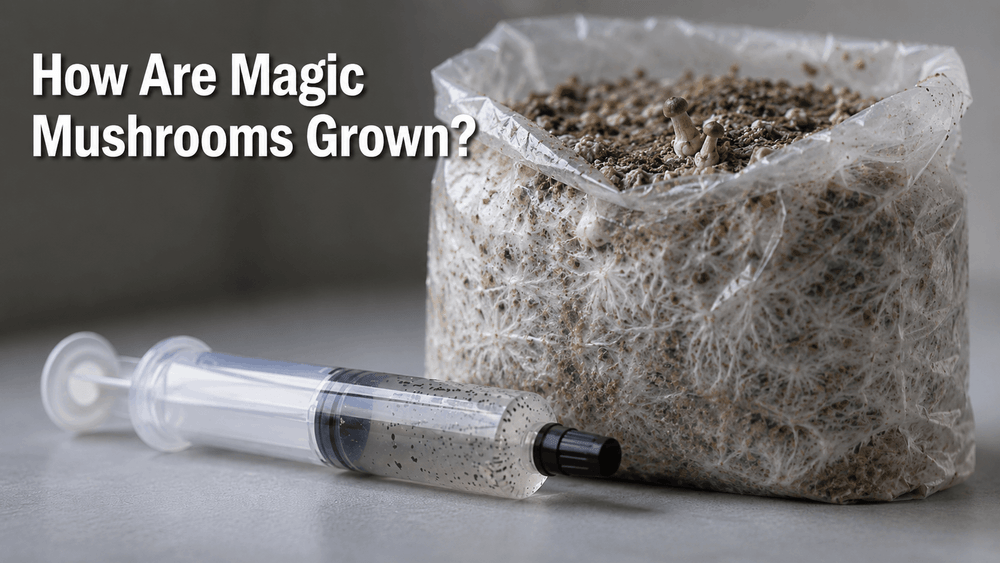
How Are Magic Mushrooms Grown? The Cultivation Process & the Law
Posted by Spore Genetics Research Team on Jun 23rd 2023
How Are Magic Mushrooms Grown? The Cultivation Process & the Law
“How are magic mushrooms grown?” is one of the most common questions in mycology—and the honest answer has two sides. There's the biology, which is the same remarkable lifecycle behind every cultivated mushroom, and there's the law, which draws a hard line at psilocybin. This guide covers both clearly, so you understand the process, where it's legal, and why the spores we supply are strictly for microscopy.
Let's break down how mushrooms are grown, what the law actually says about psilocybin species, and which mushrooms you can legally cultivate at home.
The Mushroom Lifecycle: From Spore to Fruiting Body
Every mushroom follows the same basic lifecycle, and understanding it is the foundation of mycology:
- Spore — the microscopic reproductive cell, the starting point of the whole cycle.
- Germination — under the right moisture and temperature, a spore germinates and sends out thread-like hyphae. (For timing, see our guide on how long spores take to germinate.)
- Mycelium — the hyphae branch and fuse into mycelium, the white, root-like network that is the living body of the fungus.
- Colonization — the mycelium spreads through its food source (its “substrate”), consuming nutrients as it grows.
- Pinning & fruiting — triggered by environmental changes, the mycelium forms tiny primordia (“pins”) that mature into the mushrooms we recognize—the fruiting bodies.
- Spore release — the mature mushroom releases new spores, and the cycle begins again.
This lifecycle is universal—the same whether you're looking at a gourmet oyster mushroom or any other species. For the deeper biology, see our guide to fungi and the mushroom life cycle.
Can You Legally Grow Magic Mushrooms?
Here's the part that matters most. In the United States, psilocybin and psilocin are Schedule I controlled substances, and cultivating psilocybin mushrooms is treated as manufacturing a controlled substance—a serious crime under federal law and in most states. Critically, this holds true even if you start from spores that were legal to purchase: the spores themselves contain no psilocybin, but the moment they're germinated and grown into mushrooms, psilocybin is produced and the law is crossed.
This is exactly why Spore Genetics sells spores strictly for microscopy and taxonomy research, and why we don't provide instructions for cultivating psilocybin mushrooms. For the full breakdown of the law, see our guide: Are Magic Mushroom Spores Legal?
The Legal Way to Study Psilocybin Species: Microscopy
If your interest is in psilocybin mushrooms, the legal path is microscopy—studying the spores themselves rather than growing mushrooms. Under a microscope, spores reveal the size, shape, color, and structural features taxonomists use to tell species apart. It's a genuinely fascinating, research-focused hobby, and it's the intended use of every spore syringe and print in our mushroom spores collection. If you're getting started, our guide on how to study spores under a microscope and our spore print color chart are the place to begin.
Mushrooms You Can Legally Grow at Home
The good news for anyone who wants to actually cultivate mushrooms: there's a whole world of legal gourmet and functional species that are rewarding, delicious, and completely legal to grow. They follow the exact same lifecycle described above, so you learn all the same skills. Popular beginner-friendly choices include:
- Oyster mushrooms — the fastest and most forgiving; start from a blue oyster liquid culture.
- Lion's mane — a gourmet and functional favorite; try a lion's mane liquid culture.
- Shiitake — rich and savory; grown from a shiitake liquid culture.
Browse the full range in our gourmet cultures collection, and for a complete walkthrough of the process, see our mushroom cultivation guide and liquid culture guide.
What About Grow Kits and Spore Syringes?
You'll see “grow kits” and spore syringes marketed widely, so it's worth being clear on the distinction. Legal grow kits and cultures are for gourmet and functional species like oyster and lion's mane. Spore syringes for psilocybin species, by contrast, are sold—and should only be used—for microscopy, not cultivation. Starting from a legal gourmet liquid culture is the simplest way for a beginner to grow real mushrooms at home.
Frequently Asked Questions
How are magic mushrooms grown?
All mushrooms follow the same lifecycle—spore, germination, mycelium, substrate colonization, and fruiting. However, cultivating psilocybin (“magic”) mushrooms is illegal in most places, which is why psilocybin spores are sold for microscopy study rather than cultivation.
Can you grow magic mushrooms legally?
In the U.S., no—cultivating psilocybin mushrooms is treated as manufacturing a controlled substance, even if you start from legally purchased spores. The spores are legal for microscopy because they contain no psilocybin; growing them into mushrooms is where the law is crossed.
Can you grow mushrooms from a spore syringe?
A spore syringe contains the spores that begin the lifecycle, but for psilocybin species it's for microscopy only. For legal gourmet species, growers typically start from a liquid culture rather than spores, since it's faster and more consistent.
What mushrooms can I legally grow at home?
Gourmet and functional species like oyster, lion's mane, shiitake, and reishi are completely legal to cultivate and are perfect for beginners. They follow the same lifecycle as any mushroom.
Is it illegal to grow mushrooms from spores?
It depends on the species. Growing legal gourmet mushrooms is fine; germinating and cultivating psilocybin mushrooms is illegal, even from legally purchased spores.
Disclaimer: This article is educational and is not a cultivation guide for psilocybin mushrooms. Psilocybin and psilocin are Schedule I controlled substances, and cultivating psilocybin mushrooms is illegal under federal law and in most states. Spore Genetics sells spores strictly for microscopy and taxonomy research. We ship to every U.S. state except Georgia and Idaho.