
Lion's Mane Mushroom: Benefits, Uses & How to Grow It
Posted by Spore Genetics Research Team on May 11th 2023
Lion's Mane Mushroom: Benefits, Uses & How to Grow It
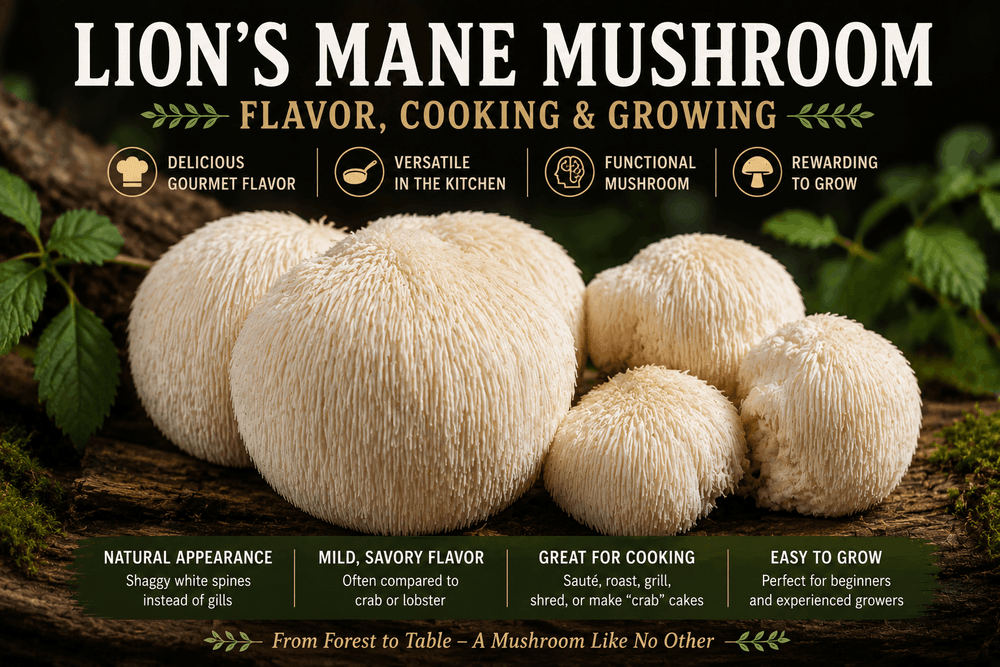
Lion's mane (Hericium erinaceus) is a distinctive gourmet and functional mushroom named for its shaggy, cascading white spines that resemble a lion's mane. It's prized in two worlds at once—in the kitchen for its tender, seafood-like flavor often compared to crab or lobster, and in wellness for its association with cognitive and nervous-system support. It's also one of the most rewarding functional mushrooms to grow at home.
Few mushrooms are as unmistakable—or as versatile—as lion's mane. Here's a complete guide to what it is, its benefits, how it tastes, and how to grow your own.
What Is Lion's Mane?
Lion's mane (Hericium erinaceus) is a gourmet and functional mushroom that looks like nothing else: instead of a cap and gills, it forms a rounded white mass of long, soft, dangling spines. It grows naturally on hardwood trees and has been enjoyed both as food and in traditional wellness practices for centuries. Its striking appearance and versatility have made it a favorite among chefs, home growers, and the functional-mushroom community alike.
The Compounds Behind the Benefits
Lion's mane owes its reputation to a specific and fairly unusual set of natural compounds:
- Hericenones & erinacines — compounds fairly unique to lion's mane, and the focus of research into nerve growth factor (NGF) and nervous-system health. Hericenones are concentrated in the fruiting body, erinacines in the mycelium.
- Beta-glucans — water-soluble polysaccharides found across functional mushrooms, most studied for immune support.
- Antioxidants — which round out its general wellness profile.
Because some of these compounds are fat- and alcohol-soluble while others are water-soluble, how lion's mane is prepared affects how much of its full profile you actually get—a point we'll return to below.
Lion's Mane Benefits
Lion's mane is one of the most researched functional mushrooms. Here's what research and traditional use suggest—framed honestly, because these are areas of ongoing study rather than established medical treatments. It's best thought of as a supportive addition to a healthy lifestyle, not a treatment.
Focus, Memory & Mental Clarity
Lion's mane is best known for its association with cognition. Its hericenones and erinacines have drawn scientific interest for supporting focus, memory, and mental clarity—the qualities that have made it the signature “brain” mushroom and a staple of nootropic routines.
Nerve & Brain Health
The compound story centers on nerve growth factor (NGF), a protein important to the growth and maintenance of neurons. Lion's mane compounds have been studied for their relationship to NGF and neuroprotection—an active and promising research area, though one still maturing in human studies.
Mood & Wellbeing
Some research has explored lion's mane in connection with mood and general wellbeing. The findings are early and encouraging rather than conclusive.
Immune & Everyday Wellness
Like other functional mushrooms, lion's mane provides beta-glucans studied for immune support, plus antioxidants. You can explore it alongside other functional species in our medicinal mushrooms collection, and read more in our guide to the therapeutic benefits of mushrooms.
What the Research Does — and Doesn't — Show
Lion's mane has a genuinely active and promising body of research, especially around its NGF-related compounds. But it's worth being straight: much of the strongest evidence still comes from cell and animal studies, and human trials—while growing—aren't yet conclusive. Lion's mane is best viewed as a supportive addition to a healthy lifestyle rather than a treatment for any condition. Consult a healthcare provider before starting any new wellness regimen.
What Does Lion's Mane Taste Like?
This is a big part of its appeal: lion's mane has a mild, subtly sweet, savory flavor and a tender, stringy texture that's frequently compared to crab or lobster meat. That seafood-like quality makes it a popular plant-based substitute in dishes where you'd want a delicate, flaky protein—lion's mane “crab cakes” are a well-loved example.

How to Cook Lion's Mane
Lion's mane is wonderfully easy to cook and takes on flavor beautifully:
- Pan-seared — slice into “steaks” and sear in butter until golden; the texture crisps outside and stays tender within.
- “Crab” cakes — shredded and bound into cakes for a classic seafood-style dish.
- Sautéed — torn into pieces and browned with garlic and butter.
- Roasted — brushed with oil and roasted until golden at the edges.
The key with lion's mane is to cook it long enough to release its moisture and let it brown—this concentrates the flavor and develops that signature seafood-like texture.
How to Take Lion's Mane as a Supplement
Beyond the plate, lion's mane is taken as a powder or—most popularly—a concentrated extract. Here's the quality detail: because its active compounds split between fat/alcohol-soluble (the hericenones) and water-soluble (the beta-glucans), a proper dual extract, made with both, captures the fullest range. It's the main thing to look for. (Our guide to mushroom tinctures explains the process.)
That's exactly how our Mycogen Neuro Balance lion's mane extract is made—dual-extracted from 100% fruiting bodies and finished alcohol-free, formulated for daily focus and clarity, as part of our mushroom extracts line. Lion's mane also features in our five-mushroom Full Spectrum blend.
Growing Lion's Mane at Home
Lion's mane is a satisfying species to cultivate and grows well on supplemented hardwood-based substrates. The easiest way to begin is with a liquid culture of a known strain—our Lion's Mane Liquid Culture comes ready to inoculate your substrate. Like other Hericium species, lion's mane leaves a white spore print, though most growers start from a liquid culture for speed and strain consistency. If you're new to working with LC, our mushroom liquid culture guide walks through the basics, and you can browse more varieties in our gourmet cultures collection.
Frequently Asked Questions
What is lion's mane mushroom?
It's a gourmet and functional mushroom (Hericium erinaceus) with a distinctive appearance—a white mass of soft, cascading spines—and a mild, seafood-like flavor.
What are the benefits of lion's mane?
Lion's mane is best known for its association with cognitive and nervous-system support—focus, memory, and clarity—thanks to compounds called hericenones and erinacines. It also provides beta-glucans and antioxidants. It's best viewed as a supportive wellness addition, not a treatment; consult a healthcare provider before starting any regimen.
What compounds are in lion's mane?
Its most notable compounds are hericenones and erinacines—fairly unique to the species and studied for their link to nerve growth factor—along with beta-glucans and antioxidants.
How do you take lion's mane for cognitive support?
Most people take it as a daily dual-extract tincture or powder; a dual extract captures both its fat-soluble and water-soluble compounds. It can also simply be enjoyed as food.
How long does lion's mane take to work?
Like most functional mushrooms, it's taken consistently over weeks as a cumulative supplement rather than a fast-acting remedy.
Is lion's mane safe? Are there side effects?
Lion's mane is generally well tolerated; some people notice mild digestive upset. Check with a healthcare provider if you're pregnant, nursing, taking medication, or managing a medical condition.
What does lion's mane taste like?
Mild, subtly sweet, and savory, with a tender texture often compared to crab or lobster—which is why it's popular as a plant-based seafood substitute.
How do you cook lion's mane?
It's excellent pan-seared as “steaks,” shredded into “crab” cakes, sautéed, or roasted. Cook it until it releases moisture and browns to develop its best flavor and texture.
Is lion's mane easy to grow?
Yes—it grows well on hardwood-based substrates, and starting from a liquid culture makes the process straightforward for beginners.
Disclaimer: Lion's mane cultures are intended for legal gourmet cultivation. Information here is educational and not medical advice—consult a healthcare provider before beginning any wellness regimen. Always source edible mushrooms from a trusted supplier or grow from a known culture; never consume wild mushrooms without expert identification.