
How Long Do Mushroom Spores Take to Germinate? Full Timeline
Posted by Spore Genetics Research Team on Mar 23rd 2026
How Long Do Mushroom Spores Take to Germinate? (Full Timeline)
Quick Answer
If you’re wondering how long mushroom spores take to germinate, the answer depends on time, conditions, and natural variability—but in most cases, early stages show no visible growth.
Mushroom spores typically take 3 to 14 days to germinate, though in some cases it can take longer depending on environmental conditions, genetics, and substrate quality.
In many cases, spores are already developing—you just may not see visible mycelium yet.
Introduction
One of the most common questions in mycology research is:
“How long do mushroom spores take to germinate?”
After inoculation, it’s easy to expect fast results—but spores operate on a natural biological timeline. Unlike liquid culture, spores must first germinate and pair before forming visible mycelium.
Understanding what happens during each stage can help you avoid unnecessary concern and better interpret your results.
The Full Spore Germination Timeline
Days 1–3: No Visible Changes
- Spores are hydrating and activating
- No visible growth is expected
- Internal biological processes begin
At this stage, everything is happening microscopically.
Days 3–7: Early Germination Begins
- Spores begin germinating and pairing
- Initial mycelium may begin forming
- Still often not visible to the eye
This is where many researchers assume something is wrong—but it’s still early.
Days 7–14: Visible Mycelium Appears
- White mycelium may start to become visible
- Growth begins expanding outward
- Colonization becomes easier to track
This is when most people first notice progress.
2+ Weeks: Slower Development (Still Normal)
- Some strains take longer to establish
- Environmental conditions may slow progress
- Growth may appear delayed but still viable
Not all successful results follow the same timeline.
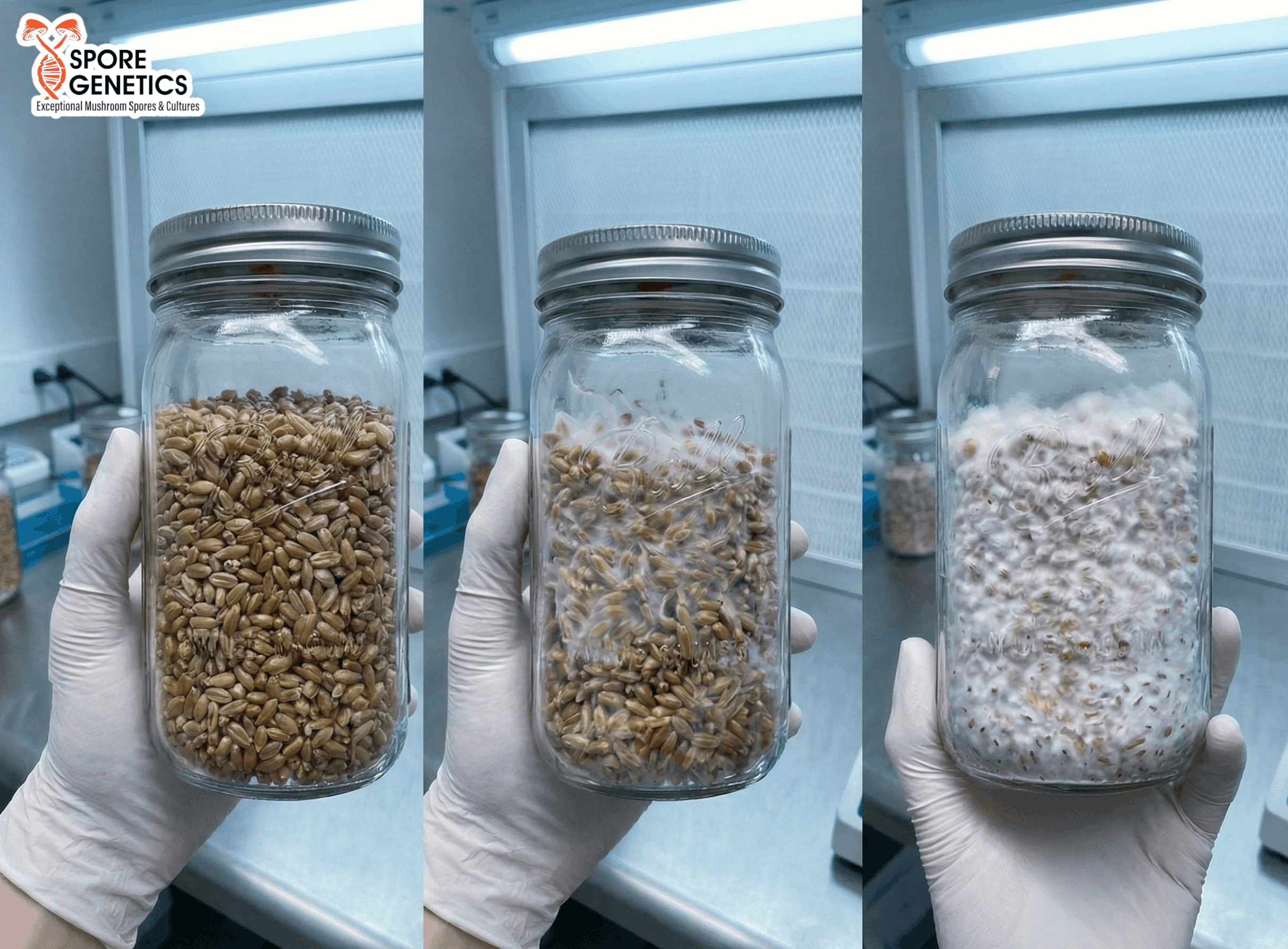
Example progression from no visible growth to early and fully developed mycelium.
What Affects Spore Germination Speed?
Several factors influence how quickly spores germinate:
Temperature
- Ideal range: 70–75°F (21–24°C)
- Lower temps slow activity
- Higher temps increase contamination risk
Moisture Levels
- Proper hydration is essential
- Too dry → no germination
- Too wet → bacterial competition
Spore Distribution
- Spores settle in solution over time
- Always shake your syringe thoroughly
- Even distribution improves consistency
Genetics
- Not all spores germinate at the same rate
- Some pairings take longer than others
- Variability is completely natural
When Should You Be Concerned?
It’s normal to see no visible growth for up to 1–2 weeks.
You may want to reassess if:
- There is no activity after 3+ weeks
- Conditions have been inconsistent
- Contamination is suspected
If you’re unsure, it may help to review common issues in our guide on why your spores aren’t germinating.
Common Mistakes That Slow Germination
- Not shaking the syringe before use
- Using inconsistent temperatures
- Over- or under-injecting
- Expecting liquid culture speed
- Disturbing early stages too often
Spore Syringes vs Liquid Culture (Speed Difference)
It’s important to understand:
- Spore syringes require germination + pairing
- Liquid culture is already active mycelium
This is why liquid culture typically shows faster results.
If you want a deeper breakdown, see our full comparison of spore syringes vs liquid culture.
FAQ
How long does it take to see mycelium after inoculation?
Most visible growth appears between 7–14 days, though this can vary.
Is it normal to see nothing after 5–7 days?
Yes, this is completely normal and expected in many cases.
Do spores always germinate?
Not all spores germinate. Success depends on conditions and viable pairings.
Final Thoughts
Spore germination is a natural process that takes time. While it can be tempting to expect immediate results, most successful outcomes begin with little to no visible activity.
Patience and consistency are key.
Consistency Starts With Quality
Using high-density spore syringes can improve consistency by ensuring even distribution and strong starting material.
Explore our collection of high-density spore syringes here:
Psilocybe cubensis spore syringes
Each order includes a step-by-step “How to Use a Mushroom Spore Syringe” guide, also accessible via QR code included with every package.
Disclaimer: Psilocybe cubensis spores are sold strictly for microscopy, taxonomy, and research purposes. Cultivation of Psilocybe cubensis mushrooms is illegal in many jurisdictions, including federally in the United States. None of the information provided or products sold are intended to encourage or facilitate any activity that violates federal or local laws. All references are intended for educational purposes related to microscopy and gourmet mushrooms only.