What Are Fungi? Mushrooms, Mycelium & the Fungal Kingdom
Posted by Spore Genetics Research Team on Mar 15th 2023
What Are Fungi? Mushrooms, Mycelium & the Fungal Kingdom
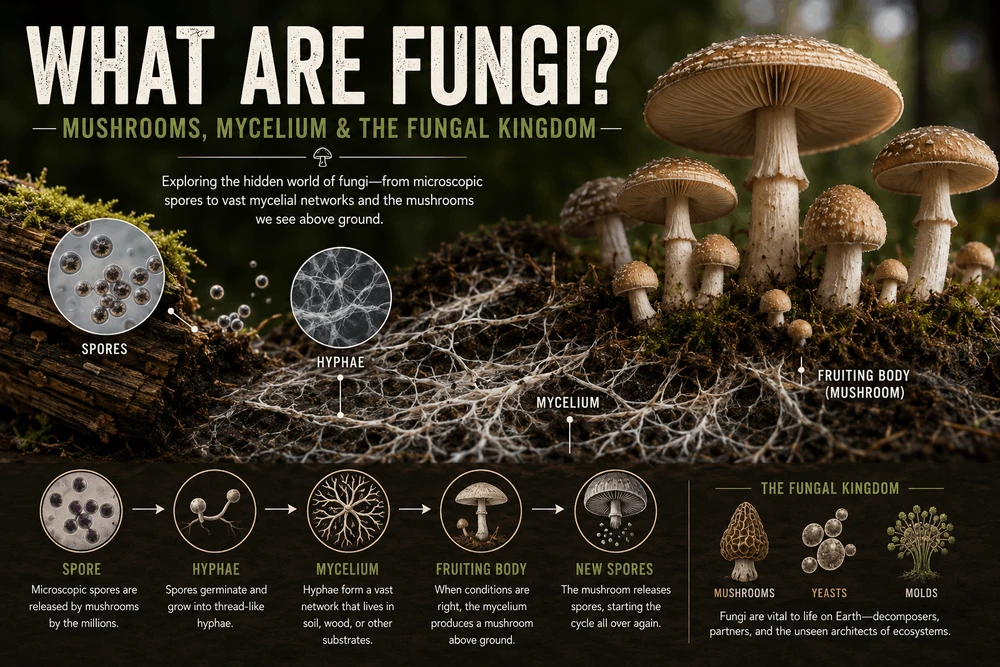
Fungi are a kingdom of life all their own—separate from plants and animals—that includes mushrooms, yeasts, and molds. The mushrooms we recognize are just the fruiting bodies of a much larger organism living out of sight, and they all begin life as microscopic spores. Understanding that hidden life cycle reveals why fungi are some of the most important organisms on Earth.
Mushrooms are often seen as a simple addition to a meal, but there's far more to them than meets the eye. To truly appreciate the hidden world of mushrooms, we need to start at the beginning and work through how a fungus actually lives and grows.
What Are Fungi? The Kingdom Fungi
Fungi belong to their own biological kingdom—Kingdom Fungi—which also includes yeasts, molds, and many less familiar organisms. They are neither plants nor animals. While we often think of fungi as decomposers that break down dead material and recycle nutrients, they play a vital, far-reaching role in ecosystems all over the world, forming partnerships with plants and keeping forests, fields, and gardens healthy.
It All Starts with Spores
Every fungus begins life as a spore. These tiny, lightweight structures are produced by the millions by each mushroom and are the first step in the life cycle of a new fungus. When conditions are right, spores germinate and begin to grow into thread-like structures—the foundation of the entire organism.
What Are Hyphae and Mycelium?
Those thread-like structures are called hyphae, and they are the real workhorses of the fungal kingdom. Hyphae spread through soil, decaying wood, or other substrates, breaking down complex molecules into simple compounds the fungus can absorb. As they grow and branch, hyphae form a dense network known as a mycelium—which can grow several feet in diameter and persist for years or even decades. The mycelium is the true body of the fungus, living mostly hidden from view.
The Mushroom Life Cycle: How Mushrooms Grow
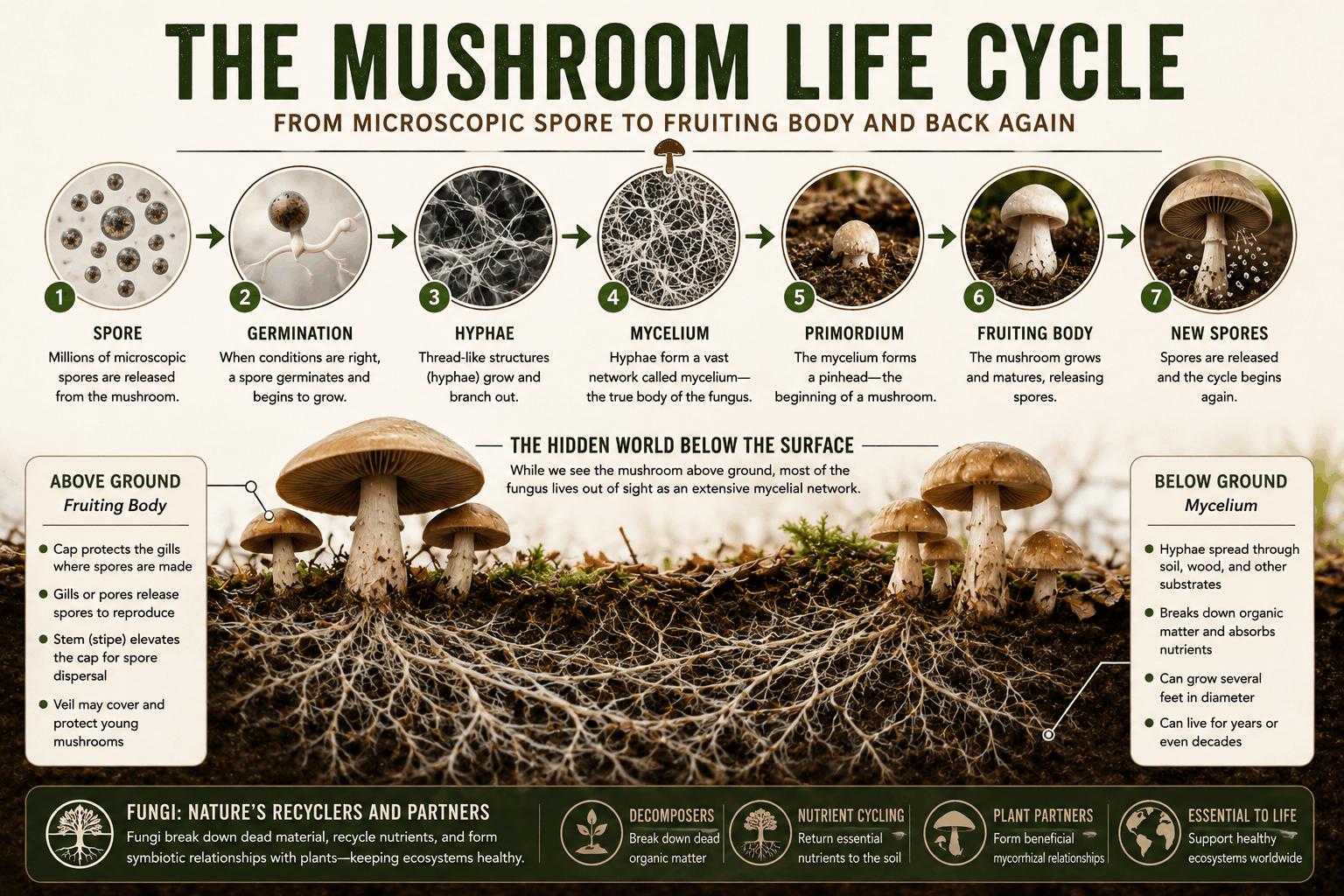
So where do the mushrooms themselves come in? The familiar mushroom is actually just the fruiting body of that larger mycelial organism. When a mycelium has accumulated enough energy and resources, it sends up a stalk topped with a cap or other distinctive shape. This is the part we usually recognize as a mushroom—and it's where the next generation of spores is produced, completing the cycle: spore → hyphae → mycelium → fruiting body → spore.
The Parts of a Mushroom
Despite their diversity, most mushrooms share some basic anatomy. They have a cap on top, a stem (or stalk) supporting it, and gills or pores on the underside of the cap where spores are produced. Many also have a veil—a protective tissue that shields the developing spores until they're ready to be released. Learning these parts is the foundation of mushroom identification and microscopy.
The Incredible Diversity of Mushrooms
One of the most fascinating aspects of mushrooms is the sheer variety of shapes, colors, and sizes they take on. Some, like the delicate chanterelle, have a wavy, funnel-like shape that's easy to spot in the woods. Others, like the classic Portobello, are unassuming but found in huge numbers worldwide. And then there are the truly bizarre, like Cordyceps, which looks like something out of a science-fiction film.
Are All Mushrooms Edible?
No—and this is important. While many mushrooms are edible and delicious, a great many are not, and some are toxic or even deadly if eaten. Edibility can only be determined by accurate species identification, which is exactly why careful study, microscopy, and taxonomy matter so much in mycology. Never consume a wild mushroom based on a casual guess.
Frequently Asked Questions
What are fungi?
Fungi are a separate kingdom of life—not plants or animals—that includes mushrooms, yeasts, and molds. They feed by absorbing nutrients and play a key ecological role as decomposers and plant partners.
What is mycelium?
Mycelium is the network of thread-like hyphae that forms the main body of a fungus. It lives within soil, wood, or other substrates, and the mushroom is its fruiting body.
How do mushrooms grow?
A spore germinates into hyphae, which branch into a mycelium. When the mycelium has enough resources, it produces a fruiting body—the mushroom—which releases new spores to begin the cycle again.
Disclaimer: This article is for educational purposes only. Never consume any wild mushroom without expert identification—many species are toxic. Spore Genetics spores are sold for microscopy and taxonomy study.