
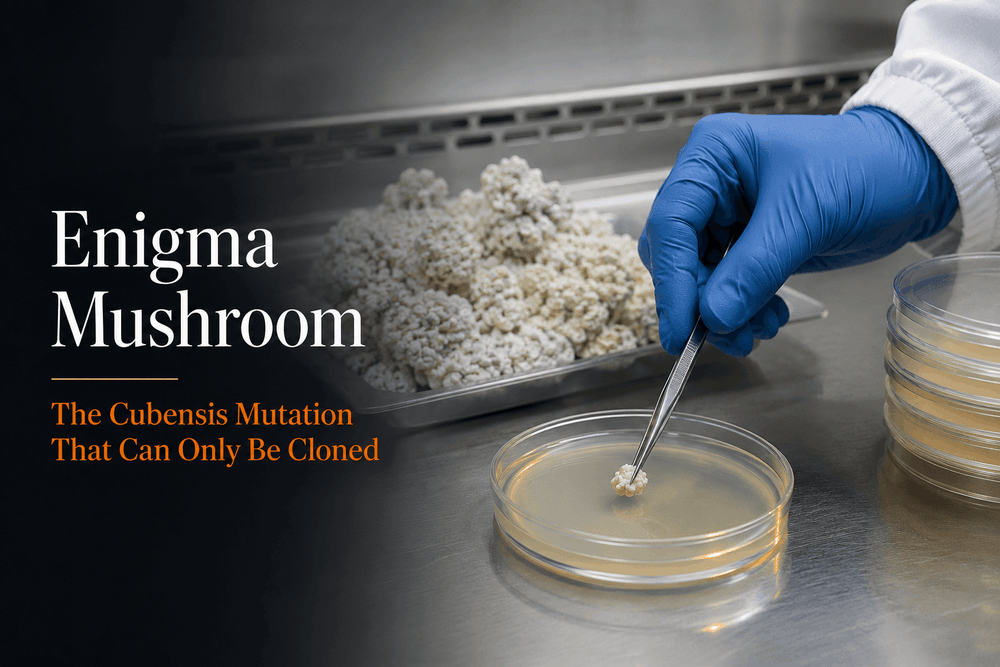
Enigma Mushroom: The Cubensis Mutation That Can Only Be Cloned
Posted by Spore Genetics Research Team on Jun 5th 2023
Enigma Mushroom: The Cubensis Mutation That Can Only Be Cloned
The Enigma mushroom is a Psilocybe cubensis mutation that never forms a cap, stem, or gills — and because gills are where spores are made, it produces effectively none. It cannot reproduce on its own. Every Enigma culture in existence today descends from tissue cloned off a single anomalous fruiting body, kept alive by hand ever since.
Most cubensis varieties are passed along as spores. Enigma cannot be. That single fact shapes everything about how it is stored, shared, studied, and sold — and it makes Enigma one of the clearest windows into how fungal genetics actually work. Here is what the mutation is, why cloning is the only option, and what that means for the genetics you end up with.
What Is the Enigma Mushroom?
Enigma is not a strain in the ordinary sense. A strain is a variety that breeds true through its spores. Enigma is a developmental mutation — a fault in the program that tells a mushroom how to build itself.
A normal Psilocybe cubensis fruiting body follows a fixed sequence. A pin forms. It differentiates into a stem and a cap. A veil stretches beneath the cap and tears. The gills underneath mature and begin releasing spores. Each stage is a distinct developmental step, and each one depends on the one before it.
Enigma stops near the start of that sequence. Tissue keeps growing, but it never differentiates. Instead of a cap on a stem, it produces a dense, folded, lobed mass — the shape that earned it nicknames like the blob mutation, the fin mutation, and the blobfish mushroom. Growth continues; development does not.
For the full profile — origin, morphology, at-a-glance traits, and what to look for under magnification — see our Enigma strain guide.
Why the Enigma Mushroom Cannot Reproduce
Mushrooms in this group make spores on basidia — microscopic club-shaped cells that line the gill surface. Four spores typically form on the tip of each basidium, then drop away when mature.
Enigma never builds gills. No gills means no basidia, and no basidia means no meaningful spore production. Its infertility is not a separate defect layered on top of the strange shape — it is a direct consequence of that shape. The organ that makes spores simply never gets built.
If you want the mechanics of that surface in detail, our guide to basidiospores covers how spore formation normally works.
The practical consequence is severe. There is no spore print to take. There is no mature cap to draw a dense multi-spore suspension from. In the wild, a fungus that cannot sporulate cannot disperse, cannot colonize new ground, and cannot pass its genetics to a next generation. Enigma is, in the strict biological sense, a dead end — and it persists only because people decided it was worth keeping.
What Cloning Actually Means in Mycology
“Cloning” sounds like laboratory science fiction. In mycology it is closer to taking a cutting from a houseplant.
A mushroom fruiting body is made of mycelium — the same branching network of hyphae that grows through the substrate below it, just packed densely into a fruiting shape. The interior of a clean fruiting body is essentially sterile tissue. Transfer a small piece of that interior onto nutrient agar, and it simply resumes growing as mycelium. For more on that network, see what is mycelium.
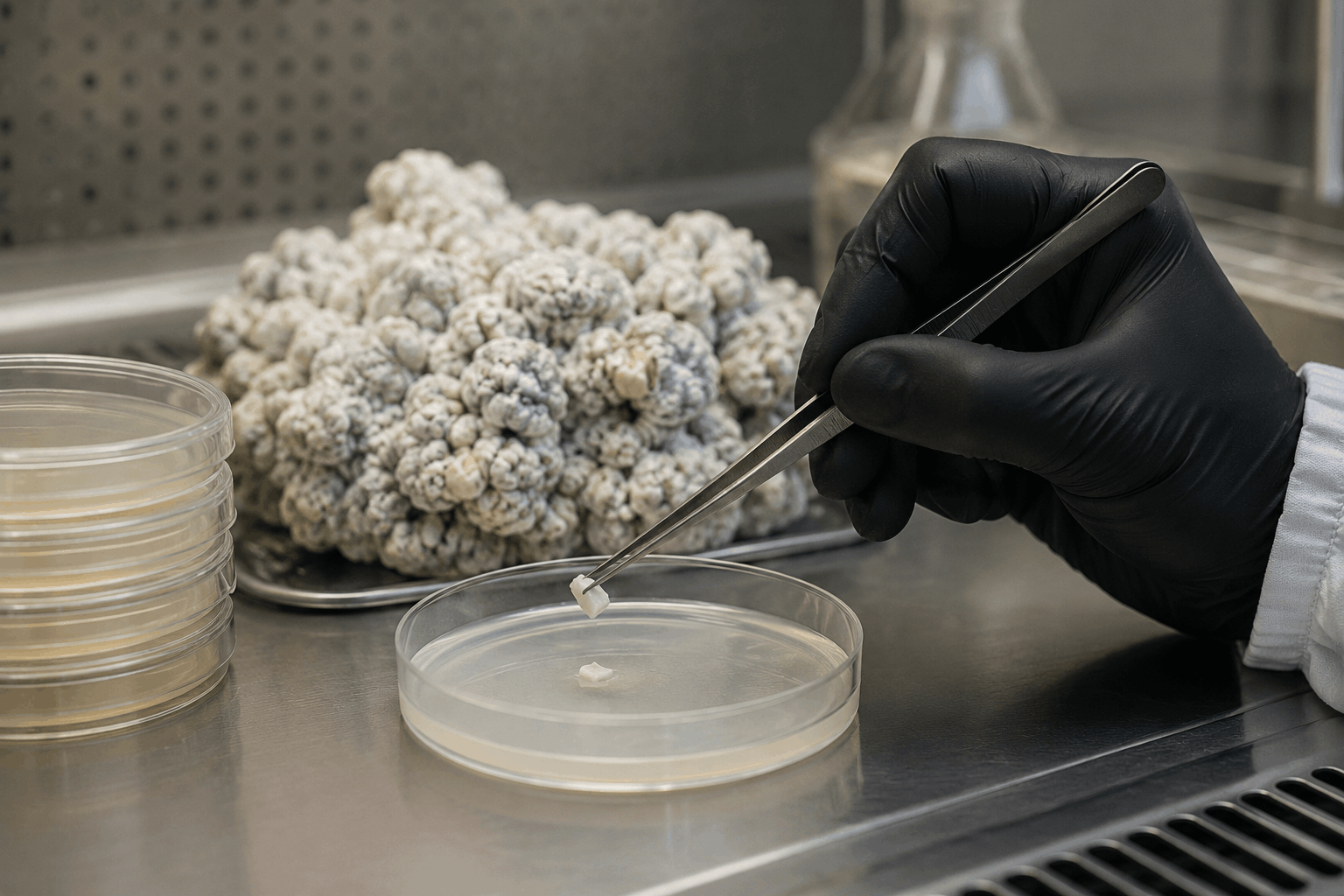
A fragment of Enigma tissue lifted onto sterile agar — the only way this mutation is passed forward.
The result is not a new organism. It is the same organism, continued — genetically identical to the fruiting body it came from, with no recombination and no new generation involved. That distinction is the whole point of the technique, and it is why cloning is the standard answer whenever a specimen cannot or should not be reproduced from spores.
This is ordinary practice across mycology, not something unique to Enigma. Gourmet growers clone a particularly good oyster or lion's mane fruit for exactly the same reason: to keep a specific result rather than gamble on a new one. If the wider field interests you, start with what is mycology.
How an Enigma Clone Line Is Maintained
Keeping a clone alive is a maintenance problem rather than a one-time event. In broad terms it means working on agar — a firm nutrient gel poured into sterile dishes that lets you see exactly what is growing.
Agar is the workhorse of culture work because it makes contamination visible. Bacteria, mold, and healthy mycelium all look different on a plate, so a compromised culture can be spotted and discarded long before it reaches anything valuable. Culture lines are periodically transferred to fresh plates to keep them vigorous, and clean stock is held in cold storage as a backup against loss. Our pre-poured sterile agar plates are made for this kind of plate work, and the rest of the bench equipment lives in mycology supplies.
Every one of those steps is a chance to lose the line. There is no spore bank to fall back on — no envelope in a drawer that can restart Enigma from scratch. If the last viable culture of a clone-only variety dies, that variety is gone.
What Cloning Does to the Genetics
Because a clone is a continuation rather than a new generation, two things follow that matter to anyone working with Enigma.
There is no recombination. Spores are the product of sexual reproduction: genetic material is shuffled, and each spore is a slightly different individual. That is why a multi-spore syringe yields variation and why isolating a favored expression takes plate work. A clone skips all of it. What you have is what the original fruit had, indefinitely.
There is no genetic reset. Sexual reproduction refreshes a lineage each generation. Clone lines never get that reset, and over many successive transfers cultivators commonly report senescence — a gradual loss of vigor as a line ages. This is why serious culture work leans on cold-stored backups from an early, healthy transfer rather than continuously working the same plate forward.
Clone or Spore: Two Different Kinds of Inheritance
Set side by side, the two routes answer different questions. Spores offer variation — a population of genetically distinct individuals to explore, compare, and select from. A clone offers consistency — one known expression, repeated.
That is also the logic behind isolated syringes. An isolate carries a single stabilized genetic line selected on plates rather than a mixed spore population, which is precisely the format a non-sporulating mutation requires. The trade-offs are laid out in multi-spore vs isolated spore syringe, and the related liquid format is covered in what is a liquid culture.
Enigma sits firmly on the clone side of that line, not by preference but by necessity. It is available as the Enigma Isolated Spore Syringe, alongside our wider range of isolated spore syringes.
Where Enigma Came From
Enigma was not bred deliberately. It appeared as a spontaneous mutation within the Tidal Wave line — itself a cross of B+ and Penis Envy — and was noticed, separated, and stabilized by cultivators who recognized that something genuinely unusual had turned up.
That parentage is suggestive. The Penis Envy side of Tidal Wave is already known for dense tissue, veils that open reluctantly, and famously poor spore production. Enigma reads as that same tendency pushed to its limit: a fruiting body that begins the process of becoming a mushroom and never finishes it.
Enigma Compared to Other Cubensis Mutations
Cubensis mutations fall into recognizable categories, and Enigma sits in a different one from most. Pigment mutations — albino and leucistic varieties — change color while leaving the structure intact. Caps, gills, veils, and spores all still form; they are simply paler. Those varieties reproduce from spores perfectly well. If that distinction interests you, we cover it in albino vs leucistic mushrooms.
Enigma is a developmental mutation instead. Pigment is beside the point; the building plan itself changed. That is why one category can be passed along in an envelope and the other cannot.
Frequently Asked Questions
What is the Enigma mushroom?
Enigma is a Psilocybe cubensis mutation that never forms a cap, stem, or gills. It grows as a dense, folded, coral-like mass of tissue and is propagated by cloning rather than by spores.
Why does the Enigma mushroom have no spores?
Spores form on basidia along the gill surface. Enigma never develops gills, so it has no basidia and no spore-bearing surface — meaning effectively no spore production.
How is the Enigma mushroom propagated?
By tissue cloning. A small piece of clean interior tissue is transferred to nutrient agar, where it resumes growing as mycelium. That culture is grown out, selected on plates, and passed forward as a genetically identical continuation of the original.
Is a cloned mushroom genetically identical?
Yes. Cloning transfers living tissue rather than combining genetic material, so there is no recombination and no new generation — the culture is the same organism continued.
What is the Enigma mushroom a mutation of?
It arose within the Tidal Wave line, a cross of B+ and Penis Envy. The Penis Envy side of that lineage is already known for dense tissue and poor spore production.
Can Enigma be grown from a spore syringe?
Not in the conventional sense. Because it does not produce a usable spore population, Enigma is supplied as an isolate — a single stabilized genetic line selected on plates rather than a mixed multi-spore suspension.
Why is the Enigma mushroom called the blob mutation?
Because of its shape. Without a cap-and-stem structure it develops into a lobed, convoluted mass often compared to coral or brain tissue. It is also called the fin mutation and the blobfish mushroom.
Do clone lines lose vigor over time?
Cultivators commonly report senescence — a gradual decline in vigor as a clone line ages through many successive transfers. Because sexual reproduction never resets the lineage, careful culture work relies on cold-stored backups taken from an early, healthy transfer.
Disclaimer: This article is provided for educational and mycological purposes only. Psilocybe spores and cultures are sold strictly for microscopy, taxonomy, and research; cultivation of psilocybin mushrooms is illegal in many jurisdictions, including federally in the United States. Nothing here is intended to encourage or facilitate any activity that violates federal or local law. Cultivation techniques described in general terms apply to legal gourmet and medicinal species.