
Enigma Strain Guide
Enigma
The Psilocybe cubensis mutation that stopped behaving like a mushroom — no caps, no gills, no veil, and almost no spores. Here is where Enigma came from, what it actually is, and why it can only exist as an isolate.
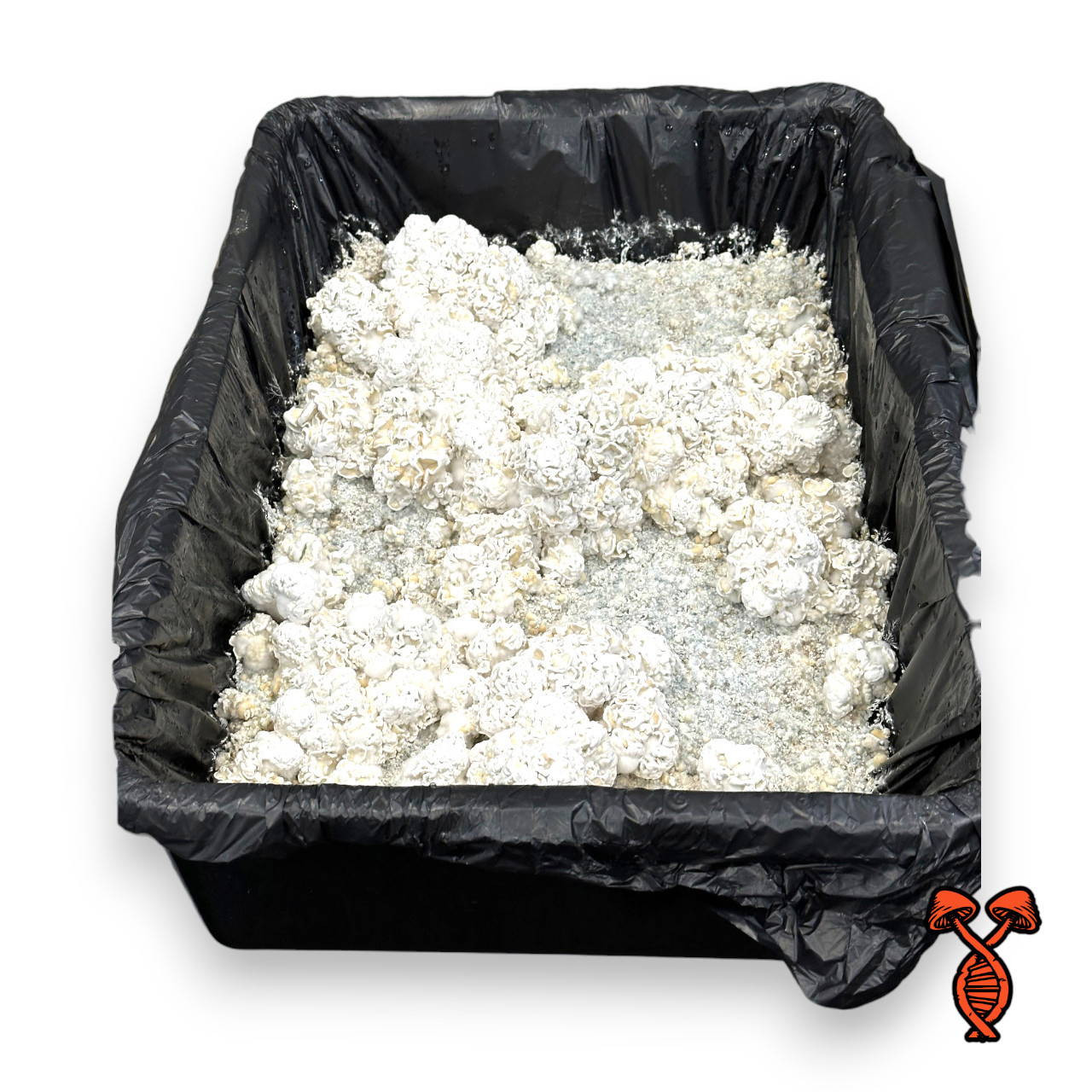
Enigma is a Psilocybe cubensis mutation that never completes normal mushroom development. Instead of forming a stem, cap, and gills, it grows into a dense, folded, coral-like mass of tissue — and because the spore-bearing surface never forms, it almost never releases spores. It is propagated through tissue culture and isolation rather than through spore prints, which is why it is often called the “blob mutation.”
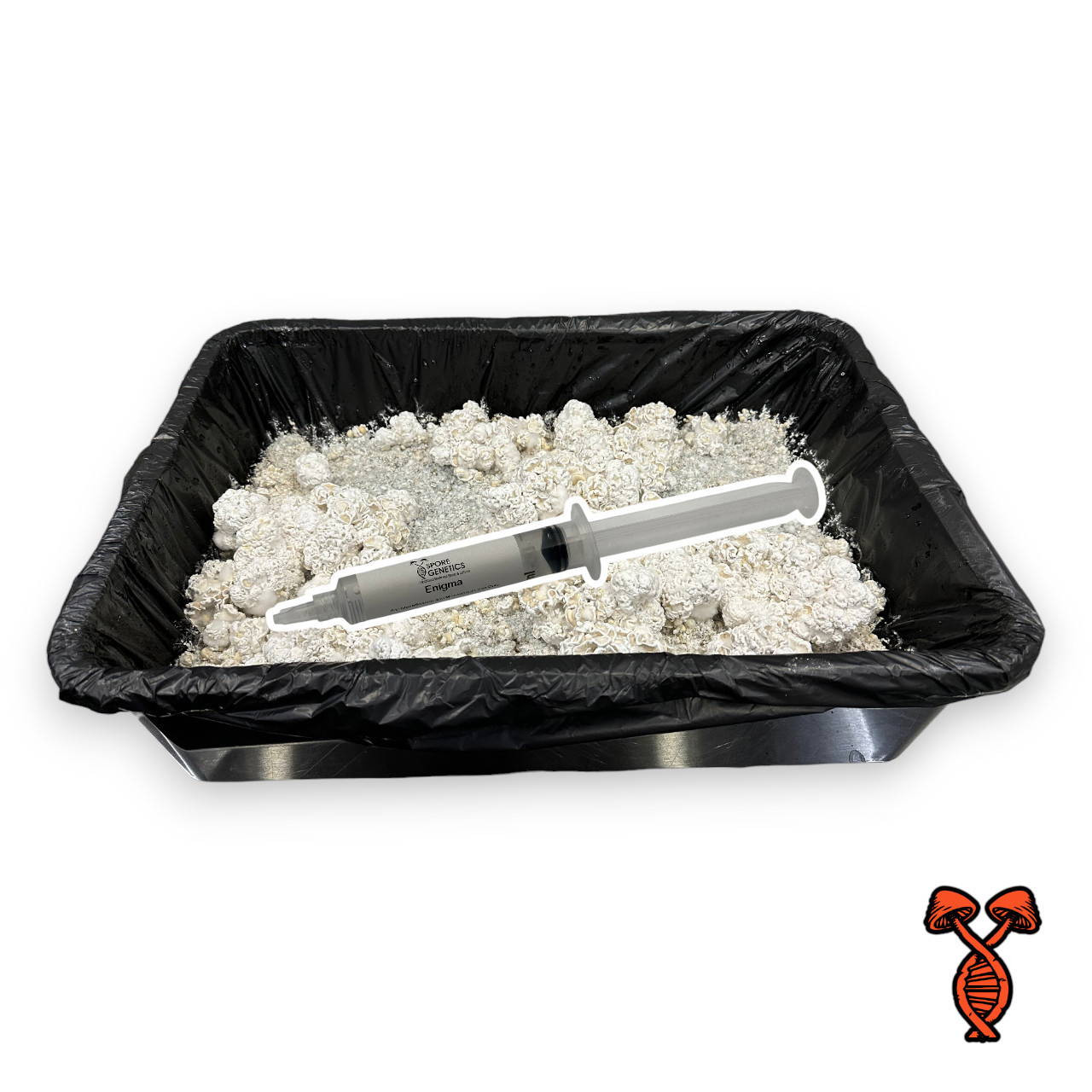
Spore Genetics carries it as the Enigma Isolated Spore Syringe ($28.99) — a single stabilised line selected on agar, the only format a non-sporulating mutation allows. Below: the Tidal Wave origin, the biology behind the mutation, and what Enigma means for anyone working with cubensis genetics.
Enigma genetics, ready for your microscope
In stock · Ships within 24 hours · Free Cubensis spore syringe with every $100 order


For microscopy & taxonomy research only. Not for cultivation.
Enigma at a Glance
| Species | Psilocybe cubensis |
| Type | Developmental mutation (not a conventional strain) |
| Origin | Arose from the Tidal Wave cross (B+ × Penis Envy) |
| Morphology | Coral- or brain-like folded mass; no cap, stem, or gills |
| Spore production | Effectively none — the spore-bearing surface never develops |
| Propagated by | Tissue culture and isolation, never by spore print |
| Also called | Blob mutation, fin mutation, blobfish mushroom |
| Best for | Morphology study, culture work, taxonomy |
Origin & Lineage
Enigma did not come from a breeding program. It appeared as a spontaneous mutation within the Tidal Wave line — itself a cross of B+ and Penis Envy — and was recognised, separated, and stabilised by cultivators who saw that something genuinely unusual had turned up in the tub.
That parentage matters. The Penis Envy side of Tidal Wave is already known for unusual development: dense tissue, thick stems, veils that open reluctantly or not at all, and famously poor spore production. Enigma reads as that tendency taken to its logical extreme — a fruiting body that begins the process of becoming a mushroom and then simply never finishes it.
Because it emerged from a widely grown cross rather than a rare wild collection, Enigma occupies an unusual place in cubensis history: a strain with no wild population, no natural range, and no spore lineage — only a chain of cultures traced back to a single anomalous fruit. For the wider family it came from, see our cubensis strain guides.
What the Blob Mutation Actually Is
A typical Psilocybe cubensis fruiting body follows a well-defined sequence. A pin forms, it differentiates into stem and cap, a veil stretches beneath the cap and then tears, and the gills underneath mature and begin releasing spores. Each of those stages is a distinct developmental step.
Enigma interrupts that sequence near the beginning. Tissue keeps growing and folding in on itself, producing the thick convoluted lobes that give the mutation its nicknames, but the cap, gills, and veil never differentiate at all. What forms instead is closer to a dense knot of undifferentiated fruiting tissue than to a mushroom in the ordinary sense.
This is why comparisons to coral, cauliflower, and brain tissue come up so often in descriptions — the folded surface area is the visible signature of growth continuing without the structural plan that normally organises it.
Why Enigma Does Not Drop Spores
In mushrooms of this group, spores are produced on basidia — club-shaped cells that line the surface of the gills. No gills means no basidia, and no basidia means no meaningful spore production. Enigma’s missing spore output is not a separate quirk layered on top of its strange shape; it is a direct consequence of that shape.
The practical effect is that Enigma cannot be distributed the way most cubensis varieties are. There is no print to take, and no dense multi-spore suspension to draw from a mature cap. If you want to understand the machinery it is missing, our guide to basidiospores covers how that surface normally works.
It also makes Enigma a biological dead end in the wild sense of the word. A fungus that cannot sporulate cannot reproduce or disperse on its own. Every Enigma in existence today persists only because people have deliberately kept the tissue alive.
How Enigma Is Kept Alive
Since spores are not an option, Enigma is carried forward through tissue culture. A small piece of clean interior tissue is transferred to nutrient agar, the resulting mycelium is grown out and selected on plates, and that isolated line is what gets passed along. Every step is a copy of the original genetics rather than a new generation of them.
This is why Enigma is offered as an isolated syringe rather than a conventional multi-spore syringe. An isolate represents a single stabilised genetic line selected on plates, which is precisely the format a non-sporulating mutation requires. The difference between the two formats is covered in multi-spore vs isolated spore syringe.
It also means Enigma behaves differently in storage and handling than a spore-based product. Isolated material is generally shorter-lived than dry spores and wants consistent refrigeration — see how to store mushroom spores for the practical side.
How to Recognize Enigma
Enigma is one of the few cubensis varieties that is unmistakable at a glance. There is no cap to assess, no stem proportion to judge, and no veil or gill colour to compare. Instead you are looking at a solid, lobed, folded mass — often pale to greyish-blue, frequently wider than it is tall, and dense enough to feel substantial for its size.
Strong blue bruising is typical wherever the tissue is handled or damaged, as it is across the species. On Enigma this tends to read more dramatically than usual simply because there is so much exposed folded surface for it to show on.
Growth is also noticeably slower to resolve than a conventional fruit. Where a normal cubensis moves from pin to mature cap on a fairly predictable schedule, an Enigma mass simply continues expanding, with no clear endpoint signalled by veil rupture or spore drop.
Enigma Under the Microscope
Enigma inverts what microscopy work on a cubensis strain usually involves. With most varieties the spores are the subject — their colour, dimensions, and shape are what you record. With Enigma the subject is the tissue itself: hyphal structure, the organisation of the folded mass, and the conspicuous absence of the gill surface and basidia you would normally expect to find.
That makes it a genuinely useful reference point. Placing Enigma tissue alongside a conventional strain is one of the clearest ways to see what a developmental mutation looks like at the cellular level, rather than reading about it in the abstract.
If you are setting up for this kind of comparative work, our guide to studying spores under a microscope covers slide preparation and magnification.
Enigma and Other Cubensis Mutations
Cubensis mutations tend to fall into recognisable categories, and Enigma sits in a different one from most. Pigment mutations such as albino and leucistic varieties change colour while leaving the mushroom’s structure intact — caps, gills, and spores all still form. Enigma is a developmental mutation instead: the pigment is beside the point, and the structure itself is what changed.
The nearest comparison in our own catalogue is Snowball, another cubensis oddity with unusual dense morphology. For a strain that pushes the Penis Envy lineage in the opposite direction — toward heavy, reliable spore output — see the PE6 strain guide.
Set against a conventional variety like Golden Teacher, the contrast is stark: one is the textbook example of cubensis development, the other is what happens when that development stops partway through.
Enigma Formats
Enigma is offered only as an isolate — the format its biology requires. Browse all isolated spore syringes or our exotic mushroom spores.
Why Researchers Reach for Enigma
A textbook developmental mutation. Few specimens show the difference between growth and development as plainly.
Unmistakable morphology. Coral-like folded tissue with no cap, stem, gills, or veil.
Genuinely rare genetics. No wild population and no spore lineage — every sample traces to cultured tissue.
A stabilised isolate. A single selected genetic line rather than a variable spore population.
Research use only. All Enigma material is supplied strictly for microscopy, taxonomy, and research — not for cultivation. We ship to every U.S. state except Georgia and Idaho; please confirm the laws where you live before ordering.
Related Strains to Study
The other cubensis oddity Enigma is compared with, both sides of its Tidal Wave lineage, and the full isolate collection.



Also browse: Cubensis Spore Syringes · Spore Prints · New Arrivals
Enigma FAQ
What is the Enigma strain?
Enigma is a Psilocybe cubensis mutation that never forms a cap, stem, or gills. It grows as a dense, folded, coral-like mass of tissue and is propagated by culture rather than by spores.
Why is Enigma called the blob mutation?
Because of its shape. Without the cap-and-stem structure of a normal mushroom, it develops into a lobed, convoluted mass often compared to coral or brain tissue. It is also called the fin mutation and the blobfish mushroom.
Does Enigma produce spores?
Effectively no. Spores form on basidia along the gill surface, and Enigma never develops gills — so there is no spore-bearing surface and no meaningful spore release.
How is Enigma propagated if it has no spores?
Through tissue culture. Clean interior tissue is transferred to agar, grown out, and selected on plates, producing an isolated genetic line that is passed forward as a copy rather than a new generation.
What is Enigma a mutation of?
It arose within the Tidal Wave line, a cross of B+ and Penis Envy. The Penis Envy side of that lineage is already known for dense tissue and reluctant spore production.
Is Enigma the same as an albino strain?
No. Albino and leucistic varieties are pigment mutations — the mushroom still forms caps, gills, and spores, just with altered colour. Enigma is a developmental mutation affecting the structure itself.
Why is Enigma sold as an isolate?
Because a non-sporulating mutation cannot be supplied as a multi-spore product. An isolate carries a single stabilised genetic line selected on plates, which is the only practical way to distribute Enigma genetics.
Questions About Enigma?
Want to compare it with other strains first? See our Golden Teacher, Albino Penis Envy, and PE6 guides, brush up on what mushroom spores are, or reach out any time via email.
Spore Genetics — Exceptional Mushroom Spores & Cultures