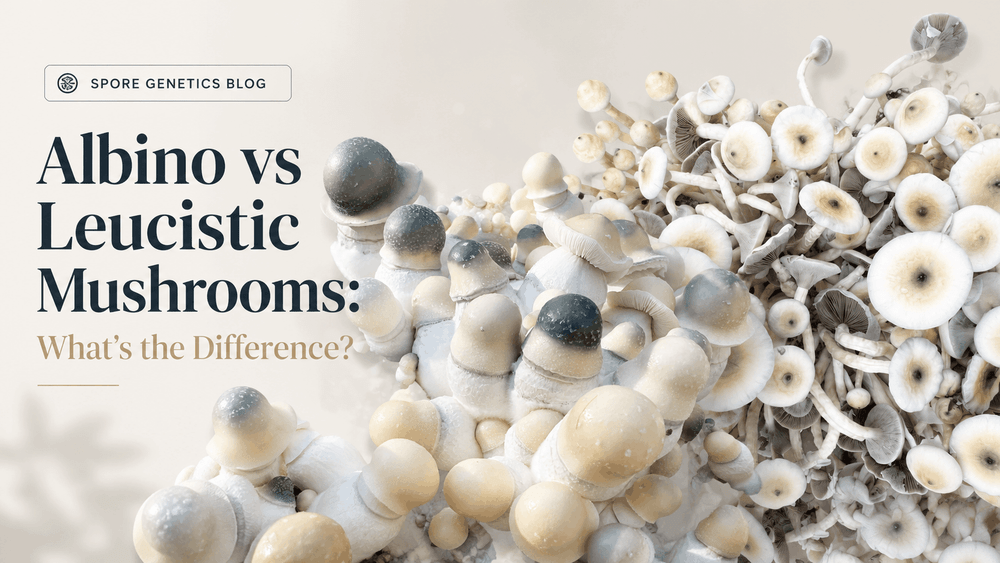
Albino vs Leucistic Mushrooms: What's the Difference?
Posted by Spore Genetics Research Team on Nov 22nd 2024
Albino vs Leucistic Mushrooms: What’s the Difference?
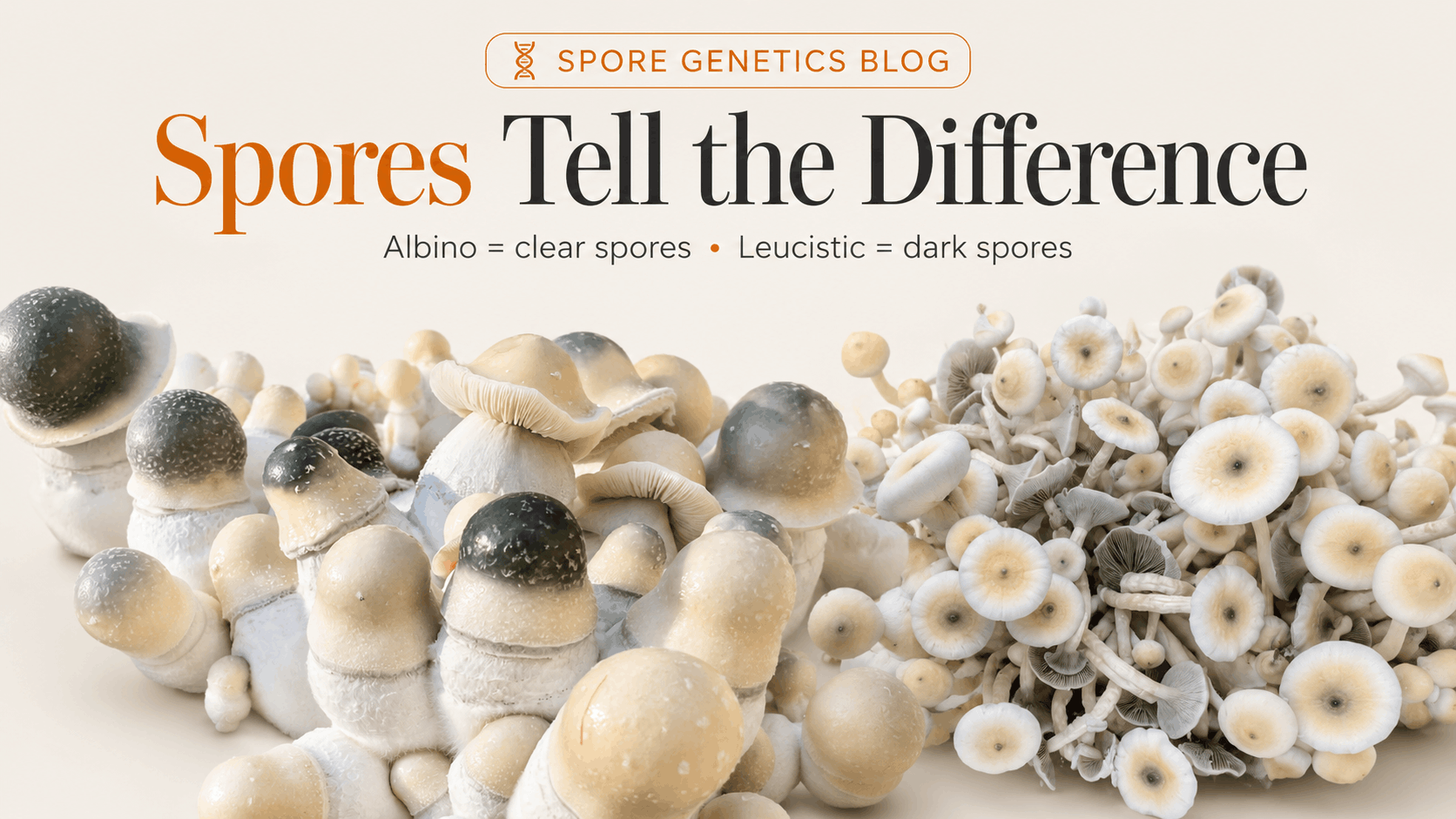
The difference comes down to the spores. A true albino mushroom produces no pigment at all — its spores are translucent or clear, and it cannot leave a visible spore print. A leucistic mushroom has heavily reduced pigment in its cap and stem but still produces normal dark, pigmented spores. Both look strikingly pale, which is why the two terms get used interchangeably — but for anyone working under a microscope, the distinction is the whole ballgame.
Most cubensis varieties sold as “albino” are in fact leucistic. Here’s how to tell them apart, why it matters for microscopy, and which strains fall into which camp.
The Core Distinction
| True Albino | Leucistic | |
|---|---|---|
| Pigment | Absent | Heavily reduced, not absent |
| Spore color | Translucent to clear | Normal dark purple-brown |
| Spore print | Faint or effectively invisible | Clear and readable |
| Gills at maturity | Stay pale or blue-grey | Darken to grey or black |
| Under the scope | Low contrast — demanding | Normal contrast — straightforward |
The shorthand worth remembering: leucistic means less pigment; albino means none. If a pale mushroom still drops a dark print, it is leucistic, whatever the label on the jar says.
Why So Many “Albinos” Aren’t
The naming convention in the hobby predates the precision. Growers saw a ghost-white mushroom, called it albino, and the name stuck — long before anyone was checking spore deposits to confirm it.
Our own A+ Albino is a good example: it carries albino in the name and looks the part, with creamy-white to bluish caps, but it is a leucistic mutation of the classic A strain and produces a full, dark spore deposit. By contrast, True Albino Teacher (TAT) — an albino mutation of Golden Teacher stabilized around 2018–2019 — is the real thing, with translucent spores. The word “true” in its name is doing real work.
What Actually Causes It
In fungi, coloration comes largely from melanin and related pigments deposited in the cell walls of the fruiting body and spores. A mutation that disrupts the pigment pathway produces a pale mushroom.
How pale depends on where the disruption occurs. Knock out pigment production entirely and you get a true albino — colorless throughout, spores included. Partially impair it, or affect only the fruiting body while leaving spore pigmentation intact, and the result is leucistic: dramatic to look at, but genetically still producing dark spores.
These mutations occur spontaneously. When one appears in a desirable strain, growers isolate it over successive generations until the trait expresses reliably — which is how nearly every named albino variety came about.
Are Albino Mushrooms More Toxic?
No. Pigment production and toxin production are unrelated biological pathways. An albino or leucistic variant of a species has the same chemistry as its pigmented counterpart — the missing color tells you nothing about whether a mushroom is safe or dangerous.
There is a real risk here, but it is an identification risk rather than a chemical one. Spore print color is one of the most dependable identification features available, and an albino specimen essentially removes it from the toolkit. A wild pale mushroom with no readable print is significantly harder to identify with confidence, which is exactly the situation in which mistakes happen. Our spore print color chart covers what each genus normally deposits — and why losing that signal matters.
Under the Microscope
This is where the distinction becomes practical rather than academic.
Leucistic strains behave normally on a slide. Their spores are the usual dark purple-brown, giving good contrast and easy viewing — the pale fruit body makes no difference to what you see at magnification.
True albino strains are a genuinely harder subject. Translucent spores are faint in solution and low-contrast against the field, so they demand more careful lighting and technique. Many researchers enjoy them precisely for that reason — they are a test of method. If you’re working with one, our guide to studying spores under a microscope covers lighting and contrast adjustments that help with pale specimens.
Albino and Leucistic Cubensis Strains
Some of the best-known varieties in the pale category:
| Strain | Type | Lineage |
|---|---|---|
| True Albino Teacher (TAT) | True albino | Golden Teacher mutation |
| Albino Penis Envy (APE) | Albino | Penis Envy × PF Albino |
| A+ Albino | Leucistic | A strain mutation |
| Albino MVP (AMVP) | Albino | TAT × Melmac PE |
| Albino Chodewave | Albino | Tidal Wave × APE |
| Albino Bluey Vuitton | Albino | Panama × Melmac PE line |
Others circulate widely too — Avery’s Albino, Jack Frost, and Yeti among them, the latter two both descended from TAT. The trait isn’t limited to cubensis either: we carry an albino Cordyceps militaris that fruits pale cream instead of the usual bright orange.
Want to compare several at once? The Albino PE Trinity 3-Pack pairs three albino PE-lineage isolates, and the APE strain guide goes deeper on the best-known of them.
Frequently Asked Questions
What is the difference between albino and leucistic mushrooms?
A true albino produces no pigment at all, so its spores are translucent and it leaves little or no visible spore print. A leucistic mushroom has greatly reduced pigment in the cap and stem but still produces normal dark spores. Leucistic means less pigment; albino means none.
Are albino mushrooms more toxic than regular mushrooms?
No. Pigment and toxin production are separate biological pathways, so a pale variant has the same chemistry as its normal-colored counterpart. The real concern is identification: without a readable spore print, a wild pale mushroom is much harder to identify with confidence.
Is Albino Penis Envy a true albino?
APE is generally classed as albino rather than leucistic, showing very pale, low-contrast spores. Some specimens express more pigment than others, which is common in albino lines where the trait can vary between fruits.
Why do albino mushrooms still bruise blue?
Blue bruising comes from psilocin oxidizing when tissue is damaged — a completely different process from pigment production. That’s why albino strains often show dramatic blue bruising against their pale flesh.
Can you take a spore print from a true albino mushroom?
Only with difficulty. Translucent spores leave a very faint deposit that’s hard to see on white paper, so dark or black card gives you a better chance. Leucistic strains, by contrast, print normally.
What is Avery’s Albino?
Avery’s Albino is a well-known pale Psilocybe cubensis variety that circulates among collectors, named after its originator. Like most strains carrying the albino label, whether it’s truly albino or leucistic comes down to whether it deposits pigmented spores.
Browse the full range in our cubensis strain guides, or shop isolated spore syringes and mushroom spores.
Disclaimer: This article is educational and covers fungal pigmentation genetics and strain morphology. It is not a foraging guide — spore print color is a key identification feature, and its absence in albino specimens makes wild identification substantially less reliable. Never consume a wild mushroom without expert confirmation. Psilocybe cubensis spores sold by Spore Genetics are intended strictly for microscopy, taxonomy, and research purposes. Cultivation is illegal in many jurisdictions, including federally in the United States. We ship to every U.S. state except Georgia and Idaho.