
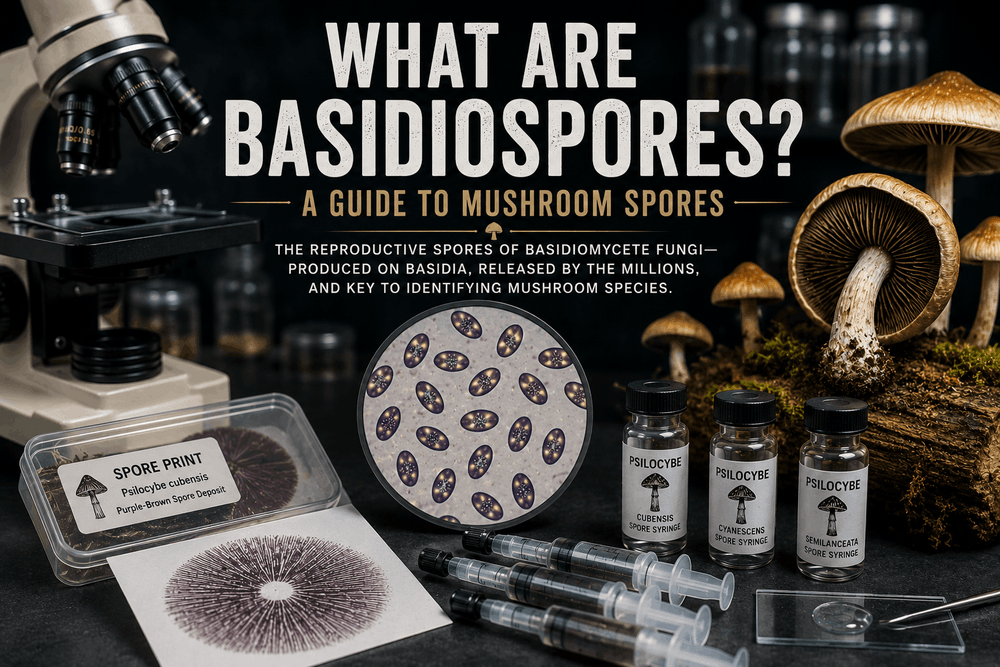
What Are Basidiospores? A Guide to Mushroom Spores
Posted by Spore Genetics Research Team on May 5th 2023
What Are Basidiospores? A Guide to Mushroom Spores
Basidiospores are the reproductive spores produced by basidiomycete fungi—the group that includes most familiar mushrooms. Formed on tiny club-shaped cells called basidia, they're released by the millions to spread and reproduce, and their size, shape, and color are central to identifying and classifying mushroom species under the microscope.
If you've studied mushroom spores at all, you've worked with basidiospores—even if you didn't know the name. Here's a clear look at what they are, how they form, and how researchers study them.
What Are Basidiospores?
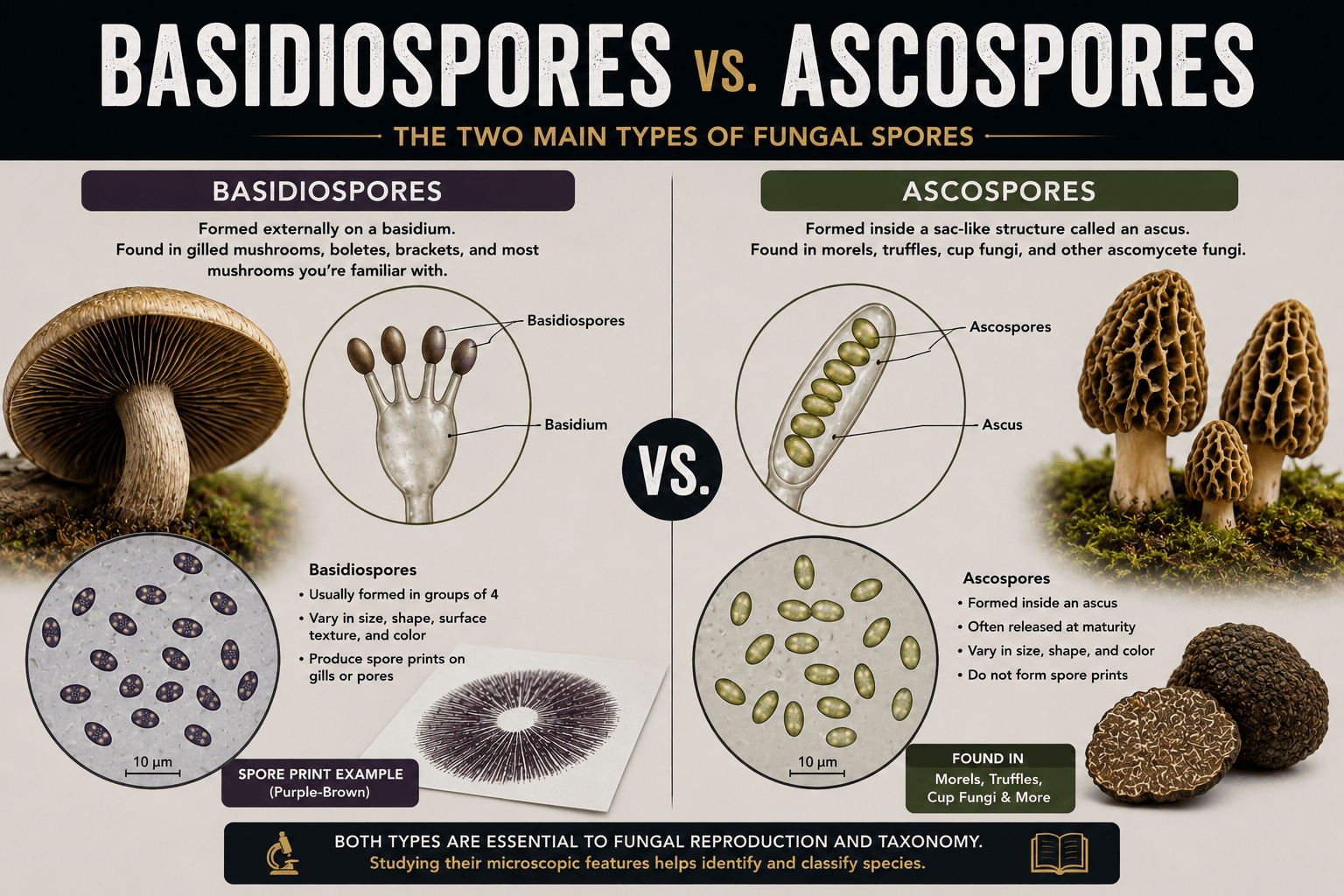
A basidiospore is the sexual spore of a basidiomycete fungus. The name comes from the basidium—a microscopic, often club-shaped structure on the mushroom's gills or pores where these spores develop. Most basidiospores form in groups of four on each basidium, then drop and disperse to start new fungal growth. The vast majority of mushrooms you'd recognize—including the entire Psilocybe genus—reproduce this way.
Basidiospores vs. Ascospores
Fungi produce spores in two main ways. Basidiospores form externally on a basidium (the mushrooms most people know—gilled mushrooms, boletes, brackets). Ascospores, by contrast, form inside a sac-like cell called an ascus, in the group that includes morels and truffles. The distinction is one of the foundational ways mycologists organize the fungal kingdom.
What Do Basidiospores Look Like?
Under the microscope, basidiospores reveal the details used for identification: their size (measured in microns), shape (round, oval, lemon-shaped, angular, and more), surface texture (smooth or ornamented), and color in deposit. Spore color is especially useful—Psilocybe species, for example, leave a distinctive purple-brown print, while other groups range from white to black to rust. These features, taken together, help pin down exactly which species you're looking at.
How Basidiospores Are Studied: Spore Prints & Syringes
There are two classic ways to capture and study spores. A spore print is made by placing a mushroom cap gill-side down on paper or glass, letting it drop its spores into a pattern—useful for both identification and observing spore color. A spore syringe suspends spores in sterile liquid, making them easy to apply to a microscope slide. Both are core tools for microscopy and taxonomy. You can explore our spore prints and spore syringes for study.
Frequently Asked Questions
What are basidiospores?
They're the reproductive spores of basidiomycete fungi—most familiar mushrooms—formed on club-shaped cells called basidia and used to reproduce and disperse.
What's the difference between basidiospores and ascospores?
Basidiospores form externally on a basidium (gilled mushrooms, boletes), while ascospores form inside a sac-like ascus (morels, truffles). It's a key division in fungal classification.
How are basidiospores studied?
Through microscopy—examining their size, shape, ornamentation, and color—using spore prints and spore syringes to capture samples for the slide.
What color are basidiospores?
It varies by group: Psilocybe species produce purple-brown spores, while others range from white to black to rust-brown. Spore color is an important identification clue.
Disclaimer: Spores are sold strictly for microscopy, taxonomy, and research purposes. This article is educational. Where psilocybin-producing species are concerned, cultivation is illegal in many jurisdictions, including federally in the United States—always follow the laws in your area.