
Panaeolus Cinctulus (Subbalteatus): ID & Habitat
Posted by Spore Genetics Research Team on May 11th 2023
Panaeolus Cinctulus (Subbalteatus): Identification & Habitat
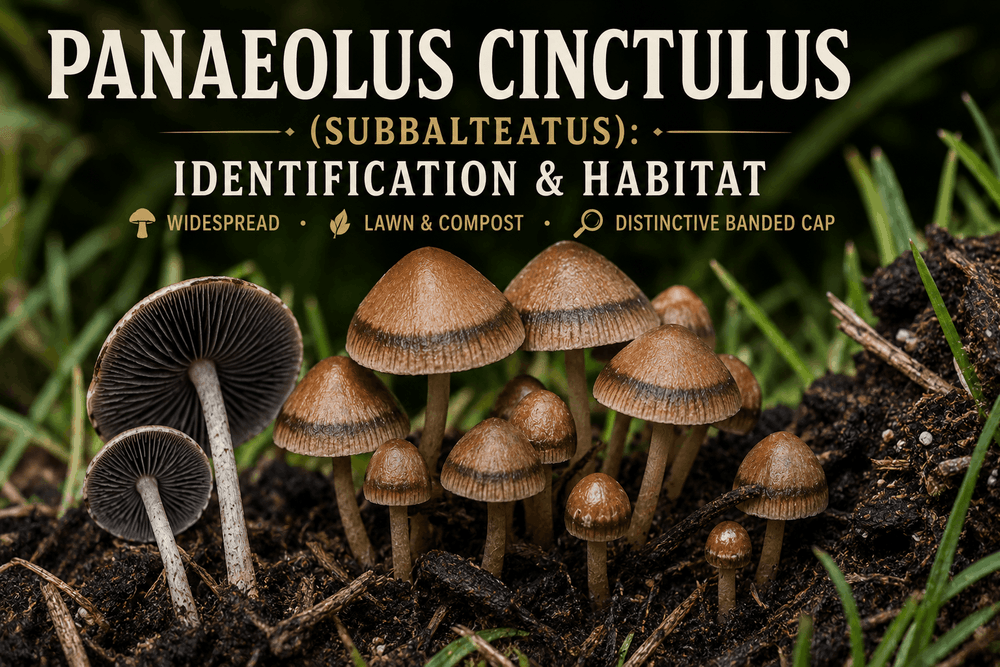
Panaeolus cinctulus—still widely known by its older name Panaeolus subbalteatus, and commonly called the banded mottlegill—is one of the most widespread mushrooms in the Panaeolus genus. Found in lawns, compost, and rich soil across much of the world, it's known for the distinctive dark “band” that forms on its cap as it dries.
Because it turns up so often in gardens and grassy areas, Panaeolus cinctulus is a species many people encounter without knowing its name. Here's a clear look at what it is, how to identify it, and where it grows.
What Is Panaeolus Cinctulus?
Panaeolus cinctulus is a mushroom in the genus Panaeolus, the same genus as the Panaeolus cyanescens (Blue Meanie). It has gone by several names over time—you'll see it listed as Panaeolus subbalteatus in older references—but cinctulus is the currently accepted name. Its common name, “banded mottlegill,” comes from the darker band of color that appears around the cap margin as the mushroom dries.
Identification & Key Features
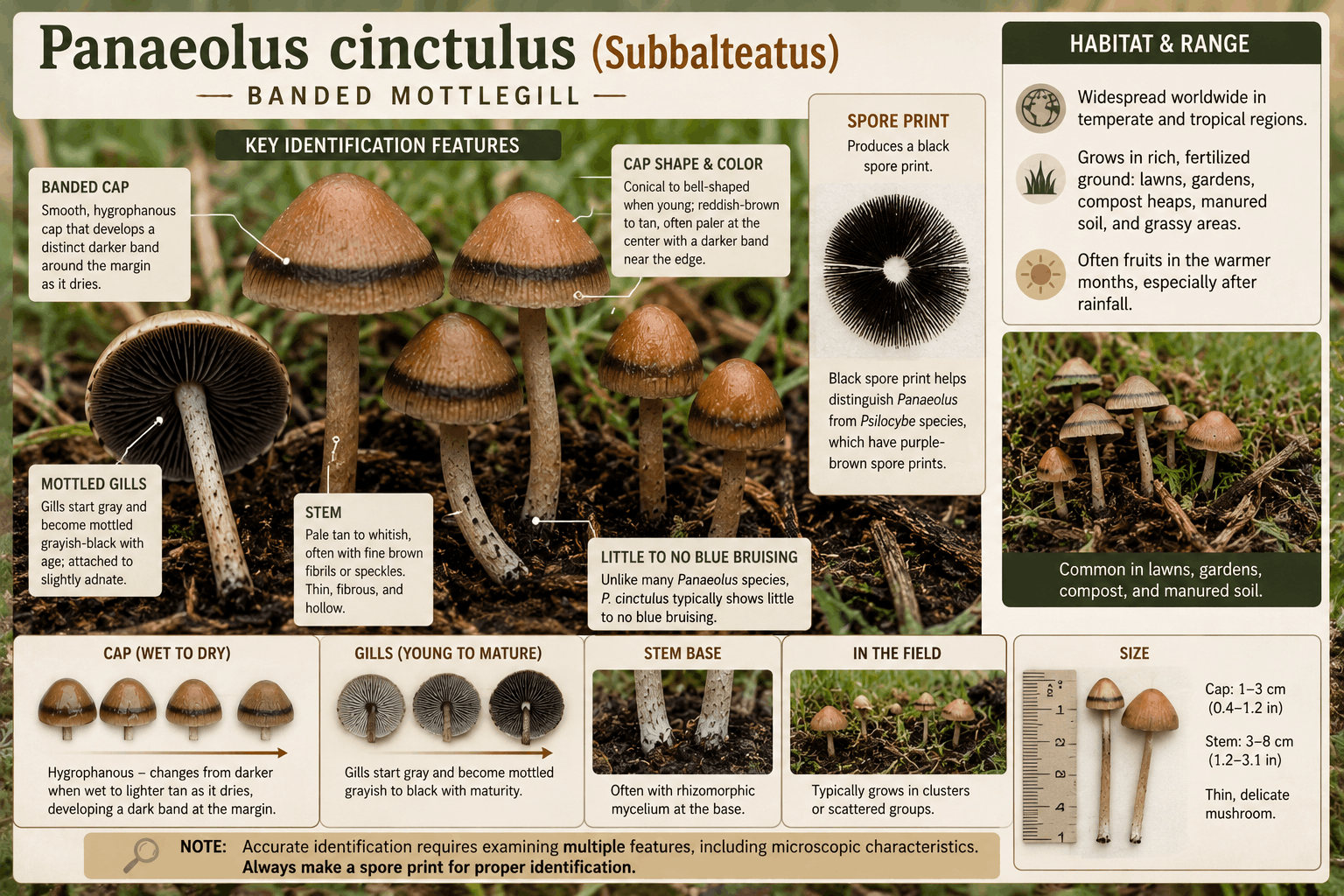
Panaeolus cinctulus has a smooth, reddish-brown to tan cap that's hygrophanous—meaning it changes color as it loses moisture—often developing that characteristic darker band around the edge. Its gills are mottled grayish-black, and like the rest of the genus it produces a black spore print, which distinguishes Panaeolus from the purple-brown-spored Psilocybe species. Unlike some of its relatives, cinctulus typically shows little to no blue bruising. As always, identification depends on assessing several features together, including microscopic ones.
Habitat & Range
This is one of the most cosmopolitan mushrooms around—Panaeolus cinctulus grows across temperate and tropical regions worldwide. It favors rich, fertilized ground: lawns, gardens, compost heaps, manured soil, and grassy areas. It's so at home in cultivated settings that it's sometimes called the “weed Panaeolus” for how readily it appears in yards and flower beds, often fruiting through the warmer months.
Panaeolus Cinctulus Under the Microscope
Like the rest of its genus, Panaeolus cinctulus leaves a jet-black spore print—an immediate point of separation from the purple-brown print of Psilocybe species that can share the same grassy habitat. Under magnification, the spores are smooth, thick-walled, and lemon-shaped (citriform) to ellipsoid, typically around 11–14 microns long, each with a distinct germ pore at the tip. The gill edges carry cheilocystidia, another microscopic feature taxonomists use to confirm the species. Cinctulus is also one of the psilocybin-containing members of Panaeolus, which is part of why it draws interest from microscopy researchers studying the genus. Our spore print color chart and guide to studying spores under a microscope cover how to examine these features.
About the Panaeolus Genus
Panaeolus is a genus of small, mostly dung- and grassland-associated mushrooms found worldwide, unified by their mottled gills and black spore prints. The genus includes species like the banded mottlegill and the Blue Meanie (P. cyanescens). Studying them alongside the broader range of species is a rewarding part of mycology. You can explore the genus in our Panaeolus spores collection.
Frequently Asked Questions
What is Panaeolus cinctulus?
It's a widespread mushroom in the Panaeolus genus, also known as Panaeolus subbalteatus or the banded mottlegill, commonly found in lawns, compost, and rich soil worldwide.
Why is it called the banded mottlegill?
“Banded” refers to the darker band that forms around the cap margin as it dries; “mottlegill” describes its spotted, mottled gray-black gills.
What color is a Panaeolus cinctulus spore print?
Jet black, like the rest of the Panaeolus genus—a quick way to tell it apart from the purple-brown-spored Psilocybe species that grow in similar grassy habitats.
What's the difference between Panaeolus cinctulus and subbalteatus?
They're the same species—cinctulus is the currently accepted name, while subbalteatus is an older synonym still seen in many references.
Where does Panaeolus cinctulus grow?
Worldwide, in rich and fertilized ground—lawns, gardens, compost, and manured soil—often fruiting in the warmer months.
Disclaimer: Panaeolus spores are sold strictly for microscopy, taxonomy, and research purposes. This article is educational. Never consume wild mushrooms—many species have toxic look-alikes and accurate identification requires expertise. Always follow the laws in your area.