
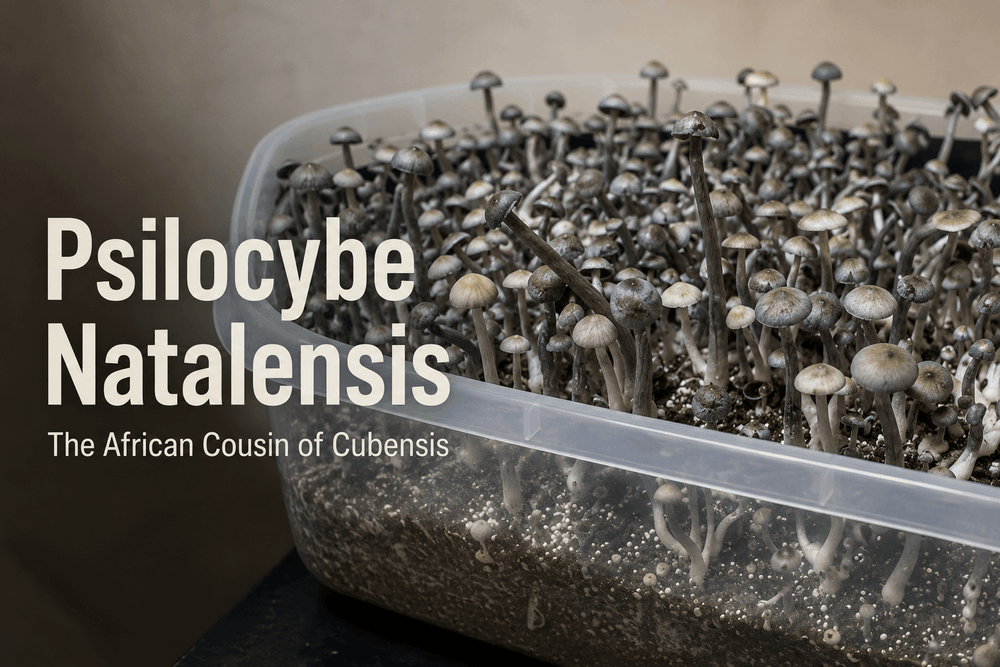
Psilocybe Natalensis (Ochraceocentrata): Species & Strain Guide
Posted by Spore Genetics Research Team on Nov 3rd 2023
Psilocybe Natalensis (Ochraceocentrata): Species & Strain Guide
Psilocybe natalensis is a psilocybin-producing mushroom native to South Africa, long known in cultivation as “Natal Super Strength.” In recent taxonomic work it has been formally described as Psilocybe ochraceocentrata — so the two names refer to the same fungus, with ochraceocentrata being the current scientific name and natalensis the name most researchers still use day to day.
It’s often called “the African cousin of cubensis” — a separate species that behaves and looks a lot like Psilocybe cubensis but comes from a different lineage and a different continent. Here’s what defines it, how to recognize it under the microscope, and where it sits among the psilocybes.
Natalensis or Ochraceocentrata? The Name Explained
For years this mushroom circulated in the research and cultivation community as Psilocybe natalensis, named for the KwaZulu-Natal region of South Africa where it grows. More recent taxonomic study reclassified and formally described it as Psilocybe ochraceocentrata — a name referring to the ochre (yellow-brown) center of the cap. You’ll still see it sold and discussed as “natalensis,” “aff. natalensis,” or by its popular name Natal Super Strength. All point to the same species. Our own Psilocybe ochraceocentrata (aff. natalensis) isolated spore syringe reflects that dual naming directly.
Key Characteristics
| Feature | Psilocybe natalensis / ochraceocentrata |
|---|---|
| Origin | South Africa (KwaZulu-Natal region) |
| Habitat | Dung and enriched grassland, like many cubensis-type species |
| Cap | Convex to broadly domed, pale tan to caramel with an ochre center; bruises blue |
| Spore print | Dark purple-brown to purple-black |
| Bruising | Blues readily where handled — a strong psilocybin-active reaction |
| Popular name | Natal Super Strength |
Natalensis Under the Microscope
For microscopy researchers, Psilocybe natalensis is a rewarding subject because it looks so similar to cubensis yet is a genuinely distinct species — a good exercise in careful comparison. It produces a dark purple-brown spore print, and under magnification the spores are subrhomboid to ellipsoid with a distinct germ pore, broadly in the same range as Psilocybe cubensis but useful to document side by side. Because the two are so alike to the naked eye, spore and microscopic features are exactly where the separation is studied. For technique, see our guide on how to study spores under a microscope, and the spore print color chart for where its print sits among the genera.
Natalensis vs Cubensis
The most common question about this species is how it compares to the familiar Psilocybe cubensis. They are close relatives with a lot of overlap, but not the same:
- Different species, different origin — cubensis is pantropical; natalensis/ochraceocentrata is South African.
- Very similar appearance — both are tan-capped, blue-bruising, purple-brown-spored dung lovers, which is why natalensis is nicknamed the African cousin of cubensis.
- Reputation for vigor — the “Natal Super Strength” name reflects its standing in the community, though as with all our material it’s offered strictly as a microscopy and taxonomy specimen.
Where It Fits Among the Psilocybes
Natalensis sits within the broad group of dung-and-grassland Psilocybe species alongside cubensis. If you’re mapping out the wider genus, our guide to the types of magic mushrooms shows how the dung-loving, wood-loving, and grassland species relate, and where a species like this one fits.
Frequently Asked Questions
Is Psilocybe natalensis the same as Psilocybe ochraceocentrata?
Yes. They are two names for the same species. Psilocybe ochraceocentrata is the formal scientific name from more recent taxonomic work, while Psilocybe natalensis is the older and still widely used name, along with the popular name “Natal Super Strength.”
What is Natal Super Strength?
Natal Super Strength is the common cultivation name for this South African species. It’s the same mushroom as Psilocybe natalensis / ochraceocentrata.
How is natalensis different from cubensis?
They’re separate but closely related species. Natalensis is native to South Africa and often described as the African cousin of cubensis; the two look very similar — tan caps, blue bruising, purple-brown spores — and are distinguished most reliably by careful microscopy and provenance.
What color is a natalensis spore print?
Dark purple-brown to purple-black, like most Psilocybe species. That places it firmly in the psilocybin-producing group and separates it from look-alikes with rusty-brown or black prints.
Does Psilocybe natalensis bruise blue?
Yes — it bruises blue readily where the tissue is handled or damaged, the same psilocin-oxidation reaction seen across psilocybin-active species. Our post on why mushrooms bruise blue explains the chemistry.
Study the species yourself with our Psilocybe ochraceocentrata (aff. natalensis) isolated spore syringe, or browse all mushroom spores.
Disclaimer: Psilocybe spores are sold strictly for microscopy, taxonomy, and research purposes. This article is educational and is not a foraging or cultivation guide. Cultivation of psilocybin mushrooms is illegal in many jurisdictions, including federally in the United States. Never consume a wild mushroom without expert confirmation. We ship to every U.S. state except Georgia and Idaho.