Morel Mushrooms: Identification, Types & Spore Study
Posted by Spore Genetics Research Team on May 8th 2023
Morel Mushrooms: Identification, Types & Spore Study
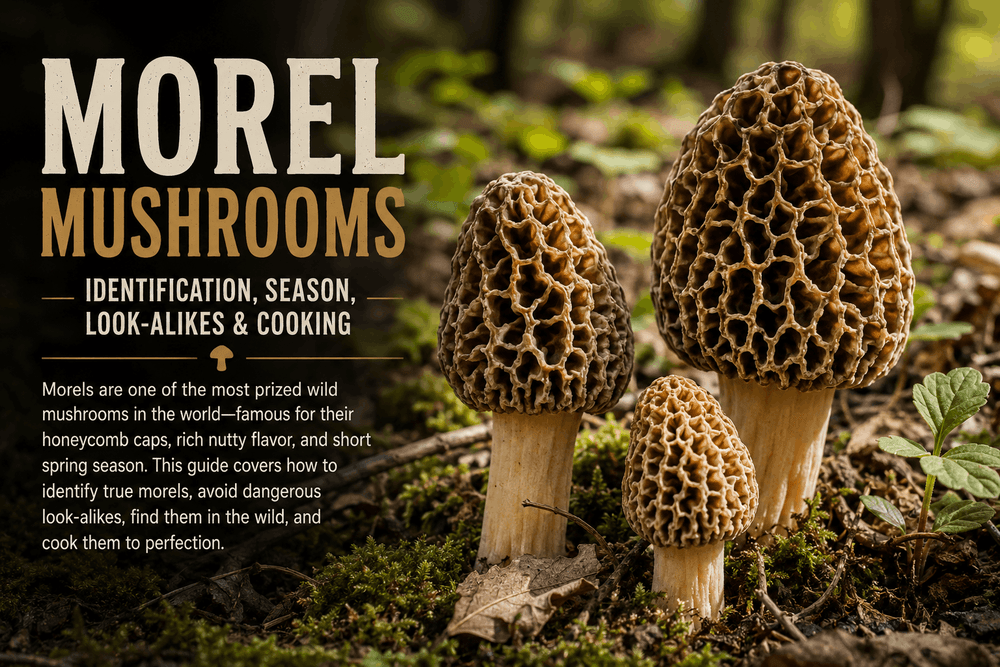
Morel mushrooms (Morchella) are one of the most prized wild mushrooms in the world, famous for their honeycomb-textured caps and rich, nutty, savory flavor. They appear for a short window each spring and—critically—have a toxic look-alike, which makes correct identification essential. They’re also unusual mushrooms biologically: unlike the gilled species most people know, morels are ascomycetes, and their pale spores set them apart under the microscope.
Few mushrooms inspire as much springtime excitement as the morel. Here’s a complete guide to recognizing them, the main types, what their spores look like, how to avoid dangerous look-alikes, and how to grow and cook them.
What Are Morel Mushrooms?
Morels are mushrooms in the genus Morchella, instantly recognizable by their distinctive cap: a pitted, honeycomb-like network of ridges and hollows, attached to a hollow stem. They belong to the Ascomycota — the sac fungi — which makes them biologically distinct from the gilled mushrooms most people picture. Unlike gourmet species such as king oyster or chestnut mushrooms, morels form complex relationships with soil and tree roots, which historically made them very difficult to cultivate—part of why they’ve long been a wild-foraged delicacy.
What Do Morel Mushrooms Look Like?
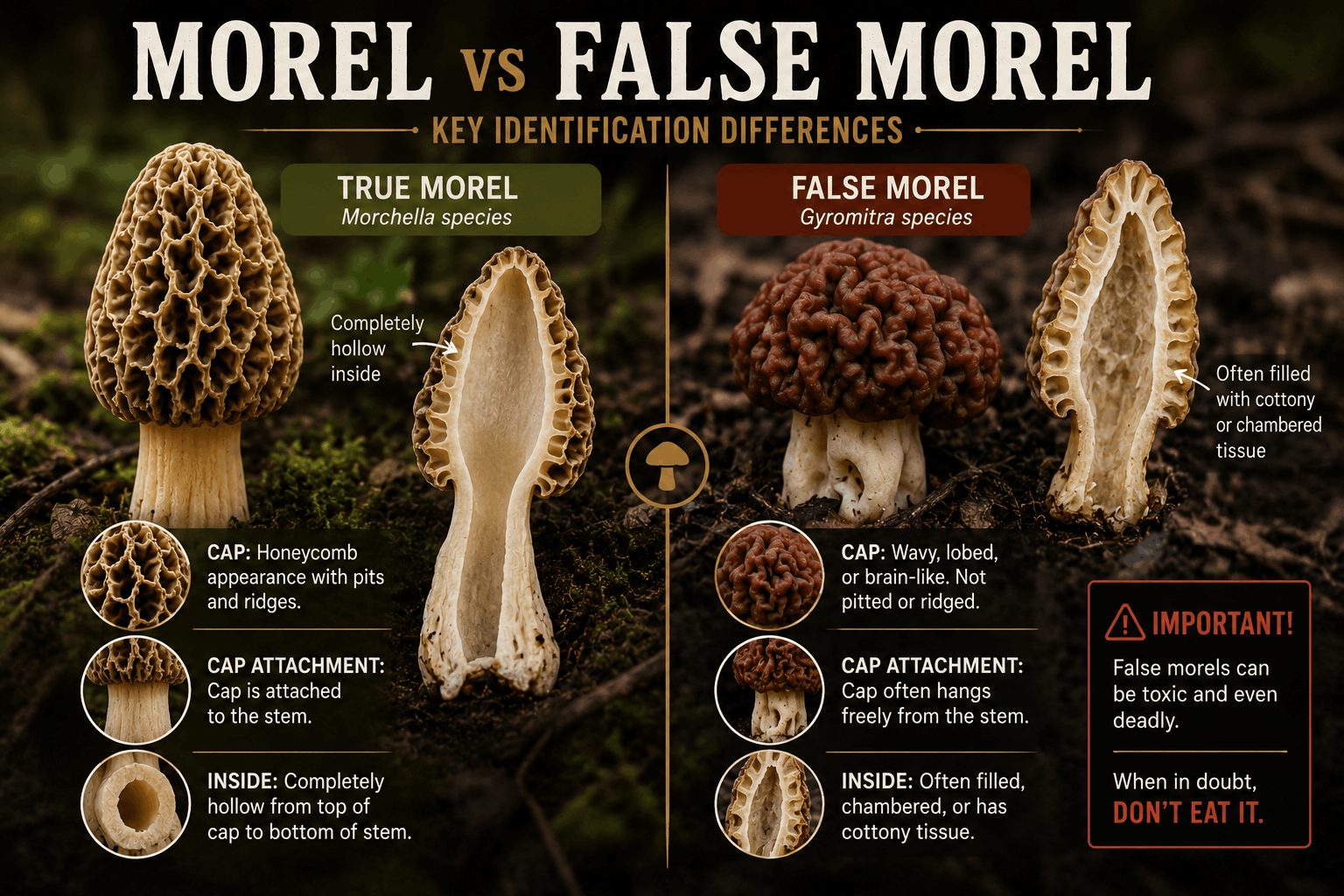
A true morel has two defining features. First, the cap is deeply pitted and ridged like a honeycomb or sponge, and it’s attached to the stem at its base. Second—and this is the key safety test—a true morel is completely hollow inside when sliced lengthwise, from the tip of the cap through the stem. They range in color from pale tan and yellow to gray and dark brown depending on the type and maturity.
Types of Morels
“Morel” covers a number of closely related Morchella species, and taxonomy in the genus is still being worked out. In practical terms, foragers and researchers usually sort them into a few groups by color:
- Yellow / blonde morels — the classic tan-to-golden morels of the Morchella esculenta group. Often the largest and most sought-after.
- Black morels — darker, more sharply ridged caps of the Morchella elata group (including species like M. angusticeps and M. snyderi), which tend to appear earlier in the season.
- Gray morels — generally young yellow morels; the gray is a stage of maturity rather than a separate group in most cases.
- Half-free morels — a distinct group (Morchella subgenus Distantes) where the cap is attached only partway down, leaving a “skirt” hanging free. Useful to know, because the partly-free cap is a step toward the fully-free caps of some false morels.
Color and size vary with age, region, and season, which is exactly why color alone is never a safe identification — the structural tests below matter far more.
Morels Under the Microscope: What Do Morel Spores Look Like?
This is where morels get genuinely interesting for the microscopy researcher, and where they differ most from the gilled mushrooms in the rest of our catalog. Because Morchella is an ascomycete, its spores don’t form on external gills the way a Psilocybe cubensis spore does. Instead they develop inside microscopic sacs called asci — typically eight spores per sac — that line the surface of the honeycomb pits. Those pits aren’t just texture; they’re the fertile, spore-producing surface of the mushroom.
A few things stand out when you study morel spores:
- Spore print color: pale — cream to yellowish or ochre — nothing like the dark purple-brown print of a Psilocybe or the black of a Panaeolus. See where it falls on our spore print color chart.
- Spore shape: large, smooth, ellipsoid, and colorless (hyaline) under the microscope — and comparatively big, which makes them a satisfying subject to examine.
- Arrangement: seeing spores lined up eight-to-a-sac in an ascus is the visual signature of a sac fungus, and a clear way to distinguish morels from the gilled, basidiospore-forming species.
If you’d like to examine them yourself, our guide on how to study spores under a microscope covers slide prep and what to look for.
False Morels: The Dangerous Look-Alike
This is the most important part of any morel guide. “False morels” (such as Gyromitra species) can resemble true morels but are toxic and can be dangerous—even deadly—to eat. The reliable distinctions:
- Hollow vs. filled: a true morel is completely hollow inside; a false morel is often filled with cottony or chambered tissue.
- Cap texture: true morels have a honeycomb of pits and ridges; false morels tend to look wavy, lobed, or “brain-like” rather than pitted.
- Cap attachment: a true morel’s cap is generally attached to the stem, while a false morel’s cap often hangs more freely.
If there is any doubt, do not eat it. Always slice a morel lengthwise to confirm it’s hollow, and never rely on a single feature alone.
When & Where Do Morels Grow?
Morels are a spring mushroom, typically appearing as the soil warms—often from March through May depending on your region and climate. They’re frequently found near certain trees (such as elm, ash, poplar, and old apple orchards), in disturbed ground, and in areas after fire. Their short, weather-dependent season is a big part of why “morel season” generates such a devoted following each year.
Growing Your Own Morels
Because morels are so difficult to cultivate and their wild season is short and unpredictable, growing your own is the most reliable way to enjoy them—and it removes the identification risk that comes with foraging. It takes patience, but it starts with quality genetics: our Golden Morel Liquid Culture gives you living mycelium of a known culture to begin from. If you’re new to working with liquid culture, our mushroom liquid culture guide walks through the basics, and you can browse more varieties in our gourmet cultures collection.
How to Clean & Cook Morel Mushrooms
Cleaning: because of their pitted caps and hollow interiors, morels can harbor grit and insects. Slice them in half lengthwise and rinse or gently soak briefly, then pat dry. Cooking: morels must always be cooked thoroughly—never eaten raw, as raw morels can cause stomach upset. Their classic preparation is simple: sauté in butter until tender and golden, which showcases their rich, nutty, earthy flavor. They’re also wonderful in cream sauces, with pasta, or alongside spring vegetables.
Frequently Asked Questions
What is the scientific name for morel mushrooms?
Morels belong to the genus Morchella, in the phylum Ascomycota (the sac fungi). “Morel” covers a number of closely related Morchella species rather than a single one.
What do morel mushrooms look like?
They have a distinctive honeycomb-pitted cap attached to a hollow stem, and are completely hollow inside when sliced lengthwise. Colors range from tan and yellow to gray and dark brown.
What color is a morel spore print?
Pale — cream to yellowish or ochre. That light print is very different from the dark purple-brown of Psilocybe species, and it reflects the fact that morels are ascomycetes rather than gilled mushrooms.
What are the main types of morels?
The common groupings are yellow/blonde morels (the M. esculenta group), black morels (the M. elata group), gray morels (usually young yellow morels), and half-free morels. Color and size vary with age and region.
How do you tell a true morel from a false morel?
A true morel is completely hollow inside and has a pitted, honeycomb cap; a false morel is often filled with cottony tissue and looks wavy or brain-like. When in doubt, don’t eat it.
When is morel season?
Spring—generally March through May depending on region and soil temperature. The season is short and weather-dependent.
Can you grow morel mushrooms?
Morels are challenging to cultivate because of their complex relationship with soil and tree roots, but it’s possible with patience. Starting from a quality morel liquid culture gives you the best foundation.
Disclaimer: This article is for educational purposes only. Morel mushrooms have toxic look-alikes (false morels) that can be dangerous or deadly—never consume any wild mushroom without expert identification. If you forage, consult a qualified expert and reliable local resources, and when in doubt, throw it out.