The History of Magic Mushrooms & Psilocybin
Posted by Spore Genetics Research Team on May 22nd 2023
The History of Magic Mushrooms & Psilocybin
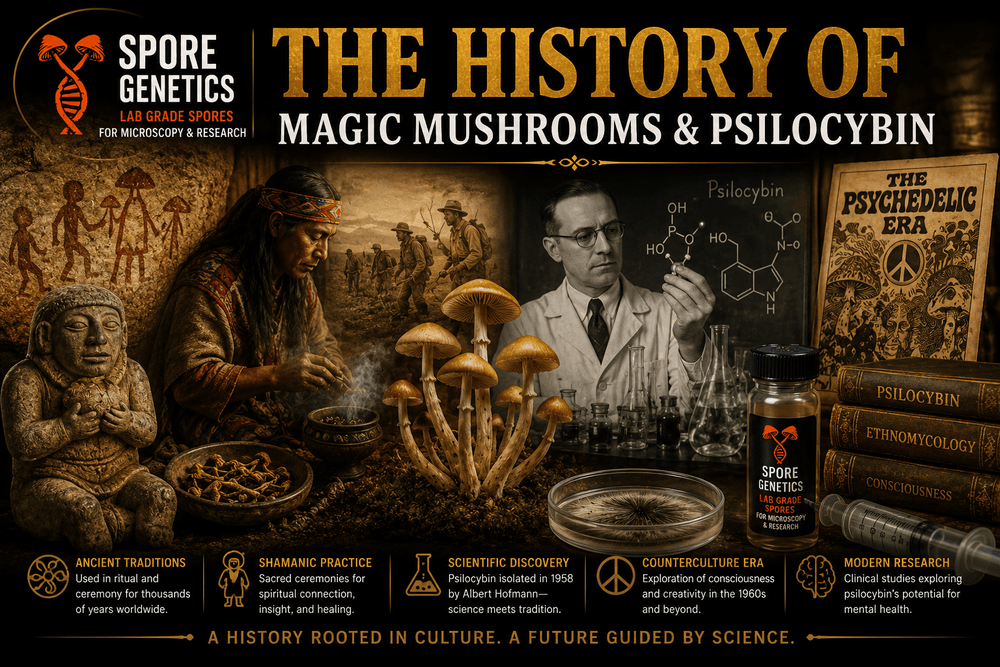
Magic mushrooms have been part of human culture for thousands of years—used in ancient rituals across the world, scientifically decoded in the 20th century when psilocybin was isolated, and now the subject of a modern research renaissance. Their history is a remarkable arc from sacred ceremony to serious science.
Few natural substances have traveled such a long and winding road through human history. Here's the story of magic mushrooms—from ancient beginnings to the laboratory and beyond.
Ancient Beginnings
The story begins deep in prehistory. Indigenous cultures across the globe—from the peoples of Mesoamerica to communities in Africa and beyond—appear to have revered certain mushrooms for their perceived spiritual properties. Rock art and archaeological hints suggest that these fungi may have played a role in ritual and ceremony for thousands of years, woven into the cultural and spiritual fabric of the societies that used them.
Some of the oldest possible evidence comes from prehistoric rock art. The Tassili n'Ajjer paintings in the Sahara (in modern Algeria), thought to be several thousand years old, include figures that some researchers interpret as mushroom-holding shamans, and the Selva Pascuala mural in Spain depicts a row of mushrooms that may represent a local Psilocybe species. In Mesoamerica, the Aztecs called sacred mushrooms teonánacatl—often translated as “flesh of the gods”—and the carved “mushroom stones” found across the region point to ceremonial use stretching back well over two thousand years.
Ritual & Shamanic Practice
In many traditions, mushrooms were used within shamanic and healing practices. Spiritual leaders and healers used them in sacred ceremonies believed to connect participants with the spirit world and offer insight and healing. The best-documented example is the Mazatec tradition of Oaxaca, Mexico—carried into the modern era by the curandera María Sabina, whose story became a pivotal bridge between Indigenous practice and the Western world.
The Discovery of Psilocybin
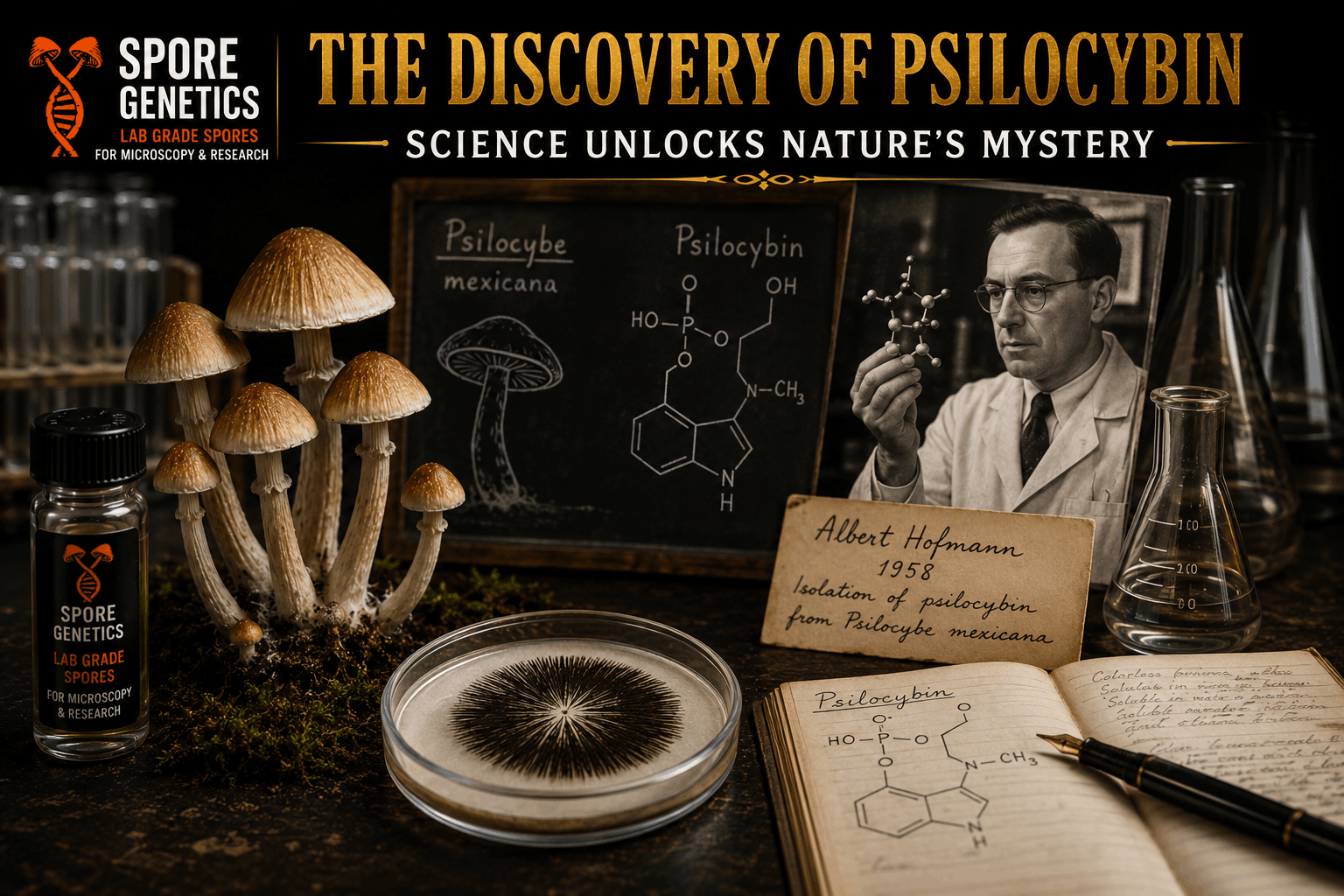
The modern scientific chapter opened in the 1950s. After the Mazatec tradition was introduced to Western audiences in 1957, Swiss chemist Albert Hofmann—already famous for his earlier work with LSD—isolated and identified psilocybin, the compound responsible for the mushrooms' effects, in 1958. This gave science a name and a molecule to study, transforming a cultural curiosity into a subject of serious chemistry and pharmacology. Today, the same species that fascinated early researchers are studied under the microscope—you can explore our mushroom spores collection for taxonomy and research.
Key Moments in Magic Mushroom History
A quick timeline of the milestones that shaped how we understand these mushrooms:
- Prehistory — ritual and ceremonial use by Indigenous cultures worldwide, hinted at in rock art and carved artifacts.
- 1957 — R. Gordon Wasson's account of a Mazatec ceremony is published in Life magazine, introducing the West to sacred mushrooms.
- 1958 — Albert Hofmann isolates and names psilocybin.
- 1960s — the Harvard Psilocybin Project and the wider counterculture bring psychedelics into the mainstream.
- 1968–1971 — psilocybin is prohibited and classified as a Schedule I substance under U.S. federal law.
- 2000s–2010s — modern clinical research revives at institutions like Johns Hopkins and Imperial College London.
- 2018 onward — the FDA grants psilocybin “breakthrough therapy” status for depression, and Oregon and Colorado create regulated adult-use frameworks.
The Counterculture Era
The 1960s marked a dramatic shift in the West's relationship with these mushrooms. Wasson's 1957 Life article, “Seeking the Magic Mushroom,” had brought the Mazatec tradition to millions of readers, and soon after, Harvard researchers Timothy Leary and Richard Alpert launched the Harvard Psilocybin Project. As psychedelics spread among artists, thinkers, and seekers exploring creativity and consciousness, a backlash followed: by the end of the decade the substances were banned, and psilocybin was ultimately classified as Schedule I under U.S. federal law. (For where the law stands today—including why spores themselves occupy a different legal position—see our guide on whether mushroom spores are legal.) Ethnobotanist Terence McKenna later became a prominent advocate, helping keep public fascination alive through the following decades.
The Modern Research Renaissance
In recent years, scientific interest has surged again. Rigorous studies at major institutions—including Johns Hopkins, NYU, and Imperial College London—are now investigating psilocybin's potential in areas like depression, anxiety, and addiction, always within controlled clinical settings. The U.S. FDA has granted psilocybin “breakthrough therapy” designation for treatment-resistant depression, and states such as Oregon and Colorado have created regulated frameworks for supervised adult use. We cover this ongoing work in our guide to psilocybin therapy and research. It's a striking full-circle moment: a substance used in ancient ritual is now the focus of cutting-edge neuroscience.
Why This History Matters
Understanding the history of magic mushrooms adds essential context to the study of these fungi today. It reminds us that they carry a deep human story—cultural, spiritual, and scientific—that stretches back millennia. To learn more about the mushrooms themselves, explore our guides to the types of magic mushrooms and Psilocybe cubensis—or browse the magic mushroom spores we offer for microscopy study.
Frequently Asked Questions
How long have magic mushrooms been used?
Evidence suggests certain mushrooms have been used in ritual and ceremony for thousands of years across many Indigenous cultures worldwide, though exact timelines are difficult to pin down.
Who discovered psilocybin?
Swiss chemist Albert Hofmann isolated and identified psilocybin in 1958, after the Mazatec mushroom tradition was introduced to Western audiences in 1957.
What role did María Sabina play?
The Mazatec curandera María Sabina brought global attention to sacred mushroom traditions in the 1950s, forming a key link between Indigenous practice and modern science.
What is teonánacatl?
Teonánacatl is the Nahuatl (Aztec) name for sacred psilocybin mushrooms, often translated as “flesh of the gods”—a reflection of their revered role in Mesoamerican ritual.
When did magic mushrooms become illegal?
In the United States, psilocybin was prohibited in the late 1960s and classified as a Schedule I controlled substance under the 1970 Controlled Substances Act, where it remains federally today.
Why is there renewed interest in magic mushrooms?
Modern clinical research is investigating psilocybin's potential for mental-health conditions, sparking a scientific “renaissance” after decades of restriction.
Disclaimer: This article is provided for educational and historical purposes only. Psilocybe spores are sold strictly for microscopy and taxonomy research; cultivation of psilocybin mushrooms is illegal in many jurisdictions, including federally in the United States. Nothing here is intended to encourage illegal activity.