
Psilocybe Cyanescens (Wavy Caps) Guide
The Rippled Wood-Lover
Caramel caps with unmistakable wavy edges, growing straight out of the wood chips — this is Psilocybe cyanescens, the true “Wavy Cap.”
Psilocybe cyanescens — the “Wavy Cap” — is a wood-loving mushroom known for the rippled, wave-like edges of its caramel-brown caps and its vivid blue bruising. With purple-brown spores and striking morphology, it's a rewarding subject for microscopy and taxonomy.
Spore Genetics carries it as a single-phenotype Psilocybe Cyanescens Wavy Caps Isolated Spore Syringe ($30) and a 30mL Master Isolate Vial ($39) for larger studies. Below: how to know it, where it grows, and the one species it's constantly confused with.
Psilocybe cyanescens spores, ready for your microscope
In stock · Ships within 24 hours · Free Cubensis spore syringe with every $100 order

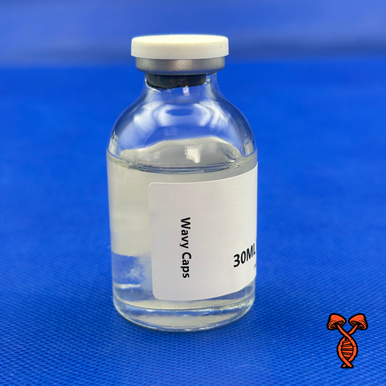
For microscopy & taxonomy research only. Not for cultivation.
Psilocybe Cyanescens at a Glance
| Species | Psilocybe cyanescens |
| Common name | Wavy Cap |
| Cap | Caramel-to-chestnut, wavy margin, 1.5–5 cm; fades as it dries |
| Spore print | Dark purple-brown |
| Habitat | Wood-loving — wood chips, mulch, decaying wood |
| Family | Hymenogastraceae |
| Best for | Microscopy, taxonomy, reference collections |
Not to Be Confused With Panaeolus cyanescens
This is the most mixed-up pair of names in the hobby. The mushroom on this page — Psilocybe cyanescens — is the true “Wavy Cap”: a wood-loving species with purple-brown spores and rippled cap edges. It shares the epithet cyanescens (“becoming blue”) with Panaeolus cyanescens (“Pan Cyan”), but they're different genera entirely.
Pan Cyan is a dung-loving grassland mushroom with jet-black spores. If that's what you're after, see our Panaeolus cyanescens (Pan Cyan) guide. If you want the wavy-edged wood-lover, you're in the right place.
A Traveler in the Wood Chips
First described in 1946 by the British mycologist Elsie Wakefield, Psilocybe cyanescens is native to parts of Europe and the Pacific Northwest of North America. It's a cool-weather, late-autumn mushroom that fruits as temperatures drop.
One of its most interesting quirks is how it travels: because it thrives on wood chips and bark mulch, it has spread widely through landscaping and garden mulch, turning up in parks and flower beds far outside its original range. Wherever fresh wood chips go, the Wavy Cap often follows.
How to Recognize It
The name says it all: as the cap matures, its margin becomes distinctly wavy and undulating. Caps are caramel to chestnut brown when moist and fade to pale buff as they dry (hygrophanous), measuring 1.5–5 cm. The gills run from pale to deep purple-brown as spores mature.
Stems are slender and white, bruising blue where handled — the classic cyanescens reaction. That wavy cap plus a purple-brown spore print is a strong signature, but as always: never identify a wild mushroom from a photo alone.
A True Wood-Lover
Like Psilocybe azurescens, the Wavy Cap is lignicolous — a wood-lover. It draws its nutrients from decaying wood, bark, and wood-chip beds rather than dung or grassland, which is the fundamental thing that separates it from the similarly-named Pan Cyan.
That wood-based, cool-climate lifestyle shapes everything about it — when it fruits, where it appears, and how it has hitchhiked across cities on landscaping mulch.
Under the Microscope
Wavy Cap spores are elliptical, thick-walled, and dark purple-brown, with a distinct germ pore, measuring roughly 9–12 × 5–8 µm. That germ pore and rich color make them a clean, satisfying subject to document — and an easy contrast against the jet-black, lemon-shaped spores of Pan Cyan.
For slide technique and lighting, see our guide on how to study spores under a microscope.
Wavy Caps Formats
Offered as a single-phenotype isolate — prepared in our ISO-7 cleanroom for microscopy and taxonomy. Browse all exotic mushroom spores.

Research use only. Psilocybe cyanescens is a wood-loving species, distinct from both Psilocybe cubensis and Panaeolus cyanescens. All spores are supplied strictly for microscopy, taxonomy, and research — not for cultivation. We ship to every U.S. state except Georgia and Idaho; please confirm the laws where you live before ordering.
Related Species to Study
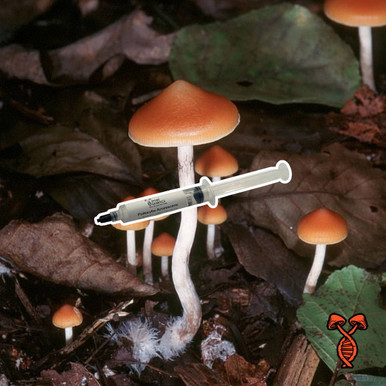
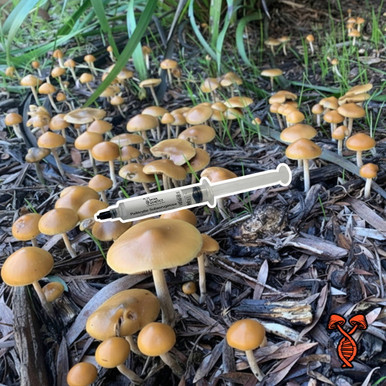
The Wavy Cap's wood-loving relatives, the Pan Cyan it's so often confused with, and the full exotic collection.

Also browse: Isolated Spore Syringes · Cubensis Spore Syringes · Spore Prints · New Arrivals
Psilocybe Cyanescens FAQ
Why is it called the Wavy Cap?
Because the cap margin becomes distinctly wavy and undulating as the mushroom matures — the trait that makes it instantly recognizable.
Is it the same as Panaeolus cyanescens (Pan Cyan)?
No. They share the name cyanescens but are different genera. This one — Psilocybe cyanescens — is the wood-loving Wavy Cap with purple-brown spores. See the Pan Cyan guide for the dung-loving, black-spored one.
Where does it grow?
On decaying wood, bark, and wood-chip mulch — which is how it has spread through landscaping into parks and gardens well beyond its native range in Europe and the Pacific Northwest.
What color are the spores?
Dark purple-brown, with a visible germ pore — a clear point of difference from Pan Cyan's jet-black spores. See our microscopy guide.
Questions About Wavy Caps?
Want to compare it with the other wood-lovers, or with Pan Cyan? Reach out any time via email, or brush up with our mushroom spore basics.
Spore Genetics — Exceptional Mushroom Spores & Cultures