
Psilocybe Azurescens (Flying Saucer) Guide
The Flying Saucer
A wood-loving icon of the Pacific Northwest — famous for its UFO-shaped caramel caps and vivid azure bruising. Here's the real Psilocybe azurescens, from discovery to microscopy.
Psilocybe azurescens — the “Flying Saucer” mushroom — is a rare wood-loving species native to a narrow stretch of the U.S. Pacific Northwest coast. Named for its broad, domed, saucer-shaped cap, it's one of the most recognizable and sought-after wild Psilocybe species for microscopy and taxonomy.
Spore Genetics carries it as a single-phenotype Psilocybe Azurescens Isolated Spore Syringe ($30) and a 30mL Master Isolate Vial ($39) for larger studies. Below: how to know it, where it grows, and what makes it distinct under the scope.
Psilocybe azurescens spores, ready for your microscope
In stock · Ships within 24 hours · Free Cubensis spore syringe with every $100 order
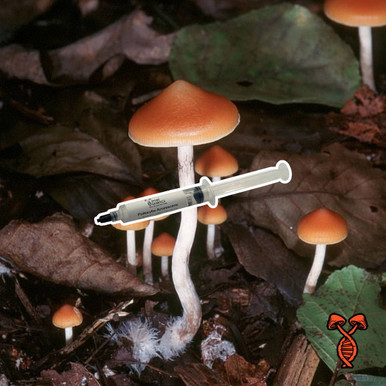

For microscopy & taxonomy research only. Not for cultivation.
Psilocybe Azurescens at a Glance
| Species | Psilocybe azurescens |
| Common names | Flying Saucer, Azzies, Blue Angels |
| Cap | Caramel-to-chestnut, saucer-shaped with a central umbo, 3–10 cm |
| Spore print | Dark purplish-brown to nearly black |
| Habitat | Wood-loving — coastal woody debris & dune grasses |
| Range & season | Pacific Northwest; fruits late September–January |
| Best for | Microscopy, taxonomy, reference collections |
A Pacific Northwest Native
Azurescens has one of the most restricted native ranges of any well-known Psilocybe. It's concentrated along a narrow coastal band near the Columbia River Delta, with the first documented collections made at Hammond, Oregon, near Astoria. From there its populations stretch south toward Depoe Bay and north through Long Beach to Westport, Washington.
Beyond that home turf it's uncommon in the wild, which is part of what makes it such a prized specimen for study — researchers and collectors have documented it for microscopy and taxonomy well beyond the Northwest, but it remains strongly associated with that stretch of the Oregon and Washington coast.
How to Recognize It
The signature look is in the name. The cap is broad and saucer-shaped — caramel to chestnut when moist, fading to straw as it dries — glossy and slightly sticky from a thin gelatinous layer, with a small raised bump (an umbo) at the center that gives it that “flying saucer” profile. The gills run from pale brown to deep purplish-black as spores mature.
The stem is long, slender, and often slightly curved, with white mycelial tufts at the base that show the azure-blue tones the species is named for. Like many Psilocybe, it bruises blue where handled — a classic identification cue. As always with wild fungi: never identify a mushroom from a single photo.
A True Wood-Lover
This is what sets azurescens apart from a strain like Golden Teacher. Where Psilocybe cubensis is associated with grassland and dung, azurescens is lignicolous — a wood-lover. In the wild it grows from sandy soils rich with decaying woody debris and among coastal dune grasses, often forming dense clusters over thick white mycelial mats.
It's also a cold-weather species, fruiting from late September into the depths of winter — a very different rhythm from its warm-loving cubensis cousins. That wood-based, coastal, cold-hardy niche is a big part of its mystique.
Under the Microscope
Azurescens spores are elliptical and dark purplish-brown to nearly black, measuring roughly 12–13 × 6–8 µm — noticeably larger than those of many cubensis strains, which makes them a satisfying subject at magnification. Its distinctive cellular structures and strong contrast make it a favorite for taxonomic comparison and reference collections.
If you're setting up a slide, our guide on how to study spores under a microscope covers the magnification and technique that show these features best.
Azurescens Formats
Offered as a single-phenotype isolate — a stabilized genetic line isolated in-house on agar, prepared in our ISO-7 cleanroom for microscopy and taxonomy. Browse all exotic mushroom spores.
Why Researchers Seek Out Azurescens
A rare wild wood-lover. Its narrow native range makes it an uncommon and prized specimen.
Unmistakable morphology. The saucer cap, umbo, and azure bruising are a joy to document.
Large, distinct spores. At 12–13 µm, they're a rewarding, high-contrast microscopy subject.
A stabilized isolate. Single-phenotype genetics for consistent, reproducible study.
Research use only. Psilocybe azurescens is a wood-loving species distinct from Psilocybe cubensis. All azurescens spores are supplied strictly for microscopy, taxonomy, and research — not for cultivation. We ship to every U.S. state except Georgia and Idaho; please confirm the laws where you live before ordering.
Related Species to Study
Azurescens' closest wood-loving relatives, another rare wild Psilocybe, and the full exotic collection.

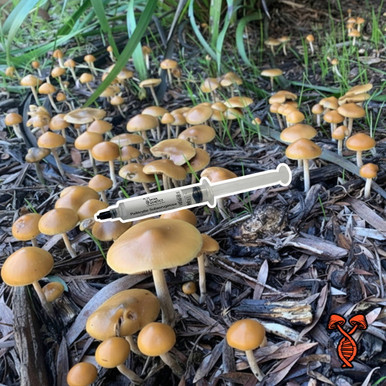


Also browse: Isolated Spore Syringes · Cubensis Spore Syringes · Spore Prints · New Arrivals
Psilocybe Azurescens FAQ
Why is it called the “Flying Saucer” mushroom?
For its cap — broad, domed, and saucer-shaped with a small central bump (umbo) that gives it a distinctly UFO-like silhouette.
How is azurescens different from cubensis?
Azurescens is a wood-loving, cold-weather coastal species with larger spores, while Psilocybe cubensis is a warm-loving grassland/dung species. They look, grow, and fruit quite differently.
Where does it grow in the wild?
Along a narrow band of the Pacific Northwest coast — near the Columbia River Delta in Oregon and Washington — on woody debris and among coastal dune grasses.
What are the spores like under magnification?
Elliptical, dark purplish-brown to nearly black, and relatively large at 12–13 × 6–8 µm — see our microscopy guide.
Questions About Azurescens?
Curious how it compares to other species, or which format suits your study? Reach out any time via email, or brush up with our mushroom spore basics.
Spore Genetics — Exceptional Mushroom Spores & Cultures