Panaeolus Cyanescens (Pan Cyan) Guide
Blue Meanies
Small, pale, and quick to stain deep blue — Panaeolus cyanescens is a tropical dung-lover with jet-black spores and a devoted following. Here's the real Pan Cyan.
Panaeolus cyanescens — “Pan Cyan” or the “Blue Meanies” — is a small, dung-loving tropical mushroom known for its pale caps, dramatic cyan-blue bruising, and distinctive jet-black spores. It's a favorite among researchers for its high-contrast spores and unmistakable staining under the microscope.
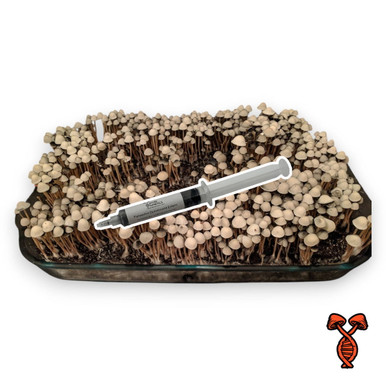
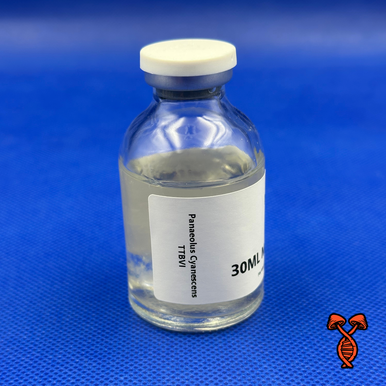
Spore Genetics carries Pan Cyan as the Estero Spore Syringe ($25) and the TTBVI Isolated Spore Syringe ($30), with 30mL master vials for larger studies. Below: the varieties, how to know it, and one very important name it's often confused with.
Panaeolus cyanescens spores, ready for your microscope
In stock · Ships within 24 hours · Free Cubensis spore syringe with every $100 order

For microscopy & taxonomy research only. Not for cultivation.
Panaeolus Cyanescens at a Glance
| Species | Panaeolus cyanescens (syn. Copelandia cyanescens) |
| Common names | Pan Cyan, Blue Meanies |
| Spore color | Jet black, heavy deposit |
| Cap | Small (1.5–5 cm), pale grey to tan; strong blue bruising |
| Habitat | Dung-rich tropical & subtropical grasslands |
| Family | Bolbitiaceae |
| Best for | Microscopy, taxonomy, reference collections |
Not to Be Confused With Psilocybe cyanescens
This is the single most common mix-up in the hobby. Panaeolus cyanescens (this page — Pan Cyan) and Psilocybe cyanescens (the “Wavy Cap”) share the species name cyanescens — Latin for “becoming blue” — but they are completely different mushrooms in different genera.
Pan Cyan is a dung-loving grassland species with jet-black spores, in the family Bolbitiaceae. The Wavy Cap is a wood-loving species with purple-brown spores and rippled cap edges. Same nickname root, very different fungi — if you're after the wavy-edged wood-lover, that's Psilocybe cyanescens: see our Wavy Caps guide, or shop the isolate syringe and master vial.
The Estero & TTBVI Varieties
Estero is a Florida line, collected from the grass-fed cattle pastures of Estero — genetically distinct from other Florida Pan Cyans and prized for its pale grey caps and clean black spore deposits.
TTBVI stands for Tamarind Tree – British Virgin Islands, marking exactly where it was first foraged: beneath a tamarind tree in a humid, dung-rich micro-climate. It's known for creamy, blue-tinged caps and heavy spore deposition — a favorite for high-contrast slides.
How to Recognize It
Pan Cyan is a small, delicate mushroom: pale grey-to-tan caps just 1.5–5 cm across, atop long, thin white stems, with tightly packed gills that darken as the black spores mature. It's a much smaller, finer mushroom than a cubensis.
The giveaway is the bruising: handle it and the pale flesh stains a vivid cyan-blue almost immediately — the trait that earned it the “Blue Meanie” name. Paired with a jet-black spore print, that's a strong identification signature. As always, never identify a wild mushroom from a photo alone.
Under the Microscope
This is where Pan Cyan shines as a study subject. Its spores are jet-black, lemon-shaped (citriform), and thick-walled with a distinct germ pore, and they deposit heavily — giving exceptional contrast and clarity on a slide. That dark, dense deposit is part of why researchers seek it out for reference collections.
Setting up a slide? Our guide on how to study spores under a microscope covers the magnification and lighting that show these features best.
Pan Cyan Formats
Both the Estero and TTBVI lines, as multi-spore syringes and single-phenotype isolates — all prepared in our ISO-7 cleanroom for microscopy and taxonomy. Browse all Panaeolus cyanescens spores.
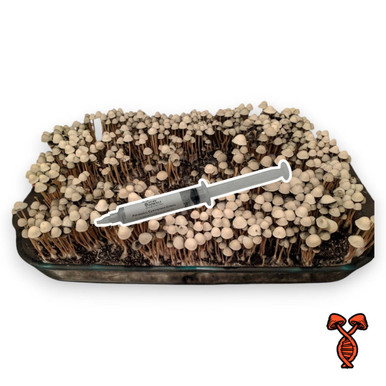

Also available in bulk as Estero and TTBVI 30mL Master Isolate Vials.
Research use only. Panaeolus cyanescens is a dung-loving grassland species distinct from Psilocybe cubensis. All Pan Cyan spores are supplied strictly for microscopy, taxonomy, and research — not for cultivation. We ship to every U.S. state except Georgia and Idaho; please confirm the laws where you live before ordering.
More to Study
Larger-volume Pan Cyan master vials, the Wavy Cap it's so often confused with, and the full Panaeolus collection.


Panaeolus Cyanescens FAQ
What is Panaeolus cyanescens?
A small, dung-loving tropical mushroom — commonly called Pan Cyan or Blue Meanies — known for pale caps, strong blue bruising, and jet-black spores.
Is it the same as Psilocybe cyanescens (Wavy Cap)?
No — that's the most common mix-up. They share the name cyanescens but are different species in different genera. Pan Cyan is a dung-loving, black-spored grassland mushroom; the Wavy Cap is a wood-loving Psilocybe with purple-brown spores.
What's the difference between Estero and TTBVI?
They're two documented collections of the same species: Estero is a Florida cattle-pasture line, while TTBVI was foraged under a tamarind tree in the British Virgin Islands. Both are Pan Cyan — different origins, same species.
What color are the spores?
Jet black, with heavy deposition — a key identification trait and part of what makes them such a high-contrast microscopy subject.
Questions About Pan Cyan?
Not sure whether to start with Estero or TTBVI, or which format fits your study? Reach out any time via email, or brush up with our mushroom spore basics.
Spore Genetics — Exceptional Mushroom Spores & Cultures