
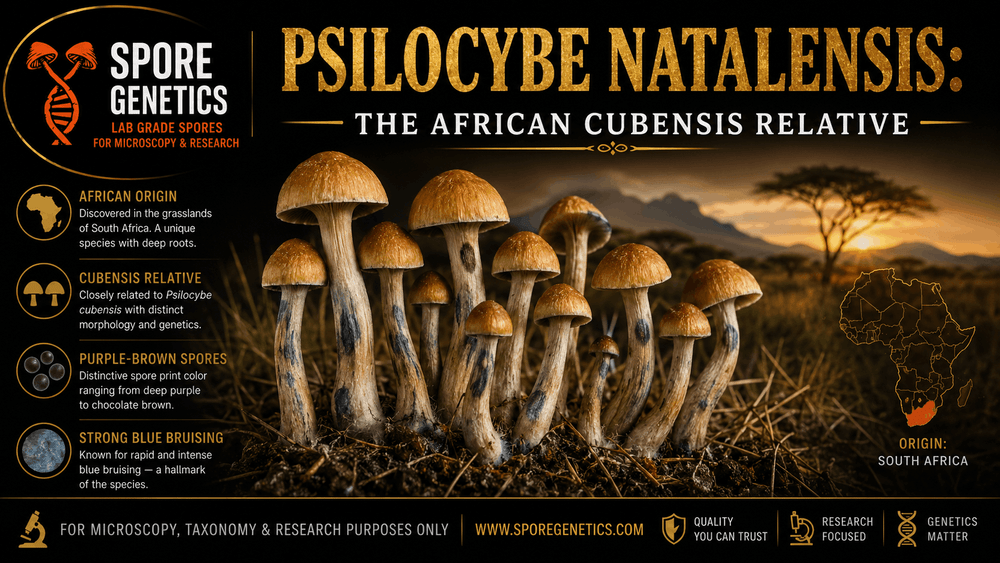
Psilocybe Natalensis: The African Cubensis Relative
Posted by Spore Genetics Research Team on May 30th 2023
Psilocybe Natalensis: The African Cubensis Relative
Psilocybe natalensis is a psilocybin mushroom native to South Africa, closely related to—and often compared with—the well-known Psilocybe cubensis. Recognized by its caramel-colored cap and strong blue bruising, it has recently been the subject of an important taxonomic update: DNA analysis has reclassified it as a distinct species, Psilocybe ochraceocentrata.
While most famous Psilocybe species come from the Americas or Europe, Psilocybe natalensis brings an African chapter to the genus. Here's a clear look at what it is, how to identify it, the recent name change, and how it compares to its famous cousin.
What Is Psilocybe Natalensis?
Psilocybe natalensis is a dung- and grassland-loving mushroom native to the KwaZulu-Natal region of South Africa, from which it takes its name. Like Psilocybe cubensis, it grows in and around the dung of grazing animals in warm, humid, subtropical conditions. It's one of the best-documented psilocybin species from Africa and has become increasingly well known among enthusiasts and researchers. You can study this species with our Black Cap Natalensis Isolated Spore Syringe, isolated and stabilized from wild South African genetics.
Natalensis or Ochraceocentrata? A Recent Reclassification
Here's an important update that sets accurate sources apart. For years, this mushroom circulated under the name Psilocybe natalensis and was often assumed to be a regional variety of Psilocybe cubensis. However, recent DNA sequencing confirmed it as a genetically distinct species, now named Psilocybe ochraceocentrata—meaning "ochre center," a nod to the golden-brown hue radiating from the middle of its cap. So while many people still search for and know it as "natalensis," the current, scientifically accurate name is Psilocybe ochraceocentrata. Our Psilocybe Ochraceocentrata aff. Natalensis Isolated Spore Syringe reflects this updated taxonomy.
Identification & Key Features
Psilocybe natalensis closely resembles cubensis, which is part of what makes it interesting to study. It typically has a caramel to golden-brown cap—often paler and sometimes almost whitish—with that characteristic ochre center, a whitish stem, and the strong blue bruising typical of the genus. Its spore print is purple-brown. Because it looks so similar to cubensis, careful attention to multiple features—including microscopic ones—is important for accurate identification.
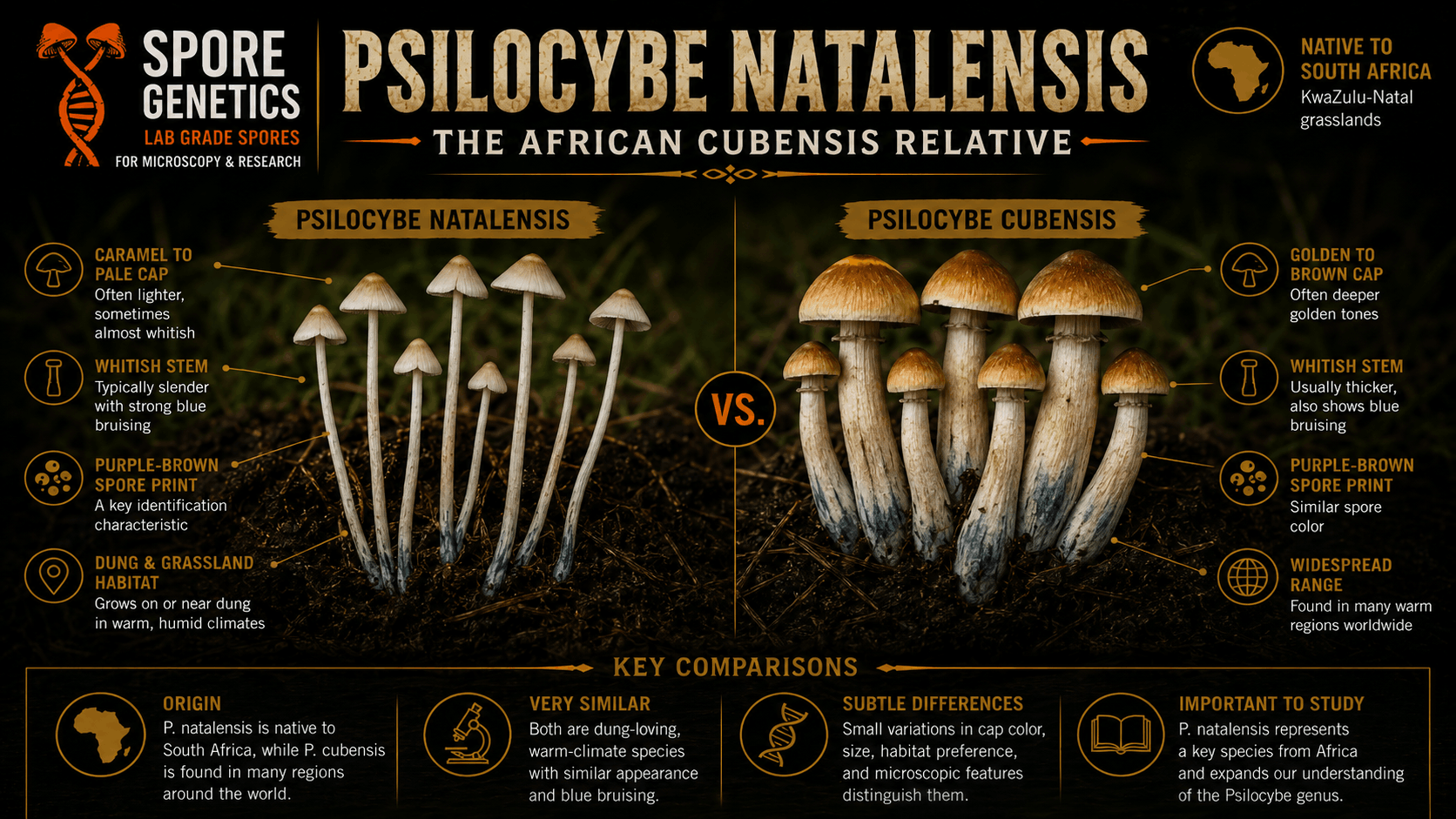
Psilocybe Natalensis vs. Cubensis
These two are frequently compared because they're so alike—both are dung-loving, warm-climate species with similar caps and blue bruising. The main distinctions come down to origin and subtle features: natalensis (ochraceocentrata) hails from South Africa, while cubensis is found across many warm regions worldwide, and there are minor differences in coloration and microscopic characteristics. For enthusiasts familiar with cubensis, natalensis offers a fascinating close comparison from a different continent—and, as the reclassification shows, a genuinely distinct species.
Habitat & Range
Psilocybe natalensis is native to South Africa, particularly the KwaZulu-Natal region, where it grows in grasslands and pastures on or near animal dung in warm, humid conditions. It was first collected there in the 1990s, and its range and dung-loving lifestyle mirror the habits seen in cubensis, adapted to the southern African climate.
Where It Fits in the Genus
Psilocybe natalensis is one of many species across the globally distributed Psilocybe genus, each adapted to its own region and habitat. To see how the species relate—from the American wood-lovers to the Mexican species and beyond—visit our guide to the types of magic mushrooms, or browse the species we offer for microscopy study in our Exotic Mushroom Spores collection.
Frequently Asked Questions
What is Psilocybe natalensis?
It's a psilocybin mushroom native to South Africa, closely related to Psilocybe cubensis. It's one of the best-known psilocybin species from the African continent, recently reclassified as Psilocybe ochraceocentrata.
Is Psilocybe natalensis the same as Psilocybe ochraceocentrata?
Yes—recent DNA analysis reclassified the mushroom long known as Psilocybe natalensis as a distinct species, Psilocybe ochraceocentrata. Many people still search for it under the natalensis name.
How is Psilocybe natalensis different from cubensis?
They're very similar—both dung-loving, warm-climate species—but natalensis is native to South Africa, with subtle differences in coloration, an ochre-centered cap, and microscopic features. It's now confirmed as a genetically distinct species.
How do you identify Psilocybe natalensis?
By its caramel-to-pale cap with an ochre center, whitish stem, strong blue bruising, and purple-brown spore print. Because it resembles cubensis, multiple features should be assessed together.
Disclaimer: Psilocybe spores are sold strictly for microscopy, taxonomy, and research purposes. Cultivation of psilocybin mushrooms is illegal in many jurisdictions, including federally in the United States. This article is educational and not intended to encourage any activity that violates federal or local laws. Never consume wild mushrooms.