How Does Psilocybin Affect the Brain?
Posted by Spore Genetics Research Team on Feb 16th 2026
How Does Psilocybin Affect the Brain?
Psilocybin — the compound behind magic mushrooms — has moved from the cultural fringes back into serious laboratories, and the question people keep asking is a simple one: what actually happens in the brain? Here's what the current science describes, in plain terms — presented for education, not as medical or usage advice.
What Psilocybin Is
Psilocybin is a naturally occurring compound found in more than 200 species of mushrooms. Once ingested, the body converts it to psilocin, the active molecule that interacts with the brain. For the full chemistry, see our guide to what is psilocybin. Everything below is about what that molecule does once it reaches the brain.
It Acts on Serotonin Receptors
Psilocin's main action is on the brain's serotonin system — specifically the 5-HT2A receptor. Serotonin helps regulate mood, perception, and cognition; psilocin binds to and activates these receptors, setting off the cascade of changes in perception and thought associated with the compound. This receptor activity is the starting point for nearly everything else researchers observe.
It Quiets the Default Mode Network
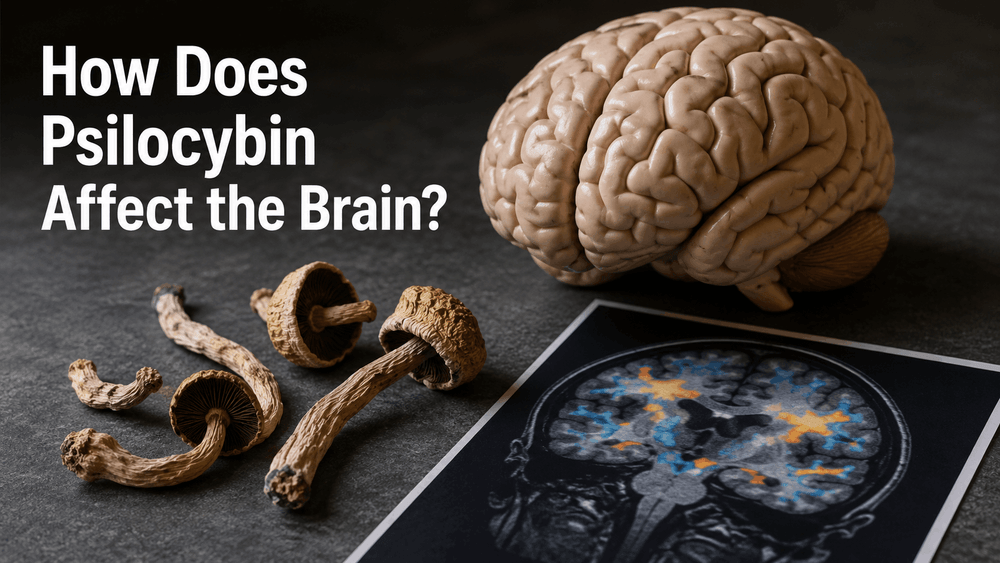
One of the most studied findings involves the default mode network (DMN) — a set of brain regions most active when we're self-reflecting, ruminating, or caught up in our internal narrative. Brain-imaging studies have repeatedly shown that psilocybin temporarily reduces activity and connectivity within the DMN. Researchers associate this quieting with the loosening of the rigid sense of self people describe — sometimes called “ego dissolution” — and with a heightened feeling of connectedness. That sense of connection so often reported anecdotally appears to have a measurable correlate in how these networks behave.
It Increases Cross-Talk Between Brain Regions
While the DMN quiets, brain regions that don't normally communicate directly begin to. Imaging shows a more globally interconnected brain, with novel communication between areas — a temporarily more “flexible” state researchers think may underlie the vivid, associative quality of the experience.
It May Promote Neuroplasticity
A major focus of current research is neuroplasticity — the brain's ability to form new connections. Preclinical studies suggest psilocybin can promote the growth of new dendritic spines (the points where neurons connect). This is an active, unfolding area of study, not a settled conclusion — but it's much of why the compound has drawn scientific attention.
What Research Is — and Isn't — Saying
Institutions like Johns Hopkins, NYU, and Imperial College London are actively investigating psilocybin in controlled clinical settings. But this research is ongoing, tightly supervised, and far from complete. Psilocybin is not an approved treatment, and nothing here should be read as a claim that it treats, cures, or prevents any condition. For the historical arc, see our history of magic mushrooms; for the wider functional-mushroom picture, our guide to the therapeutic benefits of mushrooms.
A Note on Legality and Research
Psilocybin remains a Schedule I substance under U.S. federal law, and cultivating psilocybin mushrooms is illegal in most jurisdictions. The specimens themselves are studied legally in other ways — their spores are used for microscopy and taxonomy, which is how we supply them. See are mushroom spores legal for the current picture, or explore study specimens in our mushroom spores collection.
Frequently Asked Questions
How does psilocybin affect the brain?
It converts to psilocin, which activates serotonin 5-HT2A receptors, quiets the default mode network, and increases communication between brain regions that don't usually interact directly.
What is the default mode network?
It's a set of interconnected brain regions tied to self-reflection and our internal narrative. Psilocybin temporarily reduces its activity, which researchers link to the altered sense of self people report.
Does psilocybin cause “ego death”?
“Ego dissolution” is the term researchers use for the temporary loosening of the normal sense of self, associated with reduced default-mode-network activity. It is temporary.
Does psilocybin permanently change the brain?
Research into lasting neuroplasticity is ongoing and not settled. The acute changes in brain-network activity themselves are temporary.
Is psilocybin legal?
No — psilocybin is federally Schedule I in the United States. Mushroom spores, which contain no psilocybin, are used legally for microscopy in most states.
Disclaimer: This article is for educational purposes only and is not medical advice. Psilocybin is a Schedule I controlled substance, and cultivation of psilocybin mushrooms is illegal in many jurisdictions, including federally in the United States. Spores are sold strictly for microscopy and taxonomy research. We ship to every U.S. state except Georgia and Idaho.