
Chicken of the Woods: Identification, Look-Alikes & How to Grow It
Posted by Spore Genetics Research Team on May 17th 2023
Chicken of the Woods: Identification, Look-Alikes & How to Grow It
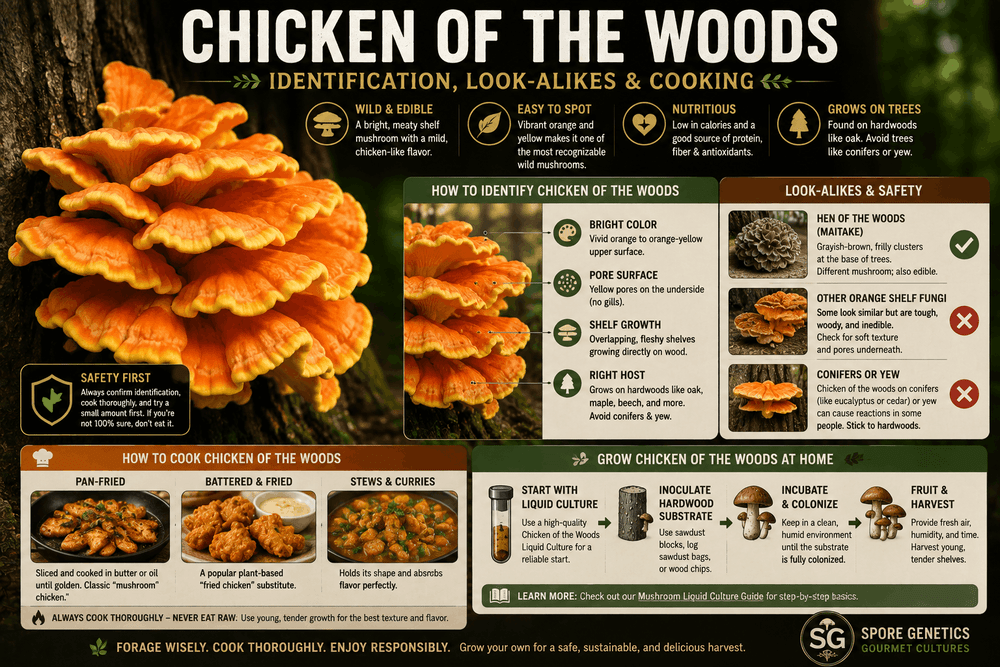
Chicken of the woods (Laetiporus) is one of the most recognizable wild edible mushrooms—a vivid orange-and-yellow shelf fungus that grows on trees and is famous for its meaty texture and mild flavor, often compared to chicken. Its bright color makes it easy to spot, but safe foraging still depends on correct identification and proper preparation.
Few wild mushrooms are as striking—or as beginner-friendly to recognize—as chicken of the woods. Here's a complete guide to identifying it, avoiding its look-alikes, cooking it safely, and even growing your own.
What Is Chicken of the Woods?
Chicken of the woods refers to several species in the genus Laetiporus, a group of bracket (shelf) fungi that grow in overlapping clusters on the trunks and stumps of trees. They're instantly recognizable by their bright orange-to-yellow coloring and soft, fleshy shelves. The name comes from their texture and flavor when cooked—meaty and mild, a well-known plant-based stand-in for chicken.
Species of Chicken of the Woods
“Chicken of the woods” isn't a single species but a group within the genus Laetiporus. Knowing which one you've found helps with both identification and safety:
- Laetiporus sulphureus — the classic sulphur shelf: bright orange caps with sulphur-yellow pores, common on hardwoods (especially oak) across eastern North America and Europe.
- Laetiporus cincinnatus — forms rosette-like clusters at the base of trees or from buried roots, with salmon-orange caps and a white (rather than yellow) pore surface.
- Laetiporus gilbertsonii — the common western species, found on oak and eucalyptus along the US West Coast.
- Laetiporus conifericola — grows on conifers and is the species most associated with stomach upset, which is a key reason foragers favor hardwood specimens.
How to Identify Chicken of the Woods
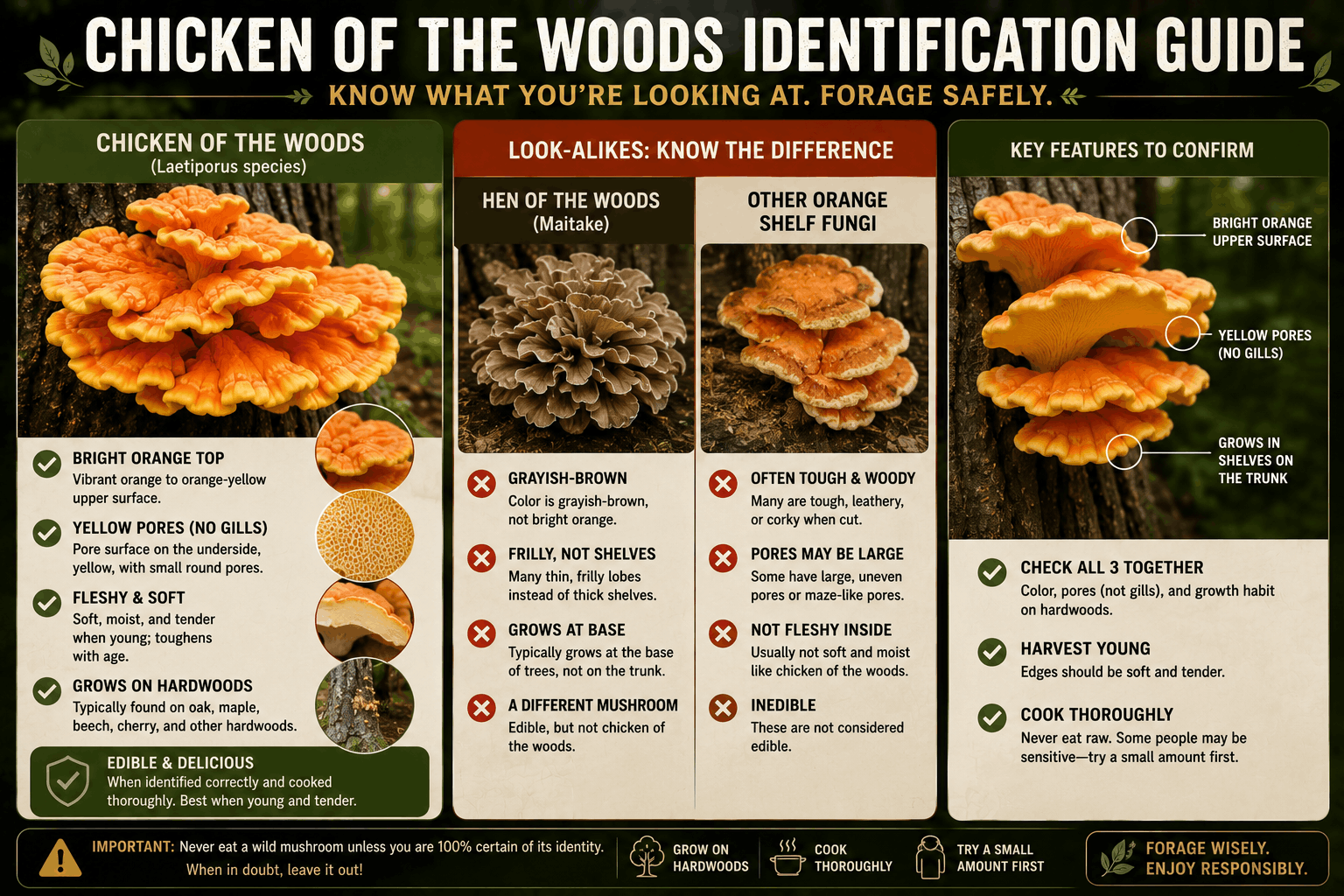
The key identifying features are hard to miss: bright orange upper surfaces with yellow pore-covered undersides (no gills), growing as overlapping shelves directly on wood. Young, tender growth at the outer edges is the best part. A crucial safety note on trees: chicken of the woods growing on conifers (like eucalyptus or cedar) or on yew can cause reactions in some people—most foragers stick to specimens growing on hardwoods such as oak.
Look-Alikes & Safety
Chicken of the woods is often confused with a couple of other bracket fungi:
- Hen of the woods (Maitake) — a different edible entirely, grayish-brown and frilly rather than bright orange.
- Other orange shelf fungi — some bracket fungi resemble it but are tough, woody, and inedible.
Two rules keep foragers safe: always confirm the bright orange/yellow color, pore surface, and hardwood host together, and always cook it thoroughly—never eat it raw. As with any wild mushroom, if you're not completely certain of the identification, don't eat it.
Chicken of the Woods Under the Microscope
Because chicken of the woods is a polypore, its spores are produced inside the tiny tubes of its yellow pore surface rather than on gills. Under the microscope, Laetiporus leaves a white spore print—a helpful confirmation feature, and a clear contrast with the dark purple-brown prints of psilocybin species like Psilocybe cubensis. The spores themselves are small, smooth, and colorless (hyaline), broadly egg-shaped to ellipsoid, and roughly 5–7 microns long. If you'd like to examine spores like these yourself, our guides on how to study spores under a microscope and how to use a spore print walk through the process.
How to Cook Chicken of the Woods
Its firm, meaty texture makes it a favorite for savory cooking:
- Pan-fried — sliced and cooked in butter or oil until golden; a classic “mushroom chicken.”
- Battered & fried — a popular plant-based “fried chicken” substitute.
- In stews & curries — it holds its shape and absorbs flavor well.
Always use young, tender growth and cook it thoroughly. Some people are sensitive to it even when properly prepared, so it's wise to try a small amount the first time.
Growing Chicken of the Woods at Home
Foraging isn't the only option—growing your own removes the identification risk entirely. Chicken of the woods can be cultivated on hardwood-based substrates, and starting from a quality liquid culture gives you a reliable, known source. You'll find our Chicken of the Woods Liquid Culture in our gourmet cultures collection, and our mushroom liquid culture guide covers the basics for beginners. For a full walkthrough specific to this species, follow our step-by-step guide on how to cultivate Chicken of the Woods at home.
Frequently Asked Questions
What is chicken of the woods?
It's a bright orange-and-yellow bracket mushroom (genus Laetiporus) that grows on trees, known for its meaty texture and mild, chicken-like flavor when cooked.
How do you identify chicken of the woods?
Look for bright orange upper surfaces, yellow pore-covered undersides (no gills), and overlapping shelves growing on wood—ideally hardwoods like oak. Confirm all features together.
Is chicken of the woods safe to eat?
Yes, when correctly identified, harvested young, and cooked thoroughly. Avoid specimens on conifers or yew, never eat it raw, and try a small amount first, as some people are sensitive to it.
What's the difference between chicken and hen of the woods?
They're different mushrooms—chicken of the woods is bright orange and meaty; hen of the woods (maitake) is grayish-brown and frilly. Both are edible but look and taste distinct.
What color is a chicken of the woods spore print?
White. As a polypore, Laetiporus releases white, hyaline (colorless) spores from its pore surface—quite different from the dark purple-brown prints of psilocybin mushrooms.
Are there different types of chicken of the woods?
Yes. The name covers several Laetiporus species, including L. sulphureus (yellow-pored, on hardwoods), L. cincinnatus (white-pored, at the tree base), and L. conifericola (on conifers). Hardwood-grown specimens are generally preferred.
Disclaimer: This article is for educational purposes only. Never consume any wild mushroom without expert identification—look-alikes and individual sensitivities exist. Chicken of the woods cultures are intended for legal gourmet cultivation; always source edibles from a trusted supplier or grow from a known culture.