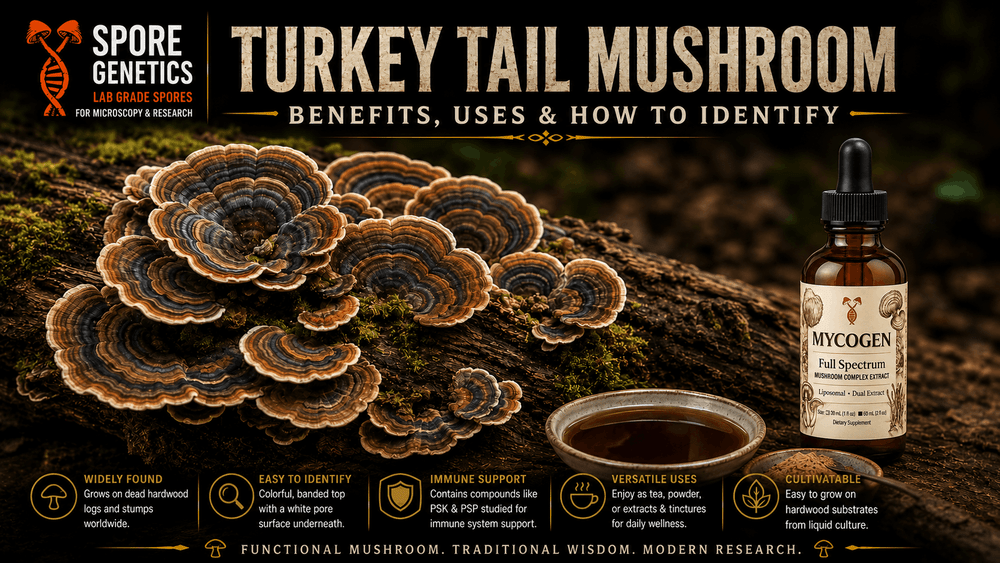
Turkey Tail Mushroom: Benefits, Uses & How to Identify
Posted by Spore Genetics Research Team on May 24th 2023
Turkey Tail Mushroom: Benefits, Uses & How to Identify
Turkey tail (Trametes versicolor) is one of the world's most recognizable and widely studied functional mushrooms—named for its colorful, banded, fan-shaped growth that resembles a wild turkey's tail. Found on decaying wood across the globe, it has a long history in traditional wellness practices and is a major focus of modern mushroom research.
Turkey tail is a great introduction to the world of functional mushrooms—common, easy to recognize, and deeply studied. Here's a clear look at how to identify it, the benefits researchers are exploring, and how it's used.
What Is Turkey Tail?
Turkey tail (Trametes versicolor) is a common polypore—a bracket or shelf fungus—that grows in overlapping clusters on dead logs, stumps, and branches worldwide. Like chicken of the woods and hen of the woods, it's a wood-decaying fungus, but it's valued for wellness rather than the dinner plate—it's too thin and leathery to eat like a culinary mushroom, and is instead used in teas, powders, and extracts.
How to Identify Turkey Tail
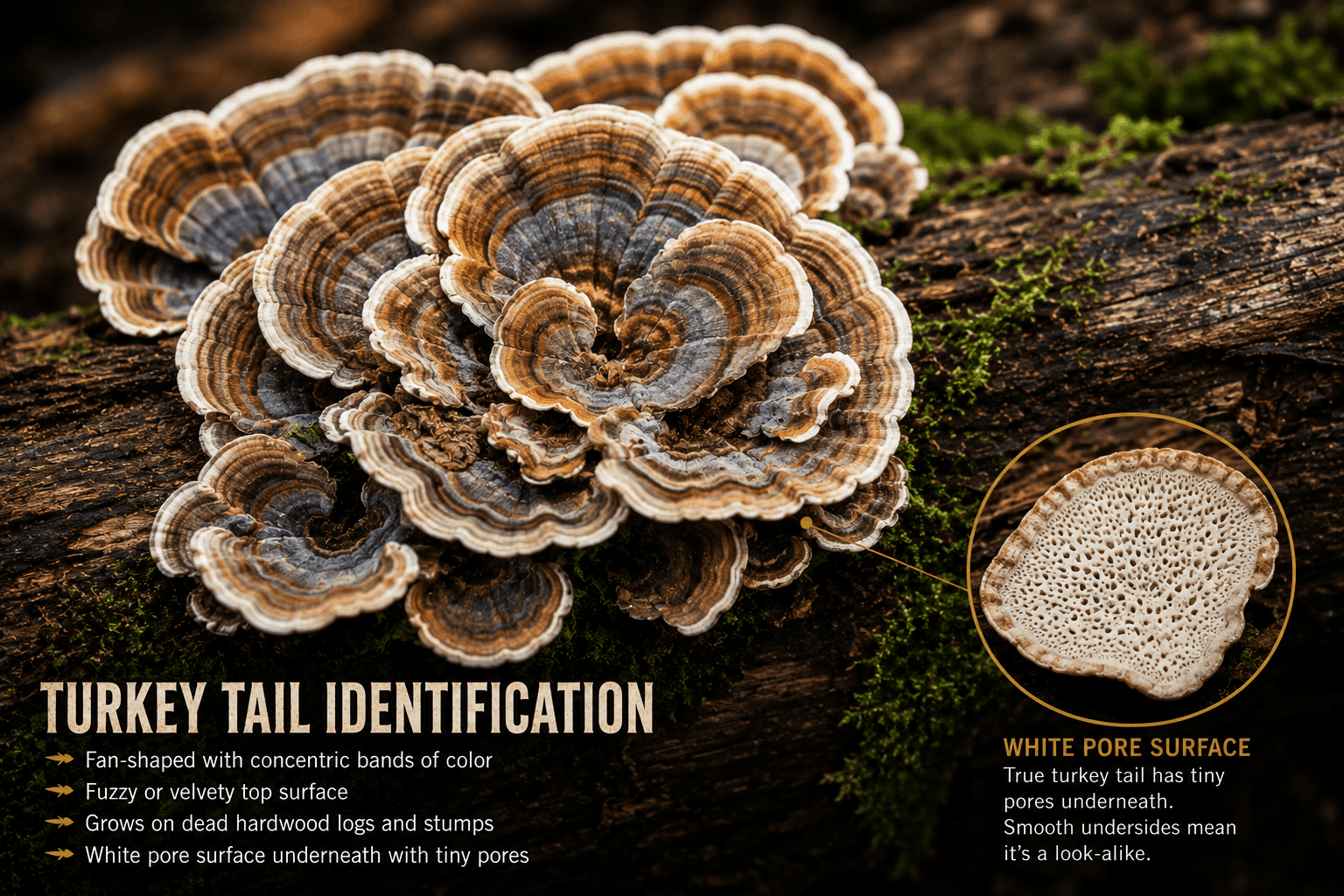
Turkey tail is known for its striking concentric bands of color—browns, tans, grays, blues, and rusts—arranged in a fan shape, with a fuzzy or velvety top surface. The key identifying feature is on the underside: true turkey tail has a white pore surface with tiny visible pores, which distinguishes it from similar-looking "false turkey tail" species that have a smooth underside. As always, confirm multiple features together.
Turkey Tail Benefits
Turkey tail is one of the most researched functional mushrooms. It's a natural source of fiber and antioxidants and contains compounds—notably polysaccharides such as PSK and PSP—that have been the subject of considerable scientific study, particularly around immune support. It's important to frame this accurately: these are areas of ongoing research rather than established medical treatments. Turkey tail is widely used as a wellness supplement, but it isn't a cure or a substitute for medical care.
How Turkey Tail Is Used
Because it's too tough to eat as food, turkey tail is typically consumed in other forms:
- Tea — simmered to make a mild, earthy herbal tea.
- Powder — dried and ground for adding to drinks or smoothies.
- Extracts & tinctures — concentrated preparations, the most common supplement form. Turkey tail is a classic component of multi-mushroom blends like our Mycogen Full Spectrum Mushroom Complex, part of our mushroom extracts line.
Growing Turkey Tail
Turkey tail is a rewarding functional mushroom to cultivate, growing well on hardwood-based substrates. Starting from a liquid culture gives you a reliable, known strain to work with—our Turkey Tail Liquid Culture comes ready to inoculate your substrate. Browse more options in our gourmet and functional cultures collection, and see our mushroom liquid culture guide to get started.
Frequently Asked Questions
What is turkey tail mushroom?
It's a common wood-decaying bracket fungus (Trametes versicolor) named for its colorful, banded, fan-shaped appearance. It's one of the most studied functional mushrooms and is used in teas, powders, and extracts.
What are turkey tail's benefits?
It's a source of fiber and antioxidants and contains compounds studied for immune support. These are areas of ongoing research, not established medical treatments—it's used as a wellness supplement, not a cure.
How do you identify turkey tail?
Look for concentric bands of color in a fan shape with a fuzzy top, and—crucially—a white pore surface underneath, which distinguishes true turkey tail from smooth-undersided look-alikes.
How is turkey tail used?
Because it's too tough to eat as food, it's typically consumed as tea, powder, or concentrated extracts and tinctures.
Disclaimer: This article is for educational purposes only and is not medical advice. Turkey tail is a wellness supplement, not a treatment or cure for any condition—consult a healthcare provider before starting any new supplement, especially if you have a medical condition. Never consume any wild mushroom without expert identification.