
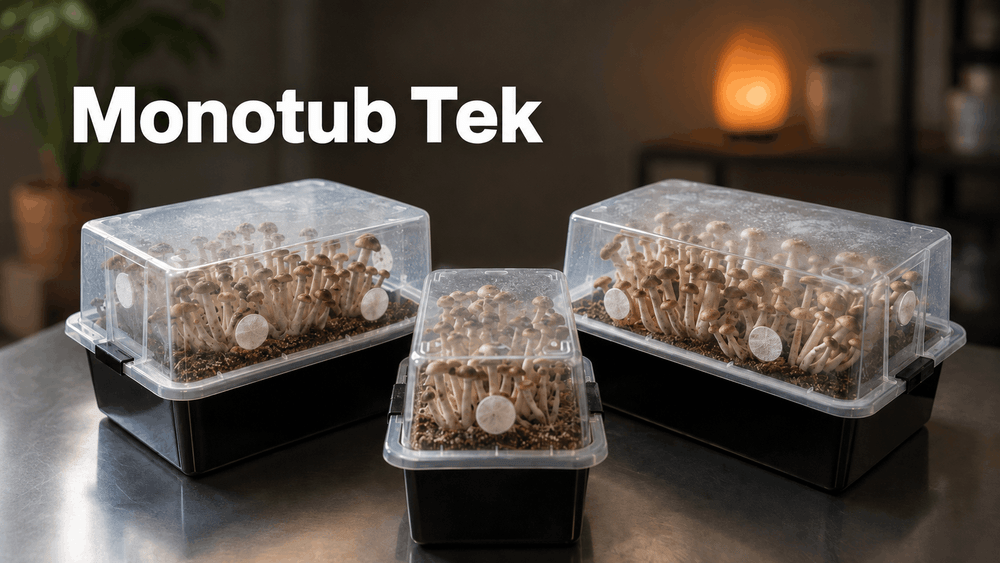
Monotub Tek: How to Grow Mushrooms in a Monotub
Posted by Spore Genetics Research Team on Jun 14th 2023
Monotub Tek: How to Grow Mushrooms in a Monotub
Once you've outgrown jars and bags, the monotub is where most home cultivators go next. It's the most popular bulk-growing method for a reason: big yields, simple gear, and multiple harvests from one setup. Here's what a monotub is, how to build one, and how to run it start to finish.
For how it compares to the beginner methods, see our guide to growing mushrooms at home.
This covers general bulk-cultivation technique for legal gourmet and functional mushrooms. Cultivating psilocybin mushrooms is illegal in most jurisdictions; psilocybe spores are handled for microscopy and taxonomy only.
What Is a Monotub?
A monotub is a large plastic storage tub converted into a fruiting chamber. You mix fully colonized grain spawn into a bed of pasteurized bulk substrate inside the tub, let it colonize, and the mushrooms fruit in the tub's humid, semi-enclosed air. It's the natural step up from PF Tek jars or all-in-one bags — more substrate means more mushrooms.
Why Growers Love It
- High yield — a bulk substrate bed produces far more than a jar cake.
- Multiple flushes — a well-run tub fruits several times.
- Simple and cheap — a storage tub, some substrate, and spawn is most of it.
- Low hands-on time — once running, it mostly manages itself.
The trade-off: more open substrate means more surface for contamination, so clean technique still matters.
What You'll Need
- A plastic storage tub (roughly 55–66 quart is a popular size) — or a ready-made monotub or complete kit from a supplier like Midwest Grow Kits
- Colonized grain spawn (started from a liquid culture or spore syringe)
- Bulk substrate — typically a coir/vermiculite/gypsum mix
- A drill and hole saw, micropore tape or polyfill, and a liner
- Gloves and a clean work area (find gear in our mycology supplies)
How to Build a Monotub
- Drill fresh-air holes — a few 2-inch holes per side for gas exchange, covered with micropore tape or polyfill to filter incoming air.
- Mind the height — holes at or just above the substrate line create the still, humid, CO2-rich microclimate near the surface that pinning likes.
- Black out the sides (optional) — many growers black out the lower tub so light comes from the top, encouraging mushrooms to grow upward.
Spawning to Bulk
In the cleanest space you can manage, mix fully colonized grain spawn into the pasteurized bulk substrate — a common ratio is about 1 part spawn to 2–4 parts substrate. Spread it into an even, level bed, optionally top with a thin casing layer to hold moisture, close the lid, and let the mycelium knit the bed together.
Colonization and Fruiting
Give the tub warmth and darkness while the mycelium colonizes the surface (usually a week or so). Once colonized, shift it to fruiting conditions — fresh air, high humidity, and indirect light trigger pinning. Our guide on when to introduce light, oxygen, and humidity covers this transition in detail. Mist and fan to keep humidity up and fresh air moving, and pins develop into mushrooms over the following days.
Harvesting and Later Flushes
Harvest each mushroom just before or as the cap opens, twisting it gently from the substrate. After the first flush, rehydrate the bed and the tub will typically give several more flushes before the substrate is spent — then retire the block to compost.
How the Monotub Compares
It sits at the “intermediate, high-yield” end of the spectrum — more productive than jars or all-in-one bags, but with more to set up and manage. If you're still choosing, our growing mushrooms at home comparison lays the methods side by side.
A Note on Species and the Law
This method applies to legal gourmet and functional mushrooms — start from our gourmet cultures. Cultivating psilocybin mushrooms is illegal in most jurisdictions including federally in the U.S.; psilocybe spores are used only for legal microscopy and taxonomy — see are mushroom spores legal, or browse study specimens in our mushroom spores collection.
Frequently Asked Questions
What size tub is best for a monotub?
A 55–66 quart storage tub is a popular, manageable first-build size.
How many holes does a monotub need?
Commonly a few 2-inch holes per side for fresh-air exchange, taped or filled with polyfill.
What's the right spawn-to-substrate ratio?
Around 1:2 to 1:4 spawn to bulk substrate is typical — more spawn colonizes faster.
How long does a monotub take?
Roughly a week to colonize the surface, then several days to a couple of weeks to fruit, depending on species and conditions.
Can you reuse the substrate?
A tub gives multiple flushes, then the block is spent and best composted.
Disclaimer: For educational purposes only, covering general bulk-cultivation technique for legal culinary and functional mushrooms. Cultivating psilocybin mushrooms is illegal in many jurisdictions, including federally in the United States. Psilocybe spores are sold strictly for microscopy and taxonomy. We ship to every U.S. state except Georgia and Idaho.