
How to Grow Mushrooms at Home: PF Tek, Grow Bags & Monotubs Compared
Posted by Spore Genetics Research Team on Oct 7th 2025
How to Grow Mushrooms at Home: PF Tek, Grow Bags & Monotubs Compared
Growing your own mushrooms at home is more accessible than it's ever been — but the method you choose shapes everything: how difficult it is, how much you harvest, and how much equipment you need. This guide compares the main beginner-friendly cultivation methods so you can pick the right one for your goals and experience level.
A note up front: this article covers cultivating legal culinary and functional mushrooms — oyster, lion's mane, reishi, and the like. Cultivating psilocybin mushrooms is illegal in most jurisdictions, and psilocybe spores are sold strictly for microscopy and taxonomy study.
The Basic Process — What Every Method Shares
Before comparing setups, it helps to know the arc they all follow. Every grow moves through the same three stages: you start from a culture (spores or, more reliably, a liquid culture), you let it colonize a nutritious substrate with white mycelium, and then you trigger fruiting with fresh air, light, and raised humidity. The methods below are really just different containers and substrates for that same journey — some simpler, some higher-yielding. For the fruiting-stage details, see our guide on when to introduce light, oxygen, and humidity.
Method 1 — PF Tek (BRF Jars)
The classic entry point. PF Tek uses jars filled with a mix of brown rice flour, vermiculite, and water, sterilized and then inoculated. The mycelium colonizes the jar, you pop the hardened “cakes” out, and fruit them in a humid chamber.
- Pros: cheap, simple, forgiving, and it needs no sterile-air equipment — the best way to learn the fundamentals.
- Cons: small yields and typically just one or two flushes per cake.
- Best for: absolute first-timers who want to understand the process before scaling.
- Difficulty: Beginner
Method 2 — All-in-One Grow Bags (AIO)
An all-in-one bag contains sterilized grain and bulk substrate in a single sealed, filter-patched bag. You inoculate it, let it colonize fully, then open it to fruit — all in the same bag.
- Pros: minimal equipment, low contamination exposure (everything stays sealed), and very hands-off.
- Cons: moderate yields, and the bag is single-use.
- Best for: beginners who want less mess and handling than jars.
- Difficulty: Beginner
Method 3 — Monotub / Bulk Grow
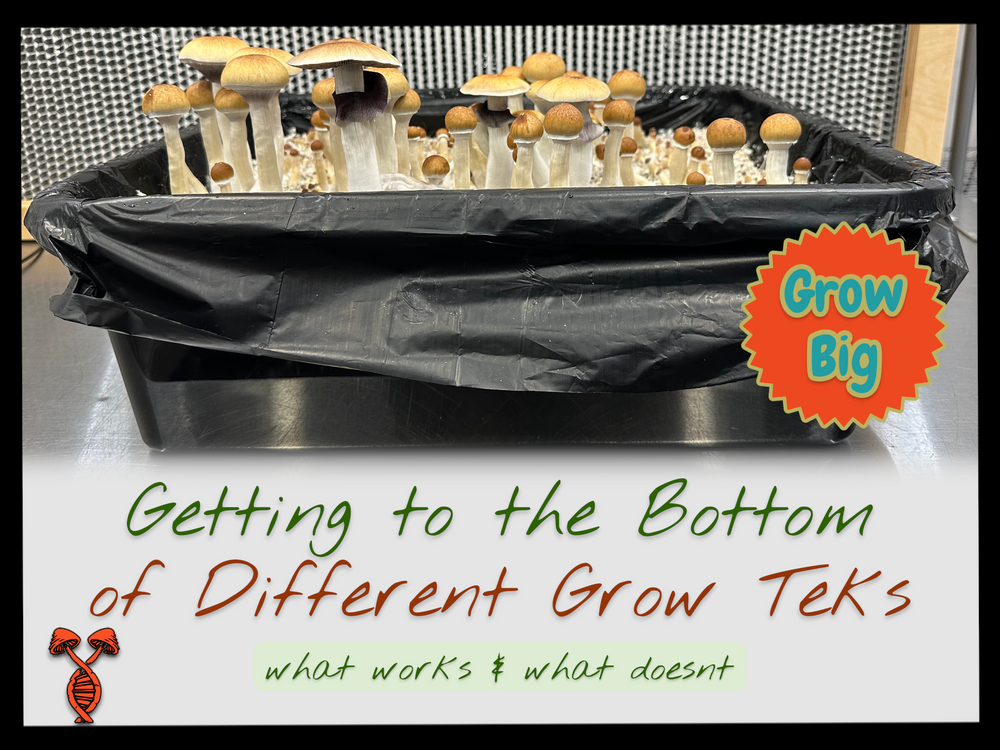
The step up in scale. You colonize grain spawn first, then mix it into a tub of pasteurized bulk substrate, where it fruits in the open air of the tub.
- Pros: large yields, multiple flushes, and it scales easily.
- Cons: more equipment, more space, and more contamination risk to manage.
- Best for: growers comfortable with the basics who want real harvests.
- Difficulty: Intermediate
Your Starting Material: Spores, Liquid Culture & Agar
Whichever method you choose, you begin from one of three starting points. Spores are the natural starting cell but carry genetic variation; a liquid culture is living mycelium that colonizes faster and more predictably; and agar lets you clean up and isolate a culture on a plate before committing it to grain. Most home growers starting gourmet species reach for a liquid culture — you can browse ready-to-use options in our gourmet cultures collection.
Methods at a Glance
| Method | Difficulty | Typical Yield | Gear Needed | Best For |
|---|---|---|---|---|
| PF Tek (BRF jars) | Beginner | Low | Minimal | Learning the process |
| All-in-One Bag | Beginner | Moderate | Very little | Low-mess first grow |
| Monotub / Bulk | Intermediate | High | More (tub, spawn, substrate) | Bigger harvests |
Which Method Should You Choose?
If it's your first grow, start with PF Tek or an all-in-one bag — both teach you the fundamentals with little gear and low risk. Once you've had a clean, successful run and understand colonization and fruiting, graduate to a monotub for the yields that make the effort worthwhile. There's no “best” method in the abstract — only the one that fits your space, budget, and experience. For a broader primer on the whole process, see our guide to everything you should know about mushroom cultivation.
A Note on Species and the Law
These methods apply to legal gourmet and functional mushrooms — oyster, lion's mane, reishi, shiitake, and more, all of which you can start from our gourmet cultures. Cultivating psilocybin mushrooms, by contrast, is illegal in most jurisdictions including federally in the U.S.; psilocybe spores are used only for legal microscopy and taxonomy study — see are mushroom spores legal for the details, or browse study specimens in our mushroom spores and isolated spore syringes collections.
Frequently Asked Questions
What's the easiest way to grow mushrooms at home?
PF Tek jars or an all-in-one grow bag — both are beginner-friendly and need very little equipment.
PF Tek vs monotub — which is better?
PF Tek is simpler and better for learning; a monotub yields far more but needs more gear and care. Most people start with PF Tek and move up.
Do I need a still-air box or flow hood?
Not for PF Tek or all-in-one bags. Larger, open work like monotubs benefits from cleaner air to reduce contamination.
How long does it take to grow mushrooms?
Roughly a few weeks to colonize plus one to two weeks to fruit, depending on the species and conditions.
Can I reuse the substrate?
Most home substrates give one to a few flushes, then are spent — they're best composted afterward.
Disclaimer: This article is for educational purposes only and covers cultivation of legal culinary and functional mushrooms. Cultivating psilocybin mushrooms is illegal in many jurisdictions, including federally in the United States. Psilocybe spores are sold strictly for microscopy and taxonomy research. We ship to every U.S. state except Georgia and Idaho.