
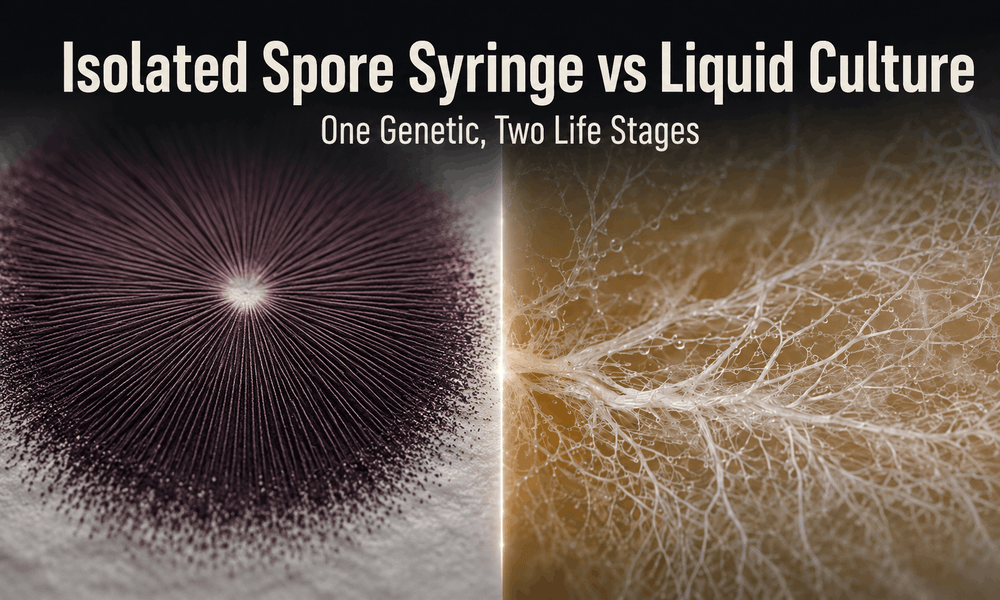
Isolated Spore Syringe vs Liquid Culture
Posted by Spore Genetics Research Team on Apr 30th 2024
Isolated Spore Syringe vs Liquid Culture
Short answer: at Spore Genetics there is no “versus.” Our isolated spore syringes are liquid cultures — one stabilized Psilocybe genetic line in sterile solution rather than a mixed spore population. We sell them under our Isolated Spore Syringe (ISO) label, they are formulated and tested to contain zero psilocybin and psilocin, and they are for microscopy and taxonomy research only.
So the useful comparisons are different ones: how an isolate (a liquid culture) differs from a standard multi-spore syringe, and how our Psilocybe isolates differ from the gourmet liquid cultures we sell for cultivation. For the plain-language basics of spores versus live mycelium, start with our spore syringe vs liquid culture guide.
What Is Actually in an Isolated Spore Syringe?
A standard multi-spore syringe holds spores collected as they naturally occur — dozens of genetically distinct genotypes from the parent mushroom. An isolated spore syringe starts from one of those multi-spore cultures and goes through multiple rounds of selection and stabilization on agar in our own lab, until a single, true-to-type phenotype is locked in. That one stabilized genetic line, held in sterile solution in a 10cc syringe, is a liquid culture.
Why do we still call it an isolated spore syringe? Because that is the name researchers know it by, it ships in the same 10cc syringe format as our spores, and the word “isolate” tells you the important part: a single phenotype, not a mixed population. The name is the label; the contents are a liquid culture.
Isolate (Liquid Culture) vs Multi-Spore Syringe
| Isolated Spore Syringe (Liquid Culture) | Multi-Spore Syringe | |
|---|---|---|
| What’s inside | One stabilized genetic line in sterile solution | Spores from many parent mushrooms in sterile solution |
| Genetics | Single, uniform phenotype | Dozens of distinct genotypes |
| Under the microscope | Consistent, repeatable characteristics | Natural variation to compare |
| Storage | Refrigerate; use within about six months | Refrigerate; dormant spores stay viable for months or more |
| Price | From $24.99 | From $15 |
| Best for | Studying one known genetic, consistently | Exploring diversity on a budget |
For the full breakdown of that choice, see multi-spore vs isolated spore syringe.
Psilocybe Isolate vs Gourmet Liquid Culture
Both are liquid cultures: one selected genetic line in sterile solution. The difference is species and purpose. Our gourmet and medicinal liquid cultures — oyster, Lion’s Mane, reishi and more — are species that are legal to cultivate, and they are sold for exactly that. Our Psilocybe isolates are formulated and tested to contain zero psilocybin and psilocin and are sold strictly for microscopy and taxonomy research, shipped to every U.S. state except Georgia and Idaho. The legal background is covered in are mushroom spores legal?
Need More Volume?
The same isolates are available as 30mL master isolate vials — roughly three syringe-equivalents of the same liquid culture, ready to use, with automatic savings when you choose any three.
Frequently Asked Questions
Is an isolated spore syringe the same as a liquid culture?
Yes. At Spore Genetics an isolated spore syringe is a liquid culture: one stabilized, single-phenotype genetic line in sterile solution, sold under our isolate label.
Do isolated spore syringes contain psilocybin?
Our isolates are formulated and tested to contain zero psilocybin and psilocin. They are sold for microscopy and taxonomy research only, and we do not ship Psilocybe products to Georgia or Idaho.
Which lasts longer, an isolate or a multi-spore syringe?
The multi-spore syringe. Dormant spores stay viable for months or more when refrigerated, while an isolate is a living culture that is best used within about six months, kept refrigerated.
What’s the difference between isolated and multi-spore?
A multi-spore syringe contains many genetic variations; an isolated syringe is one stabilized phenotype as a liquid culture, chosen for consistency. See our multi-spore vs isolated guide for the full comparison.
Do you sell magic mushroom liquid cultures?
Our Psilocybe isolated spore syringes and 30mL master isolate vials are liquid cultures, formulated and tested to contain zero psilocybin and psilocin and sold for microscopy and taxonomy research only.
Browse our isolated spore syringes and 30mL master isolate vials, or explore gourmet liquid cultures for cultivation.
Disclaimer: Psilocybe spores and isolates are sold strictly for microscopy, taxonomy, and research purposes. Gourmet and medicinal liquid cultures are offered for species that are legal to cultivate. Cultivation of psilocybin mushrooms is illegal in many jurisdictions, including federally in the United States. We ship to every U.S. state except Georgia and Idaho.