
How to Make Agar for Mushroom Cultivation
Posted by Spore Genetics Research Team on Dec 5th 2023
How to Make Agar for Mushroom Cultivation
Agar is the single most useful tool in a mycologist's kit. This firm, nutrient-rich gel — poured into petri dishes — lets you isolate clean cultures, catch contamination before it ruins a grow, and preserve the genetics of a culture you like. Here's how to make your own agar plates from scratch, how to use them, and when it's easier to start with ready-poured ones.
This is general mycology technique used for cultivating gourmet and functional mushrooms and for studying cultures. Psilocybe spores are handled for microscopy and taxonomy only.
What Agar Is — and Why It's Worth the Trouble
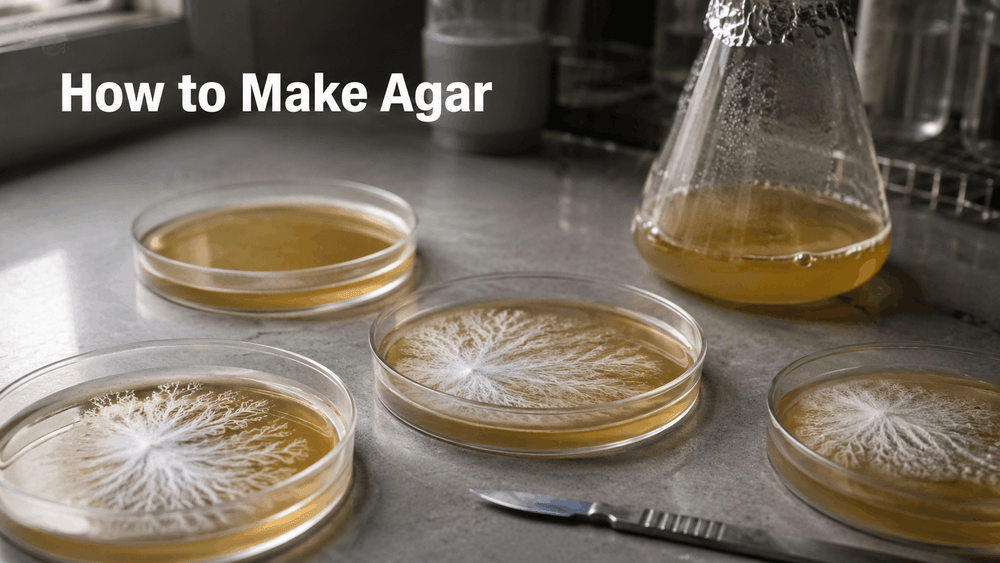
Agar is a gelatin-like substance derived from seaweed. On its own it's just a solidifying agent; combined with nutrients and sterilized, it becomes a clear medium that mushroom mycelium grows across beautifully. Because you can see everything on a plate, agar gives you three things no jar or bag can:
- Isolation — select a single healthy sector of mycelium and transfer it, narrowing a mixed culture down to one clean, vigorous genetic (the same idea behind an isolated spore syringe).
- Contamination detection — bacteria, mold, and healthy mycelium all look different on a plate, so you catch problems early.
- Preservation — a clean plate stored cold can be transferred forward, keeping a genetic alive long-term.
A Basic Agar Recipe
The popular all-purpose choice is LME (light malt extract) agar, often with a little peptone for extra nutrients. Per liter of water:
- 20 g agar-agar powder
- 20 g light malt extract (LME)
- 1–2 g peptone (optional)
Other recipes exist (potato dextrose and others), but LME agar is clean, reliable, and beginner-friendly.
How to Make Agar Plates — Step by Step
- Mix the agar, LME, and water in a flask or jar and swirl to distribute.
- Sterilize in a pressure cooker at 15 PSI for ~30–40 minutes — this sterilizes and dissolves the agar. (Boiling alone won't sterilize.)
- Cool until the container is hand-warm but the agar is still liquid.
- Pour in a still-air box or in front of a flow hood, a shallow layer into each sterile petri dish, and cover.
- Set & store — let plates gel fully, then store them inverted (lid down) so condensation doesn't drip onto the surface.
Working With Your Plates
Transfer a small piece of tissue or a drop of culture to the center, seal the dish, and let the mycelium radiate outward. Cut and move the cleanest, fastest sector to a fresh plate — that's isolation. Once you have a plate of pure, healthy mycelium, use it to inoculate grain or liquid culture on the way to fruiting. Our guide to growing mushrooms at home shows where agar fits in the wider workflow.
Or Skip the Prep: Ready-Poured Plates
Making agar means owning a pressure cooker and setting aside a careful couple of hours. If you'd rather get straight to isolating and studying cultures, our SG Signature LME-Peptone Agar plates come pre-poured, sterile, and ready to use — no mixing, sterilizing, or pouring. You'll find them with the rest of our mycology supplies.
Tips for Cleaner Agar Work
- Work quickly and minimize open-dish time.
- Flame-sterilize your scalpel between cuts.
- Keep a cold backup plate of any genetic you value.
- Label everything — species, date, transfer number.
Frequently Asked Questions
What is agar used for in mushroom cultivation?
Isolating clean cultures, spotting contamination early, and preserving genetics.
Do you need a pressure cooker to make agar?
Yes — boiling alone doesn't sterilize the medium.
What's the best agar recipe for beginners?
LME (light malt extract) agar, optionally with a little peptone.
Can you buy agar plates already made?
Yes — pre-poured sterile plates skip all the prep.
How long do agar plates last?
Sealed and stored cold, viable cultures keep for months.
Disclaimer: For educational purposes only, covering general mycology technique for legal culinary and functional mushroom cultivation and culture study. Cultivating psilocybin mushrooms is illegal in many jurisdictions, including federally in the United States. Psilocybe spores are sold strictly for microscopy and taxonomy. We ship to every U.S. state except Georgia and Idaho.