
How to Cultivate Shiitake 3782 Mushrooms at Home
Grow Shiitake 3782, Syringe to Harvest
Large, thick, dark-brown caps with outstanding flavor — a trusted strain with a couple of extra steps that pay off. Here's the full walkthrough.
Shiitake 3782 is one of the most trusted and widely grown shiitake strains in North America — for good reason. It consistently produces large, thick, dark-brown caps and sturdy stems with outstanding flavor. Shiitake (Lentinula edodes) thrives across a wide temperature range, making it a reliable performer for both beginners and experienced growers.
You'll Need a Living Culture
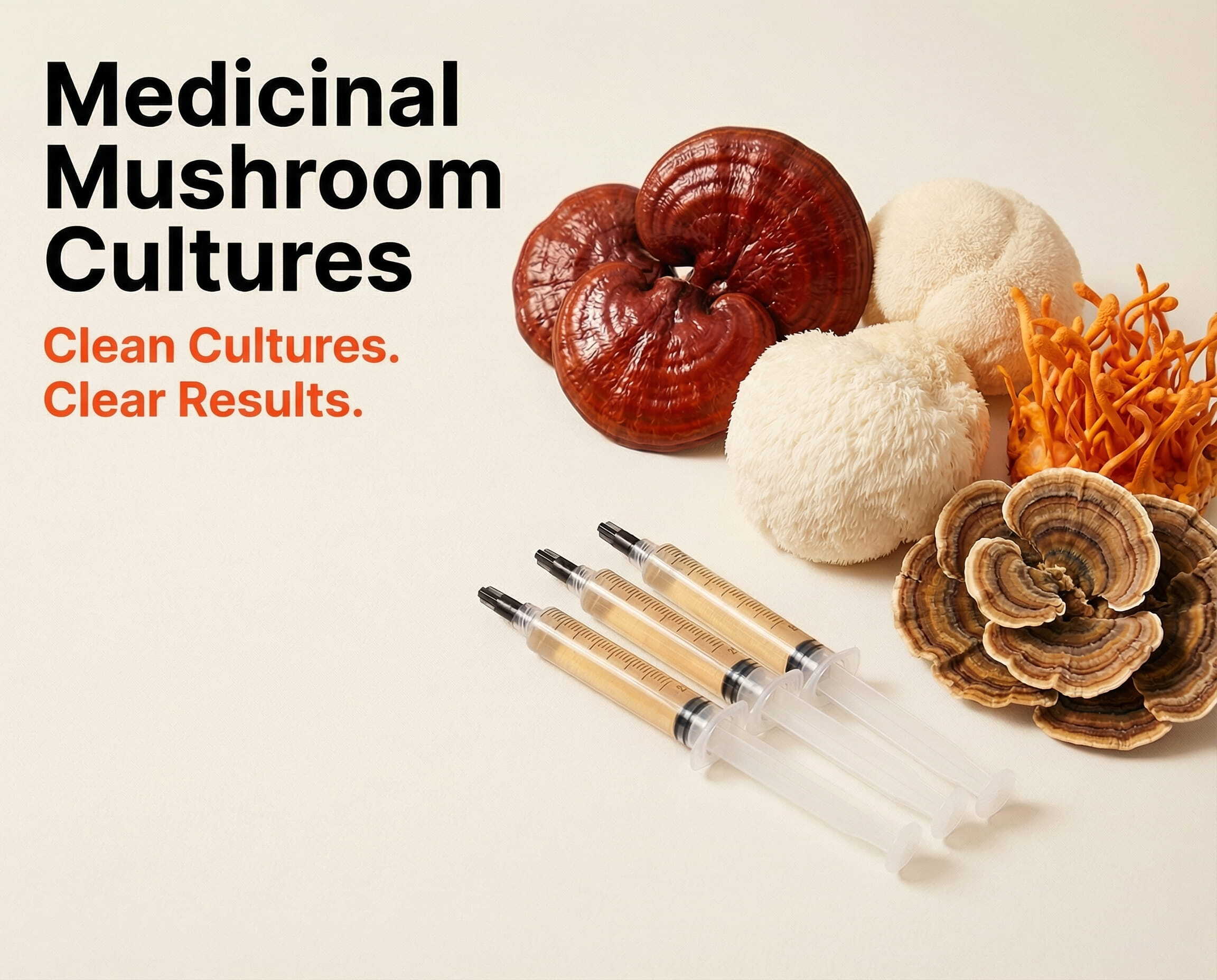
This guide starts from a Shiitake 3782 liquid culture. Grab yours below — and if you're new to liquid cultures, our LC guide covers the syringe basics first.
Shop Shiitake 3782 Liquid Culture → How to Use a Liquid Culture →Shop Cultures & Supplies
Drag or scroll to explore →





1What Grains Should I Use?
For Shiitake 3782, rye berries or a 5-grain mix typically deliver the fastest, most vigorous growth. You can also use oats, straight millet, or standard grain blends — just make sure your grains are properly sterilized.
Shiitake is resilient once established, but starting clean helps tremendously with speed and consistency.
Pro Tip
- Trusted pre-sterilized grain bags are available from MidwestGrowKits.com and MycoLabs.com.
- If sterilizing your own grains, cook and sterilize appropriately based on grain type and volume.
2How Do I Inoculate?
Inoculation is straightforward — work in a clean environment. A still-air box (SAB), laminar flow hood, or the oven-door method all work well. You'll need isopropyl alcohol, paper towels, vinyl gloves, grain bags/jars, and your Shiitake liquid culture syringe.
Be sure to check how many cc's to inject based on your jar or bag size.
- Put on vinyl gloves and sanitize your workspace with isopropyl alcohol.
- Wipe/spray your gloves and let everything air dry.
- Sanitize the injection port (grain bag) or jar lid injection point using alcohol swabs.
- Shake your syringe vigorously to evenly distribute contents.
- Remove the cap, attach the sterile needle, and inject.
Pro Tip
After puncturing the port, hold the syringe at a 45° angle and gently rotate the bag/jar 360° to help distribute the culture.
For grain jars, you may shake vigorously after inoculation — this won't harm the culture.
3Colonization
Shiitake colonizes efficiently around 72–76°F and often fully colonizes grain in roughly ~2 weeks. Cooler conditions below ~65°F will slow growth and may take 3+ weeks.
- Grain bags: at 40–50% colonization, cut the tape, let the bag stand tall, then break-and-shake.
- Grain jars: shake vigorously to redistribute colonized grains.
- Keep bags/jars in darkness until fully colonized. Light exposure during inspection won't harm the mycelium.
Don't fret if the block begins to show brownish coloration — this is common with shiitake. When grain becomes a uniform dark chocolate-brown (sometimes with small amber droplets), it's typically ready to spawn to sawdust.
If growth stalls, check temperatures. Large fluctuations can slow or disrupt colonization.
4Transferring to Substrate
Shiitake 3782 thrives on Master's Mix (hardwood sawdust + soy hull). This species performs best in bags where fruiting can be directed.
RULE OF THUMB — one colonized grain bag can inoculate 6 Master's Mix bags. For faster colonization, split into 2.
- Put on gloves and sanitize your workspace with isopropyl alcohol.
- Spray the outside of colonized grain bags/jars and the Master's Mix bag; allow to dry.
- Open the grain and Master's Mix bags and transfer colonized grain into the Master's Mix bag.
- Seal with a heat sealer (or use clips/rubber bands/zip ties). Leave some air inside for mixing.
- Shake vigorously to disperse grain throughout the substrate.
- Tape the top of the bag to the bottom to trap CO₂.
- At ~50% recolonization, remove tape, break-and-shake thoroughly, then retape into block form.
- Allow full colonization. Keep in the dark again during this phase.
No fresh-air exchange is needed during this phase — Shiitake needs CO₂ to finish colonizing.
5Curing the Block
Shiitake 3782 benefits from an extra step the other gourmets don't need: curing. Shiitake mycelium behaves differently from oysters and lion's mane — it often needs a physiological "trigger" to shift from colonization to fruiting.
- Cut the tape that holds the top of the bag to the bottom.
- Cut a few small ~1-inch slits near the top of the bag to allow oxygen in.
- Don't worry about hydrating during curing.
- Let the block sit on a shelf for 10–14 days while the surface hardens and turns a darker, leathery brown.
- Indirect light is fine during this stage.
It's normal for the shiitake cake to become very tough during curing — this is part of what supports strong fruiting.
6Cold-Shock Trigger
Once cured, trigger the block with a cold water shock to kick off fruiting.
Cold Shock, Step by Step
- Place the block in a tote/bucket/container that fits it comfortably.
- Add cold water until it rises about 1 inch above the block.
- The block may float — use a clean, heavy object to hold it down if needed.
- Soak for 12–24 hours. Do not exceed 24 hours.
Within about a week, you should see a heavy pinset forming on top of the block.
7The Fruiting Stage
Congrats — this is the home stretch. Shiitake 3782 can fruit across a broad range, roughly 65–80°F.
Fruiting conditions & Pro Tips:
- After soaking, keep blocks around ~65°F for thicker, meatier fruits.
- Warmer temps (no higher than 80°F) can fruit faster and shorten dormancy.
- Frequent fresh air exchange supports thick stems and well-formed caps.
- 8–12 hours of light daily (sunlight not required).
- Mist once daily; increase to 2–3× if your environment is dry. If using a humidifier, aim for 80%+ humidity.
- After each harvest, reduce humidity for a short dormancy period. After a couple of weeks, re-soak for 8–12 hours (not 12–24).
Note on Surface Mold
Shiitake can sometimes develop surface mold due to its thick skin. If you notice it, sanitize a knife with isopropyl alcohol and gently shave off the mold. Then mix 1 part hydrogen peroxide (3–5%) with 3 parts filtered water and mist affected areas daily until resolved.
Method 1 — Fruiting Chamber (Bare Block)
Remove the bag entirely so the block is bare, then set it into a fruiting chamber (tote/monotub). Add about 1 inch of water to the chamber, but keep the block on a small plate/stand so it isn't sitting directly in water. Use filter patches if available. If there are no holes, open the lid 2–3 times a day (or more) for frequent air exchange.
Method 2 — Automated Grow Tent
Place blocks in a tent and provide frequent fresh air exchange. Open the door periodically and/or use a fan to pull in fresh air. A good starting point is 15 minutes every 3–4 hours, adjusting based on humidity and block condition. Aim for 80%+ humidity.
Need Help or Have Questions?
If you have specific questions along the way, contact us via email or phone. We're here for you every step of the way.
Best of luck with everything, fellow fungi friends — and happy cultivating!
Spore Genetics — Exceptional Mushroom Spores & Cultures