
How to Cultivate Amanita Muscaria at Home
Establish Amanita Muscaria With a Living Host Tree
Fly Agaric doesn't grow like Lion's Mane or oysters — it partners with the roots of a living tree. This is a patient, long-term establishment project, not a quick indoor flush.
Important Safety Notice
Amanita muscaria contains toxic and psychoactive compounds and should not be treated as an edible gourmet mushroom. Keep the culture and any mushrooms away from children and pets. This guide covers mycorrhizal establishment only — for observation, taxonomy, and permitted research, not consumption.
Amanita muscaria — commonly known as Fly Agaric — grows very differently from Lion's Mane, Reishi, oysters, and other wood-decomposing mushrooms. It cannot be reliably grown by colonizing a grain bag and transferring it into Master's Mix.
It's an ectomycorrhizal mushroom: its mycelium must form a long-term relationship with the living roots of a compatible tree. The tree supplies sugars from photosynthesis, while the fungus helps the tree access water and nutrients from the soil.
So the first goal isn't mushroom production — it's establishing Amanita mycelium around the fine feeder roots of a healthy host seedling. Root colonization can occur within a few months, but outdoor mushrooms may take years and are never guaranteed. (Amanita muscaria has formed experimentally verified mycorrhizae with pine and aspen seedlings, with colonized roots developing over roughly 3–5 months.)
You'll Need a Living Culture
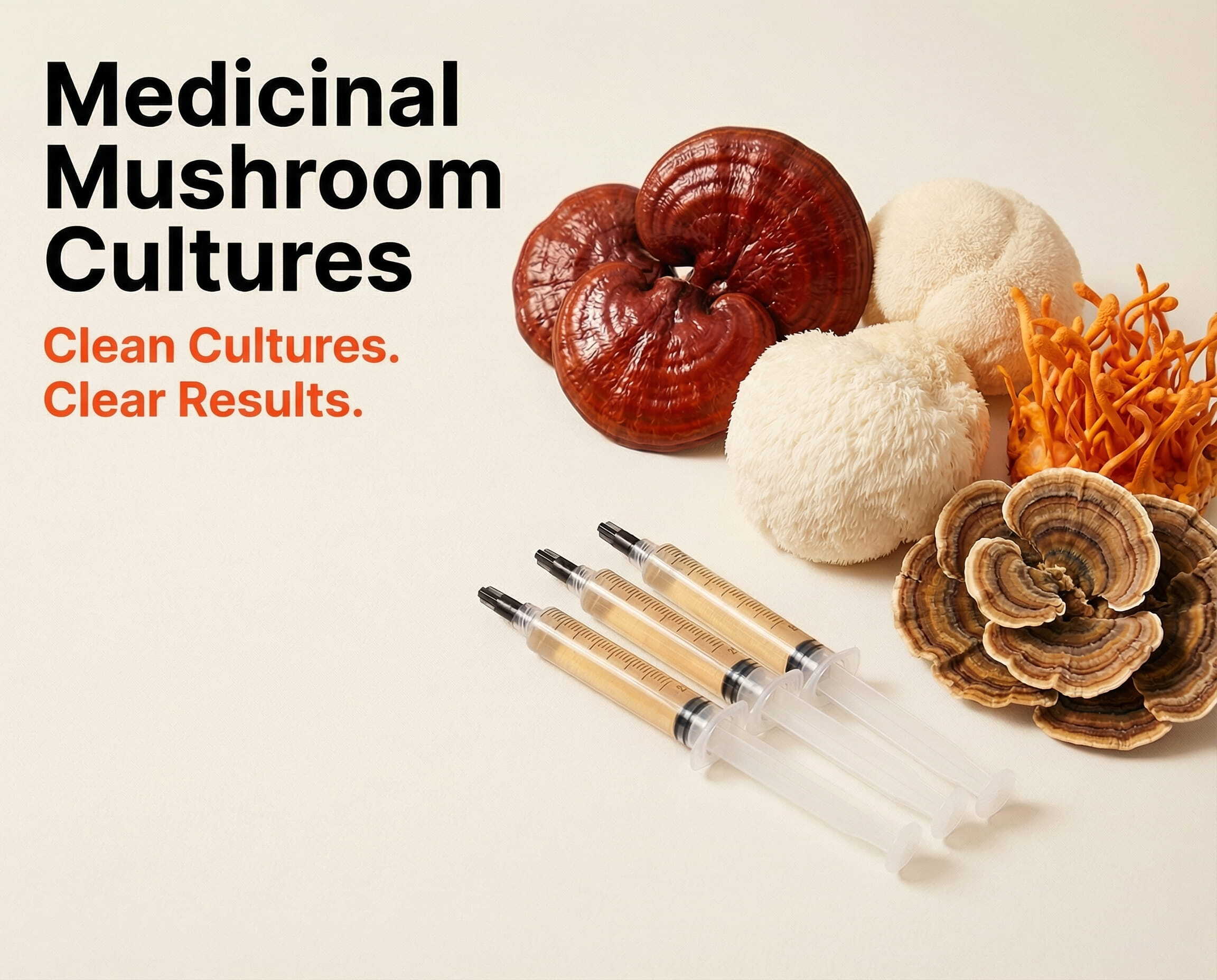
This project starts from an Amanita Muscaria liquid culture and a compatible host seedling. Grab your culture below — and if you're new to liquid cultures, our LC guide covers the syringe basics first.
Shop Amanita Muscaria Liquid Culture → How to Use a Liquid Culture →Cultures & Supplies
Drag or scroll to explore →




1What Host Tree Should I Use?
Amanita muscaria has a relatively broad host range, but the most practical choices for a home project are pine, spruce, birch, and aspen.
Pine is our first recommendation — Amanita muscaria has repeatedly been shown forming mycorrhizae with pine seedlings, including ponderosa pine. Aspen is another experimentally confirmed host, and Amanita muscaria is commonly associated with birch and spruce in temperate and boreal forests.
Choose a young, actively growing seedling with plenty of fine feeder roots. About 6–12 weeks old is a good starting point, though slightly older container-grown seedlings work too. Whenever possible, pick a species already adapted to your climate — a healthy tree is essential, since the fungus ultimately depends on sugars from its host.
Pro Tip
- Begin with two seedlings rather than relying on a single attempt.
- Use seedlings that haven't already been heavily inoculated with commercial mycorrhizal blends.
- Avoid trees in rich garden soil with established fungal communities — competing fungi may reach the roots before your Amanita culture does.
- Don't use grass, houseplants, vegetables, or fruit-tree seedlings that don't normally form ectomycorrhizae.
2What Growing Medium Should I Use?
Amanita muscaria should begin in a low-nutrient, well-draining root medium. Rich compost, manure, heavily fertilized potting soil, grain bags, and Master's Mix are not suitable. For the easiest home method, use a clean seed-starting mix, extra vermiculite or perlite for drainage, a small container with drainage holes, a compatible tree seedling, and your Amanita muscaria liquid culture.
Simple home mix:
1 part clean seed-starting mix : 1 part vermiculite or perlite. The medium should hold moisture while still allowing plenty of air around the young roots.
Advanced: Research-Style Carrier
Amanita and other ectomycorrhizal cultures have been established in a carrier of roughly 1 part peat : 9 parts vermiculite. One published synthesis method added 5 mL of mycelial slurry to a 200 mL peat-and-vermiculite container, let the fungus establish for two weeks, then introduced a sterile seedling — evaluating mycorrhizal formation after three months. The exact lab nutrient solution isn't normally available to home growers, so the simple seedling-pot method is more practical for most.
Pro Tip
- Don't use soil collected from a forest — it can carry competing fungi, insects, nematodes, and plant pathogens.
- Don't sterilize the living tree's roots with alcohol or bleach.
- Avoid potting mixes with large amounts of fertilizer or slow-release pellets.
- Prepare the root medium lightly moist — not dripping wet — before planting the seedling.
3Preparing the Host Seedling
Use a small pot about 3–4 inches wide with working drainage holes. Clean the pot and tools before beginning.
- Add a small amount of prepared root medium to the bottom of the container.
- Carefully remove the seedling from its original container.
- Gently loosen the outside of the root ball without breaking or stripping the fine roots.
- Position the seedling inside the new pot.
- Fill around the roots with the prepared medium.
- Water lightly to settle the mix.
- Allow excess water to drain before inoculation.
The fine, newly developing feeder roots are the most important part of the project — Amanita mycelium must contact these roots to begin forming its ectomycorrhizal sheath.
4How Do I Inoculate the Root Zone?
You don't need a fruiting chamber. Work in a clean area with minimal airflow and gather gloves, alcohol swabs, your seedling, and your Amanita muscaria liquid culture syringe.
- Put on gloves and clean your work surface with isopropyl alcohol.
- Shake the liquid culture syringe thoroughly to distribute the mycelium.
- Attach the provided sterile needle.
- Wipe the outside of the seedling pot and any tools you'll handle.
- Insert the needle ~1–2 inches into the root medium, aiming alongside the root ball rather than through the main roots.
- Inject small amounts in three or four locations around the seedling.
- Use about 2–3 cc total during the first application.
- Label the pot with the culture name and inoculation date.
- Apply another 2–3 cc around the root zone roughly two to three weeks later.
The two-application schedule adapts nursery guidance that recommends repeated ectomycorrhizal inoculations 2–3 weeks apart. (Research systems have also used ~5 mL of fungal slurry in a small 200 mL root container.)
Pro Tip
- Don't inject all the liquid into one location.
- Don't inject into the tree trunk.
- Don't empty the syringe onto the soil surface — the culture needs close contact with the developing roots.
- Don't break and shake the pot.
- One 10 cc syringe normally covers one complete two-stage inoculation, or splits between two smaller experimental seedlings.
5Colonization
Keep the inoculated seedling in these conditions:
- Root-zone temperature: 64–72°F (target ~68°F)
- Light: 12–16 hours of normal plant or daylight
- Water: keep the root medium evenly moist
- Humidity: normal seedling conditions — no fruiting chamber needed
- Fresh air: normal plant airflow
- Initial root-establishment period: ~3–5 months
Amanita cultures have been maintained around 68°F in darkness before being introduced to seedlings, and other lab cultures as warm as 77°F; media comparisons also found strong growth between ~50 and 68°F. For a combined fungus-and-seedling system, 64–72°F is a conservative working range. Unlike a grain bag, the pot won't necessarily turn white — much of the important growth happens directly on and between the feeder roots.
During this stage:
- Keep the tree actively growing.
- Don't let the pot dry completely, and don't leave roots in standing water.
- Don't repeatedly disturb or repot the seedling.
- Avoid strong fertilizer while the fungal relationship develops.
- Keep the root zone cooler than the foliage if the seedling is under a warm light.
Briefly checking the pot won't harm the culture — but repeatedly removing the seedling to inspect its roots can damage the exact structures you're trying to establish.
6What Should Healthy Mycorrhizal Roots Look Like?
Wait at least 8–12 weeks before attempting any inspection; a more useful evaluation usually comes around the 3–5 month mark. Examine only a small portion of the outside root ball. Healthy ectomycorrhizal root tips may appear:
- Shorter and more branched than ordinary roots
- Slightly swollen
- Covered with a pale, cream, white, or lightly colored fungal sheath
- Surrounded by fine visible hyphae
- Firm and healthy rather than soft or rotting
Ectomycorrhizal fungi form a mantle around short feeder roots. Successful roots often show a cottony appearance or visible sheath — but lab or microscopic examination is the most dependable verification. A little white mycelium in the pot doesn't prove mycorrhizae have formed; the key sign is organized fungal growth associated directly with healthy root tips.
7Transferring the Seedling Outdoors
Once the seedling has stayed healthy for at least 3–5 months and appears to have established new feeder roots, it can move to a larger container or an appropriate outdoor location. Before planting outside:
- Make sure the host tree suits your climate and property.
- Gradually harden the seedling to outdoor conditions over 7–14 days.
- Select a location with well-draining soil; avoid heavily fertilized lawns or garden beds.
- Dig a planting hole only large enough for the root ball, and keep the inoculated root ball intact.
- Plant at the same soil depth it was growing at in its pot.
- Water the root zone thoroughly after planting, and keep moisture consistent through the first growing season.
- Apply a light layer of compatible leaf litter or pine needles around the root zone — without piling it against the trunk.
Amanita muscaria is commonly associated with acidic forest soils, but extremely low pH can inhibit lab mycelial growth. Let the host tree's existing soil needs take priority over aggressively modifying soil for the fungus.
8The Fruiting Stage — Realistic Expectations
There is no dependable indoor fruiting-chamber recipe for Amanita muscaria. Root colonization and mushroom production are two separate milestones — a tree may develop Amanita mycorrhizae without ever producing visible mushrooms.
Outdoor fruiting depends on many interacting conditions: a healthy, established host tree; a mature mycorrhizal root network; seasonal soil-temperature changes; consistent soil moisture; rainfall; local climate; competition from other soil fungi; and the specific culture-and-host pairing. In established pine plantations, Amanita muscaria fruiting was strongly tied to rainfall and plantation age — documented under both 5-year-old and 16-year-old trees, with much higher production in the older plantation.
For a home project, don't expect mushrooms in the first few months. Fruiting may take several years, and some successfully colonized trees may never produce visible mushrooms. Do not place the tree in a high-humidity mushroom chamber to force fruiting — the host requires normal plant light, root aeration, and a natural seasonal cycle.
9Observation & Handling (Not Harvesting to Eat)
Amanita muscaria should not be harvested or prepared as an edible gourmet mushroom.
For observation, photography, taxonomy, or other permitted research, allow the mushroom to develop until its cap has expanded and its identifying features are visible. Young mushrooms may first emerge as pale, rounded structures before the colored cap becomes exposed.
If removing a specimen:
- Keep children and pets away from the area.
- Do not taste any part of the mushroom.
- Remove the entire specimen carefully if the base is needed for identification.
- Wash your hands after handling it, and clean any tools used.
- Don't place specimens where they could be mistaken for edible mushrooms.
Leaving some mature mushrooms in place lets them complete their natural spore-production cycle.
Common Problems & What They Mean
The pot isn't turning white. Normal. Amanita doesn't colonize a pot like an oyster colonizes grain — most development happens around individual feeder roots.
No mycelium visible after several weeks. Root association takes months. Maintain the seedling and avoid digging through the pot — research systems typically evaluate at ~3–5 months, not weeks.
The seedling is wilting or yellowing. Check soil moisture, drainage, light, and root temperature. The host must stay healthy for the fungal relationship to develop; constantly saturated soil can suffocate or rot roots.
Green or black mold on the soil. Green, black, or rapidly spreading fuzzy surface growth is not a normal sign of root colonization. Reduce excess moisture and isolate the plant if it's spreading.
White growth on the roots. Pale growth can be encouraging, but ordinary molds and other mycorrhizal fungi can look similar. Look for a consistent sheath around healthy short root tips, not loose surface fuzz alone.
Roots look brown or black. Healthy mycorrhizal tips stay firm. Soft, slimy, foul-smelling, or collapsing roots indicate damage or rot, not colonization.
Tree looks healthy, but no mushrooms. Expected. Root establishment is the realistic first goal; outdoor fruiting is seasonal, depends on rainfall and host maturity, and can't be guaranteed.
Responsible Cultivation Note
Amanita muscaria has spread beyond its original range through the movement of inoculated trees and has formed associations with new host species in some regions. Do not release inoculated plants into forests, parks, restoration areas, or other natural habitats. Keep the project on controlled private property, and confirm the species is appropriate for your region before planting outdoors.
Need Help or Have Questions?
Amanita muscaria is one of the most specialized cultures we carry — the process is about establishing a living relationship between the fungus and a compatible host tree, not producing quick indoor flushes. Don't hesitate to contact us via email or phone with questions about choosing a host seedling, inoculating the root zone, or evaluating early mycorrhizal development. We're here for you every step of the way.
Best of luck with everything, fellow fungi friends — and happy cultivating!
Spore Genetics — Exceptional Mushroom Spores & Cultures