
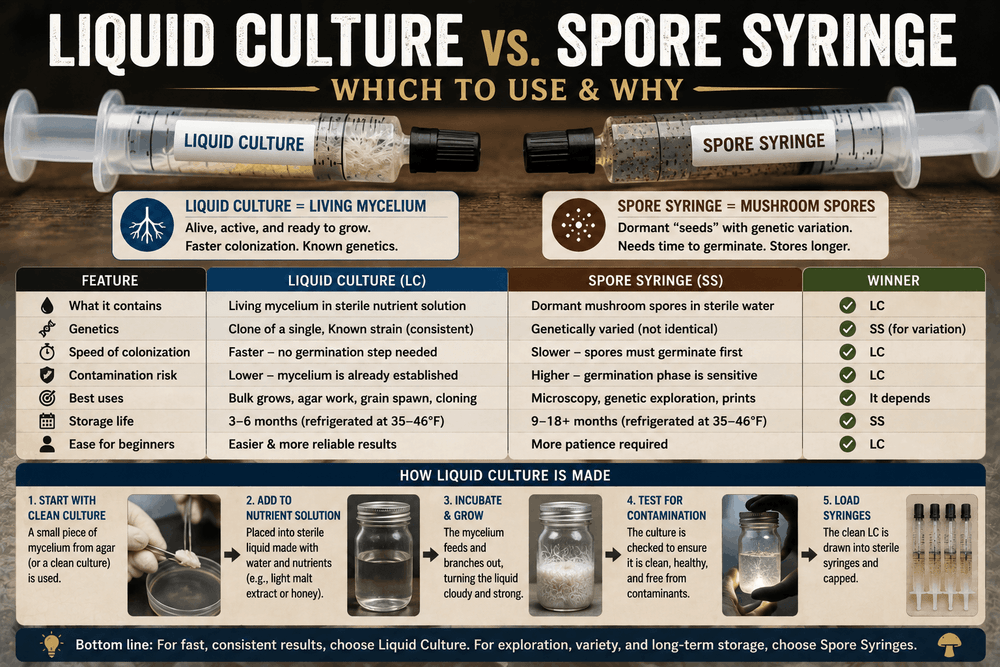
Liquid Culture vs. Spore Syringe: Which to Use & Why
Posted by Spore Genetics Research Team on May 14th 2023
The key difference is simple: a spore syringe contains mushroom spores (genetically varied and not yet germinated), while a liquid culture contains living mycelium of a known, established strain. For faster, more consistent cultivation, liquid culture usually wins; for microscopy, genetic variation, and long-term storage, spore syringes have the edge. Here's how to choose.
If you're getting into mushroom cultivation, this is one of the first questions you'll face. Both are liquids in a syringe, but they do very different things. Here's a clear breakdown—plus how liquid culture is made.
What Is a Spore Syringe?
A spore syringe contains mushroom spores suspended in sterile water. Spores are the reproductive cells of a mushroom—think of them as the "seeds." Because a syringe holds spores from a mushroom's natural reproduction, it contains genetic variation: the spores aren't identical. That variation makes spore syringes ideal for microscopy study and for exploring different genetic expressions, and they store well for long periods. The trade-off is that spores must first germinate before mycelium develops, which takes time and carries a bit more contamination risk during that early phase.
What Is a Liquid Culture?
A liquid culture (LC) contains living mycelium—the vegetative, root-like body of a fungus—suspended in a sterile nutrient solution. Because the mycelium is already alive and growing from a single, selected strain, there's no germination step and no genetic guesswork. For a full primer, see our mushroom liquid culture guide.
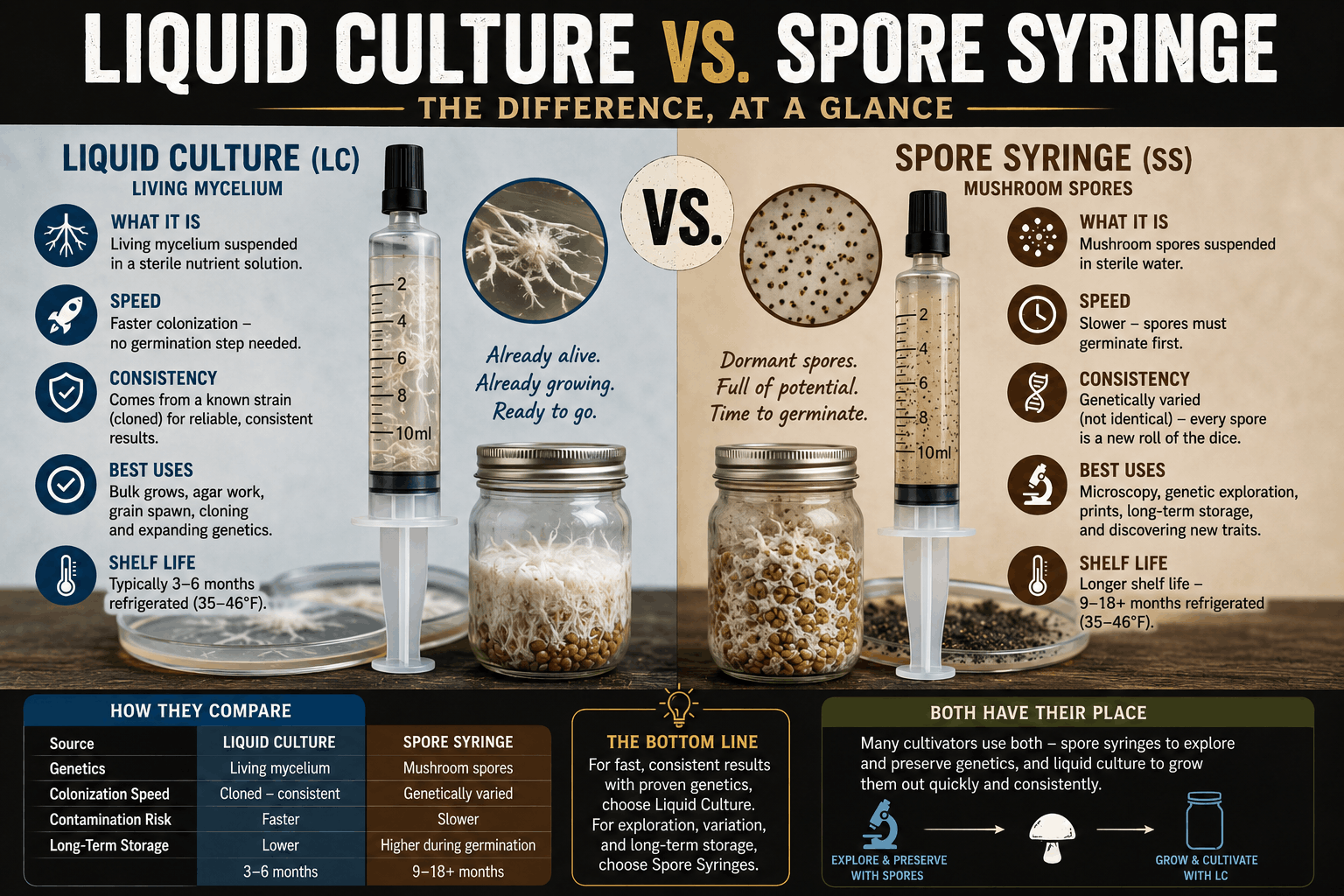
Liquid Culture vs. Spore Syringe: The Key Differences
- What's inside: spore syringe = spores (seeds); liquid culture = living mycelium (already growing).
- Speed: liquid culture colonizes faster—no germination step to wait through.
- Consistency: liquid culture is a known, uniform strain; spores carry genetic variation.
- Contamination risk: LC's head start generally means less exposure during the vulnerable early phase.
- Best for microscopy: spore syringes—spores are what you study under the scope.
- Storage: spore syringes keep for long periods; liquid culture is best used while fresh and active.
Which One Should You Use?
For growing gourmet mushrooms quickly and predictably, liquid culture is usually the better tool—you're starting with proven, living genetics. For microscopy, taxonomy, and studying genetic variation, a spore syringe is the right choice. Many cultivators keep both on hand: spores for exploration and storage, liquid culture for reliable production.
How Is Liquid Culture Made?
Liquid culture is created by introducing a small amount of viable culture (or germinated spores) into a sterilized liquid nutrient broth—typically a light sugar solution—in a sealed vessel. Under sterile conditions, the mycelium spreads through the liquid over several days, producing a cloudy suspension of healthy mycelium ready to