

Psilocybe Niveotropicalis Isolated Spore Syringe – 10cc | Spore Genetics
A newly described, rare South Florida wood loving species. Also known as “Niveo” or “Niveos”
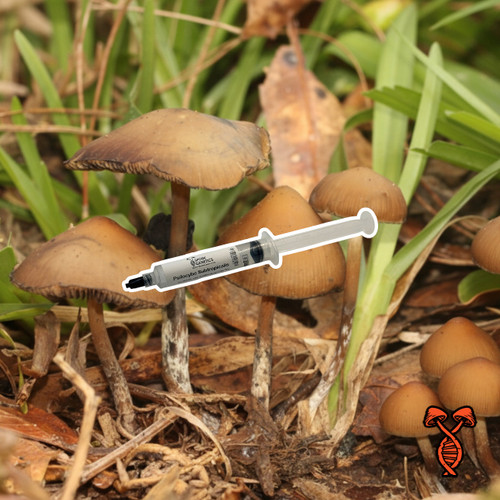
Psilocybe niveotropicalis is one of the most exciting new additions to modern mycology. Officially described in 2024 by Ostuni, Rockefeller, Jacobs, and Birkebak, this bluing, wood-rotting psilocybin species was first discovered in Jupiter, Palm Beach County, Florida—making it one of the only tropical Psilocybe species native to the United States.
It belongs to section Stuntzae by appearance but DNA testing places it phylogenetically close to the wood-lover group (section Caerulescentes), alongside species like Psilocybe ovoideocystidiata and Psilocybe wayanadensis. This blend of features makes it a standout for microscopy and taxonomic study.
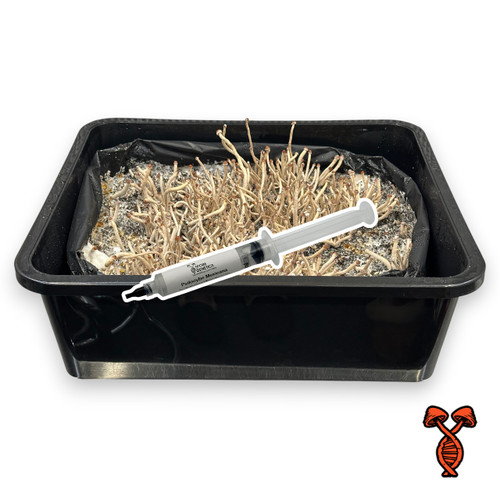
Our 10cc Isolated Spore Syringe offers researchers a rare chance to examine this newly discovered species up close, prepared in our ISO-7 cleanroom for clarity and sterility.
Macroscopic Features
Cap (Pileus):
· 20–40 mm, occasionally up to 58 mm
· White to pale yellow when young; dries medium brown or grey
· Hygrophanous, smooth, lightly sticky when moist
· Often shows a distinct darker umbo
· Splits with age and bruises blue when handled
Gills (Lamellae):
· Adnexed, close to subdistant
· Start white, then turn rusty to dark purple-brown with maturity
· Blue bruising along the gills
· Raspberry-red fluorescence under 365 nm UV light — a unique diagnostic feature
Stem (Stipe):
· 15–55 mm long, 2–7 mm thick
· Whitish to sorrel-brown, often fibrillose-striated
· Base may be slightly bulbous with white rhizomorphs
· Strong blue bruising
· Thick white annulus that often persists and turns blue with age
Spore Print:
Dark purplish brown.
Microscopic Features
Typical basidiospores:
· (7.9) 8.9–10.2 (11.0) × (6.3) 7.0–8.4 (9.4) µm
· Rhomboid to subrhomboid, thick-walled, yellow-brown
· Distinct germ pore
Key diagnostic trait:
≈10–20% of spores are irregular or split, showing cordate, bifid, or apically cleft shapes.
This unusual morphology is new to the genus Psilocybe and makes the species especially valuable for spore microscopy.
Cystidia:
· Cheilocystidia form a wide sterile band, many with rounded or double apices
· Pleurocystidia present and variable
Clamp connections are present throughout.
Psilocybe Niveotropicalis Habitat & Ecology
In the wild, Psilocybe niveotropicalis fruits:
· On dyed or irrigated mulch beds
· Under shrubs and landscaping plants
· Fruiting season: January to mid-September (skips mid-summer)
· Region: So far confirmed only in Palm Beach County, Florida
· Growth pattern: solitary, scattered, or caespitose clusters
Its ecology resembles North American wood-lovers but with a tropical range, making it a unique bridge between temperate and warm-climate Psilocybe species.
Research Significance
DNA sequencing shows Psilocybe niveotropicalis is:
· Closely allied with P. ovoideocystidiata, P. wayanadensis, and Thai wood-lover species
· Sister to section Caerulescentes (Cubensis group)
· Morphologically unique due to its spore irregularities, raspberry-fluorescing gill edges, and persistent annulus
These features position it as one of the most important Psilocybe discoveries of the decade.
Psilocybe Niveotropicalis Product Details & What's Included
✔ 10cc Psilocybe Niveotropicalis Spore Isolate
✔ Prepared in our ISO-7 cleanroom
✔ Includes sterile needle + alcohol prep pad
✔ Dark purple-brown spores for clear microscopic observation
✔ Extremely rare species—limited releases
✔ Comes with our How to Use a Mushroom Spore Syringe research insert
For microscopy and taxonomic research only. Not for cultivation.