Amanita Muscaria (Fly Agaric): Effects, Legality & Facts
Posted by Spore Genetics Research Team on Dec 30th 2022
Amanita Muscaria (Fly Agaric): Effects, Legality & Facts
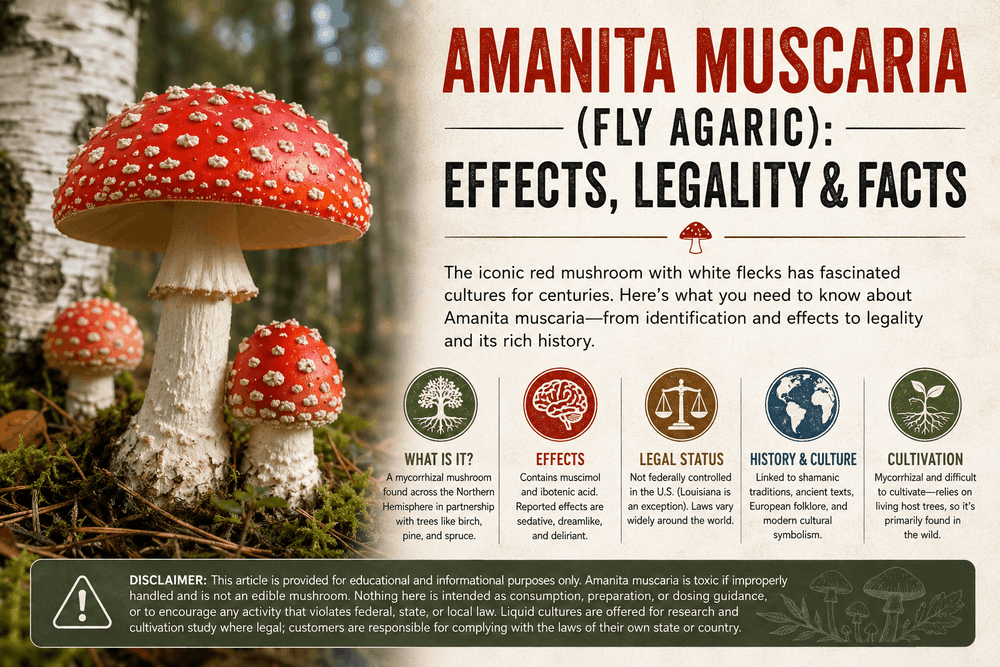
Amanita muscaria, commonly known as fly agaric, is one of the most recognizable mushrooms in the world—the iconic red cap dotted with white flecks. Unlike psilocybin mushrooms, it contains muscimol and ibotenic acid rather than psilocybin, and it grows across the Northern Hemisphere in partnership with trees like birch and pine.
Few mushrooms are as instantly familiar as the fly agaric. It appears in fairy tales, video games, and folklore the world over, yet there's far more to this species than its storybook looks. Below we cover what Amanita muscaria actually is, how to identify it, its reported effects, its legal status, and the rich cultural history behind it.
What Is Amanita Muscaria?
Amanita muscaria is a mycorrhizal mushroom in the family Amanitaceae, found naturally throughout the Northern Hemisphere and introduced to parts of the Southern Hemisphere. The common name “fly agaric” comes from its historical use as an insect attractant. It forms symbiotic relationships with the roots of trees—especially birch, pine, spruce, and fir—which is part of why it appears in woodland settings rather than on dung or decaying matter like many other species.
How to Identify Fly Agaric
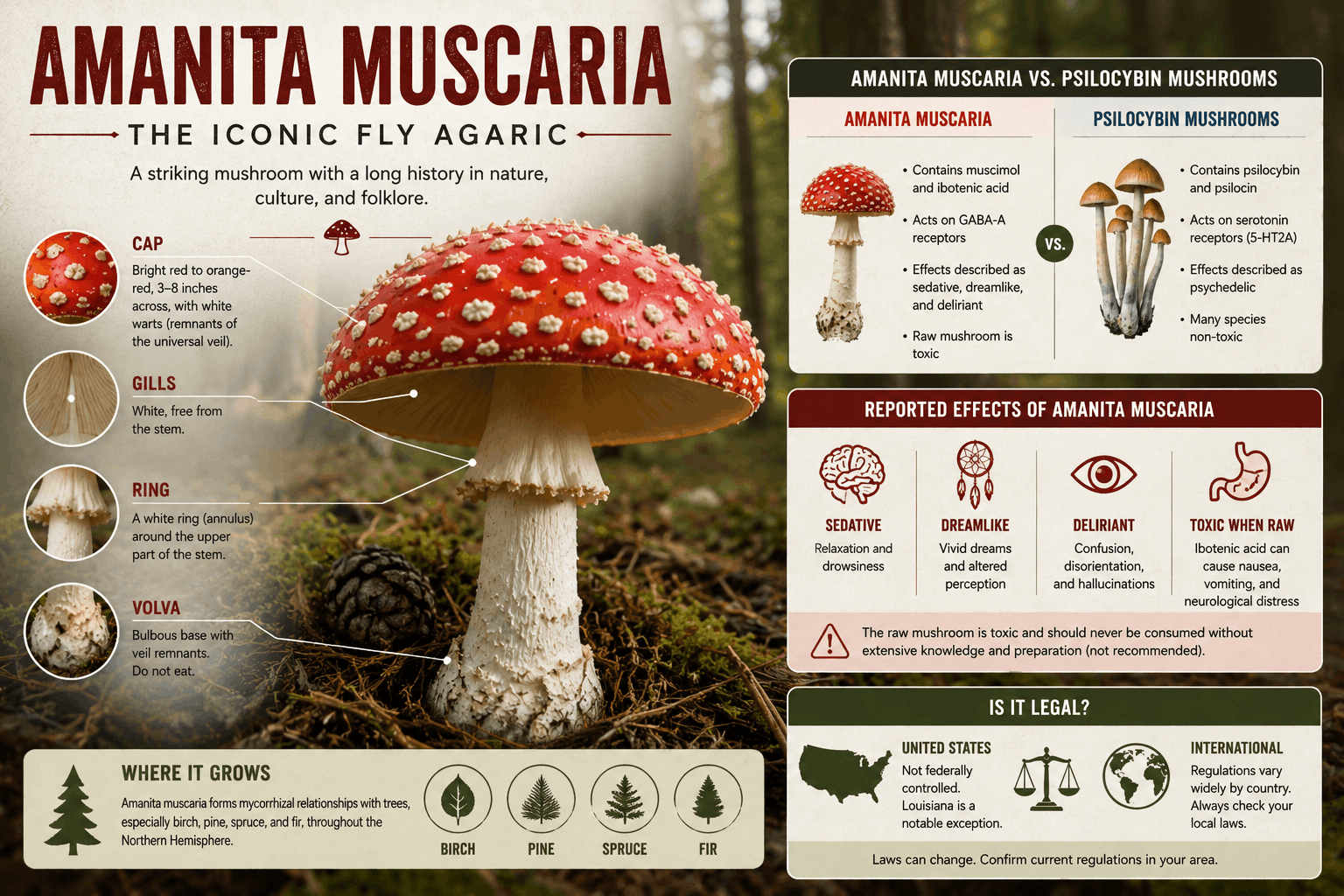
The classic fly agaric has a brilliant red to orange-red cap, typically 3–8 inches across, studded with white or pale-yellow warts (remnants of the universal veil that once enclosed the young mushroom). Beneath the cap are white gills, a white stem with a ring, and a bulbous base. Rain can wash the white flecks away, and color can fade with age or variety, so identification should always consider the whole mushroom and its habitat.
Amanita Muscaria vs. Psilocybin Mushrooms
This is the most important distinction to understand: Amanita muscaria is not a psilocybin mushroom. It belongs to an entirely different genus and contains different active compounds—primarily muscimol and ibotenic acid—which act on the brain through a different mechanism than psilocybin. So while both are often grouped under the broad “psychoactive mushroom” umbrella, they are biologically and chemically distinct, and they are regulated very differently.
Reported Effects of Amanita Muscaria
The primary compounds in Amanita muscaria are muscimol and ibotenic acid. Muscimol acts as a GABA-A receptor agonist, and historical and anecdotal accounts describe sedative, dreamlike, and deliriant effects rather than the classic serotonergic experience associated with psilocybin. It's important to note that the raw mushroom is considered toxic—ibotenic acid can cause significant gastrointestinal and neurological distress—which is why this species is studied with caution and treated very differently from edible or gourmet mushrooms.
Is Amanita Muscaria Legal?
In the United States, Amanita muscaria is not a federally controlled substance—it contains no psilocybin and is not scheduled. The notable exception is Louisiana, which restricts it. Internationally, regulations vary widely, with some countries controlling its sale or possession. Because rules differ by location and can change, always confirm the current laws in your own state or country.
History & Cultural Significance
Few mushrooms carry as much cultural weight as the fly agaric. It features prominently in the shamanic traditions of indigenous Siberian peoples, has been proposed by some scholars as a candidate for the mysterious “Soma” of ancient Vedic texts, and is woven into European folklore. Its red-and-white imagery is so embedded in culture that many connect it to winter and holiday symbolism. Whatever the theories, the fly agaric's place in human history is as striking as its appearance.
Can You Cultivate Amanita Muscaria?
Because Amanita muscaria is mycorrhizal—it depends on a symbiotic relationship with living host trees—it is far more difficult to cultivate than saprotrophic gourmet species that grow on grain or wood. This is why it's most often encountered in the wild. For researchers and enthusiasts studying this species, Spore Genetics offers an Amanita Muscaria Liquid Culture. (Looking for something more beginner-friendly? Our Lion's Mane Liquid Culture is a popular, easy-to-work-with gourmet option.)
Frequently Asked Questions
Is Amanita muscaria poisonous?
Yes—the raw mushroom is considered toxic and can cause serious illness due to ibotenic acid. It is not treated like an edible mushroom and should never be consumed without expert knowledge.
Does Amanita muscaria contain psilocybin?
No. It contains muscimol and ibotenic acid, which are chemically distinct from psilocybin. Amanita muscaria and psilocybin mushrooms are different genera with different active compounds.
Is Amanita muscaria legal?
In the U.S. it is not federally controlled, with Louisiana as a notable exception. Laws vary internationally, so check your local regulations.
Can you grow Amanita muscaria?
It's challenging. Because the species is mycorrhizal and relies on living host trees, it's much harder to cultivate than gourmet mushrooms grown on grain or wood.
Disclaimer: This article is provided for educational and informational purposes only. Amanita muscaria is toxic if improperly handled and is not an edible mushroom. Nothing here is intended as consumption, preparation, or dosing guidance, or to encourage any activity that violates federal, state, or local law. Liquid cultures are offered for research and cultivation study where legal; customers are responsible for complying with the laws of their own state or country.